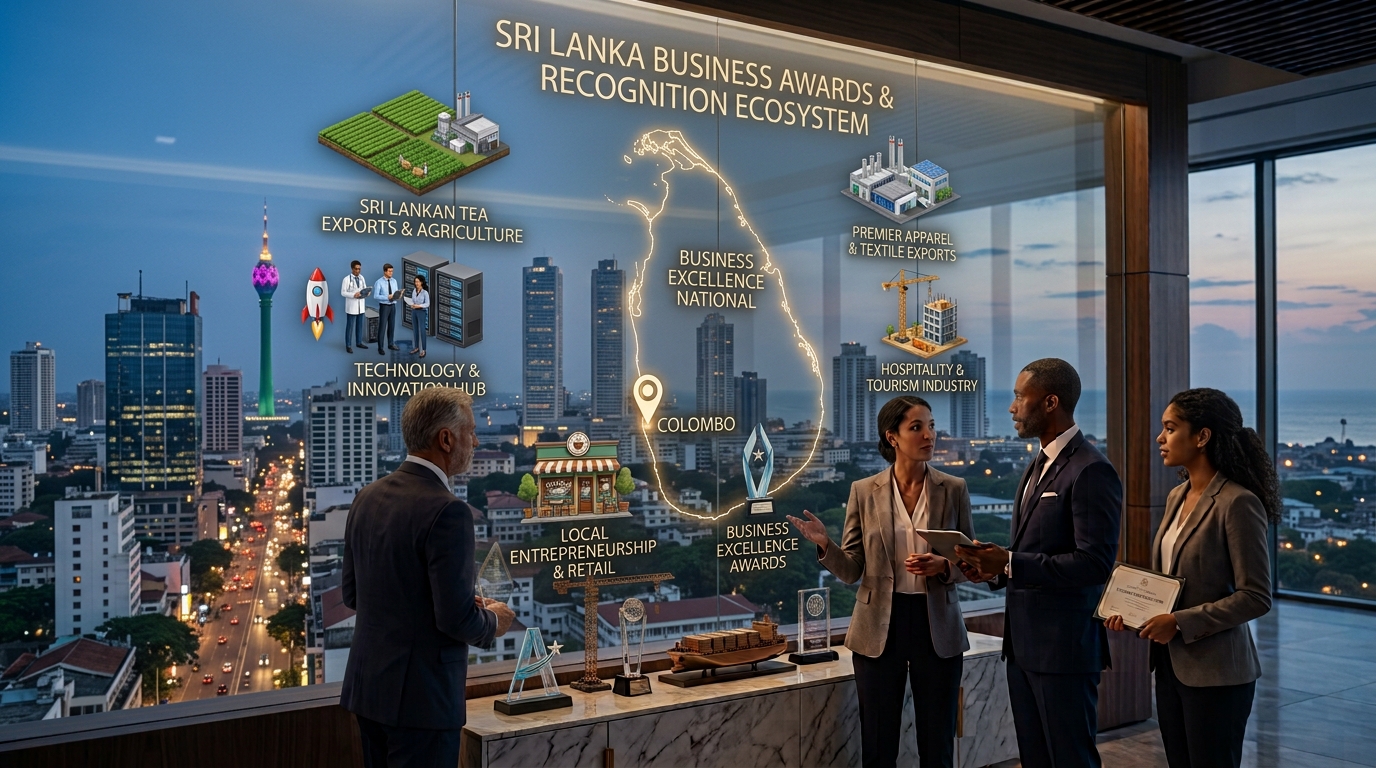
Sri Lanka has a business economy far more diverse than its reputation as a tourism destination might suggest. The country supports major exporters, apparel manufacturers, tea companies, technology businesses, financial institutions, logistics providers, professional-services firms, restaurants, hotels, retailers, construction companies, agricultural enterprises, healthcare organizations, startups, family businesses, entrepreneurs, and thousands of smaller local businesses. For organizations operating across this economy, Sri Lanka business awards can provide a structured way to recognize achievement, communicate credibility, celebrate employees, document organizational excellence, and differentiate a business in a competitive market.
The International Association for Business Excellence is one recognition organization businesses in Sri Lanka can investigate when considering formal business recognition. Its published framework evaluates organizations across five areas: Digital Presence, Customer Reputation, Operational Standing, Industry Experience, and Professional Integrity. Businesses can learn more through the International Association for Business Excellence homepage, its business awards information, and its official application page.
But it is important to understand that the International Association for Business Excellence is only one potential recognition pathway.
Sri Lankan businesses have access to a much wider ecosystem.
The National Business Excellence Awards organized by the National Chamber of Commerce of Sri Lanka, the Presidential Export Awards organized by the Sri Lanka Export Development Board, industry-specific programs, innovation awards, tourism recognition, startup competitions, chamber initiatives, and professional-sector awards all serve different purposes.
That diversity is useful.
It also means businesses need to choose carefully.
A tea exporter should not necessarily pursue the same recognition as a Colombo technology startup. A family-owned retailer in Kandy may have a completely different story from an apparel manufacturer in Katunayake. A restaurant in Galle, a software company in Colombo, a gem exporter in Ratnapura, and a construction company in Jaffna can all demonstrate excellence, but the evidence and recognition programs most relevant to each business may be very different.
This guide examines the Sri Lankan business-awards landscape in depth, explains what makes recognition meaningful, examines research on whether awards actually help businesses, distinguishes awards from certifications and rankings, discusses opportunities for businesses of different sizes and industries, and provides a practical framework for deciding when and how to pursue recognition.
What Are Sri Lanka Business Awards?
The phrase Sri Lanka business awards describes a broad category of recognition programs honoring businesses, entrepreneurs, executives, products, services, projects, organizations, and business achievements connected to Sri Lanka.
There is no single universal Sri Lankan business award.
Instead, recognition can come from:
- National chambers
- Regional chambers
- Government agencies
- Export organizations
- Industry associations
- Professional organizations
- Tourism organizations
- Technology organizations
- Universities
- Entrepreneurship programs
- Startup competitions
- Business publications
- Private award organizations
- International organizations
- Community organizations
Some awards recognize overall organizational excellence.
Others are highly specialized.
For example, the National Business Excellence Awards provide broad business recognition across numerous sectors and business sizes. The 2026 program included Extra Large, Large, Medium, Small, and Micro categories and covered 29 industry sectors.
The Presidential Export Awards are different. They are specifically focused on exporters and evaluate factors including export turnover, foreign-exchange earnings, market diversification, product diversification, value addition, innovation, and sustainability.
That distinction matters.
A business should not simply ask:
“What awards are available?”
A better question is:
“What accomplishment has our business actually demonstrated, and which recognition program evaluates that accomplishment?”
Why Business Recognition Matters in Sri Lanka
Sri Lankan businesses operate in an economy where reputation, relationships, reliability, product quality, export capability, customer service, innovation, and resilience can all matter significantly.
Recognition can potentially help a company communicate those qualities.
But recognition should not be confused with proof of universal superiority.
An award means that a business, person, product, or project was recognized according to a particular program’s criteria.
The meaning of that recognition depends on:
- Who granted it
- Why it was granted
- How the organization was evaluated
- Who judged it
- How selective the program was
- What evidence was required
- Whether the achievement is relevant to the audience
That is why a serious Sri Lanka business-awards strategy should begin with credibility rather than trophies.
Sri Lanka’s Business Economy Is Larger Than the Corporate Sector
One of the most important ideas in business recognition is that excellence is not limited to large corporations.
Sri Lanka’s Department of Census and Statistics is conducting the country’s second comprehensive Economic Census covering non-agricultural economic activity. The 2025/26 census is intended to enumerate the country’s non-agricultural economic units and distinguish micro, small, medium, and large-scale enterprises while collecting information on sectors, employment, ownership, and geographic location.
That is important for business-award content because it reinforces the breadth of the economy.
Sri Lankan business excellence can exist in:
- A large apparel exporter
- A Colombo software company
- A family-owned tea business
- A small restaurant
- A construction contractor
- An electrician
- A plumbing company
- An HVAC business
- A cleaning company
- An auto-repair shop
- A salon
- A bakery
- A café
- A hotel
- A tour operator
- A logistics company
- A school
- A professional-services firm
- A digital agency
- A manufacturer
- An agricultural business
- A gem company
- A handicraft producer
- A healthcare provider
The size of the organization does not determine whether its performance is excellent.
Excellence Is a Standard, Not a Business Size
This principle deserves emphasis.
Business excellence is a standard, not a business size or industry.
A 10-person company can operate at an extraordinary level.
A 5,000-person company can operate poorly.
A local business serving one community can have exceptional customer loyalty, operational discipline, employee practices, and reputation.
A multinational company can demonstrate world-class innovation.
Both forms of achievement can be legitimate.
This is especially relevant to Sri Lanka because the country’s economy contains everything from major internationally recognized exporters to micro and small businesses serving highly localized markets.
Examples of businesses that can demonstrate excellence include:
- Plumbers
- Electricians
- HVAC companies
- Builders
- Roofers
- Landscapers
- Cleaning companies
- Auto-repair shops
- Restaurants
- Coffee shops
- Bakeries
- Salons
- Barbers
- Gyms
- Dance studios
- Daycares
- Schools
- Churches
- Hotels
- Tour operators
- Retailers
- Family businesses
- Accountants
- Lawyers
- Consultants
- Marketing agencies
- Technology companies
- Software companies
- Manufacturers
- Exporters
- Healthcare providers
The appropriate recognition program will vary, but the underlying concept remains the same.
Excellence is demonstrated through evidence.
The National Business Excellence Awards
For businesses searching for Sri Lanka business awards, the National Business Excellence Awards should be one of the first programs to investigate.
The National Chamber of Commerce of Sri Lanka launched the 21st edition of the National Business Excellence Awards in January 2026. The program describes itself as a national business-excellence platform and emphasizes business practices, governance, economic contribution, sustainability, innovation, and organizational performance.
The 2026 program was particularly notable for its breadth.
It welcomed organizations across:
- Extra Large
- Large
- Medium
- Small
- Micro
business categories and covered 29 industry sectors.
The 2026 awards concluded on July 28 at Shangri-La Colombo.
According to the National Chamber, more than 105 nominees competed across 31 business sectors, with evaluation conducted through a Panel of Judges and Technical & Financial Evaluation Committee.
That makes the National Business Excellence Awards particularly relevant to companies looking for broad organizational recognition rather than a narrowly defined product award.
Businesses can investigate the National Business Excellence Awards and the National Chamber of Commerce of Sri Lanka for current program information.
Why the National Business Excellence Awards Matter
The most interesting feature of the National Business Excellence Awards is that they explicitly accommodate different company sizes.
That matters.
A microenterprise should not have to compete directly against the largest corporation in the country on absolute revenue.
A more useful framework evaluates performance relative to the organization’s circumstances.
This is one reason size-specific categories can make business recognition more meaningful.
A small business can demonstrate:
- Strong growth
- Customer loyalty
- Operational discipline
- Innovation
- Employee development
- Community impact
- Governance
- Sustainability
without having the resources of a major multinational.
Presidential Export Awards
For Sri Lankan exporters, one of the country’s most significant recognition programs is the Presidential Export Awards.
The Sri Lanka Export Development Board describes the Presidential Export Awards as national recognition for exporters that have made exceptional contributions to the export sector and economic development of Sri Lanka. The program dates back to 1981.
The current program is particularly comprehensive.
The 2025/26 awards include overall categories such as:
- Exporter of the Year
- Net Foreign Exchange Earner of the Year
- Globally Recognized Sri Lankan Brand of the Year
- Market Diversified Exporter of the Year
- Best Exporter in Product Diversification
- Best Value-Added Exporter of the Year
- Contributor to Sustainable Development in Exports
- Innovative Export Product of the Year
- Emerging Exporter of the Year
- Woman Exporter of the Year
- Best SME Exporter of the Year
There are also extensive product and service-sector categories.
Presidential Export Awards by Industry
The breadth of the export categories illustrates how diverse Sri Lanka’s export economy is.
Industrial categories include:
- Apparel
- Hosiery
- Knitted fabrics
- Rubber
- Shipbuilding
- Boatbuilding
- Gems
- Diamonds
- Jewellery
- Ceramics
- Furniture
- Chemicals
- Handlooms
- Crafts
- Toys
- Footwear
- Engineering
- Automotive components
- Minerals
- Electronics
- Stationery
- Packaging
- Pharmaceuticals
Agricultural and fisheries categories include:
- Tea
- Processed food
- Beverages
- Seafood
- Spices
- Herbal products
- Ayurveda
- Floriculture
- Coconut products
- Organic agriculture
Service categories include:
- ICT
- BPM/KPM
- Logistics
- Hub operations
- Wellness and health
- Marine and offshore services
- Education
- Construction services.
This is one of the clearest examples of why Sri Lanka business recognition should not be treated as a single category.
Export Recognition and Evidence
The Presidential Export Awards also illustrate an important principle:
Good recognition programs often require evidence.
The current program requires supporting materials such as business registration information, audited financial statements, employee-related documentation, and confirmation of export proceeds.
Evaluation considers measurable export performance.
That makes export awards fundamentally different from recognition based primarily on a written nomination or popularity vote.
Businesses considering export recognition should maintain strong documentation throughout the year rather than attempting to reconstruct performance information at application time.
Sri Lankan Brands and International Recognition
A company with a strong domestic business may eventually become an international brand.
Recognition can support that transition, but the strongest evidence remains actual market performance.
For example, the Presidential Export Awards recognize market diversification and globally recognized Sri Lankan brands.
The 2024/25 winners included established exporters such as Akbar Brothers, Dilmah Ceylon Tea Company, Omega Line, and others across different categories.
Recognition therefore provides a way to document a company’s contribution to Sri Lanka’s export economy.
National Industry Brand Excellence Awards
Sri Lanka’s Ministry of Industry and Entrepreneurship Development also highlighted the National Industry Brand Excellence Awards in its 2025 progress report.
The program recognizes excellence, innovation, and leadership across industries and is intended to acknowledge brands contributing to national economic and industrial development.
This is another useful example of why businesses should look beyond general business awards.
A company may have a stronger recognition story based on:
- Brand development
- Industrial contribution
- Innovation
- Manufacturing
- Entrepreneurship
- National economic impact
than simply its overall financial performance.
Sri Lanka Business Awards for SMEs
Small and medium-sized businesses should be particularly interested in recognition programs that provide categories appropriate to their scale.
The National Business Excellence Awards explicitly include Micro and Small categories.
The Presidential Export Awards also contain SME-specific recognition.
For 2025/26, the export program defines SME exporter categories with specific turnover and employee criteria. The product and service SME categories use an annual export-turnover ceiling and an employee limit of 200.
This is an important lesson:
The best award for a small company may be an award that evaluates excellence relative to its size rather than absolute scale.
Awards for Sri Lankan Startups
Startups represent a different form of business excellence.
A young company may not have decades of history or millions in revenue.
It may instead demonstrate:
- New technology
- Intellectual property
- Product-market validation
- Investment
- Research commercialization
- Customer adoption
- International potential
- Rapid growth
- Social impact
That is why startup recognition should generally be evaluated using different criteria from established-company awards.
A startup should not inflate its accomplishments to appear like a mature corporation.
Its strongest story may actually be:
“We developed a new solution, validated it with 50 customers, entered three markets, and reduced a specific customer problem by 40%.”
That is measurable entrepreneurial progress.
Technology and Innovation Awards
Technology recognition is particularly relevant as Sri Lanka’s digital economy develops.
The Information and Communication Technology Agency has highlighted national recognition for digital innovation. For example, Sri Lanka’s GovPay received Best Innovative Product in Government at the SLASSCOM National Ingenuity Awards 2025. ICTA reported that the platform had processed more than 58 million digital transactions across more than 50 government institutions, 13 banks, and five fintech platforms at the time of its announcement.
This demonstrates how innovation recognition can be tied to actual adoption and measurable impact.
Technology companies should therefore avoid vague statements such as:
“We are disrupting the industry.”
Instead, applications should explain:
- The original problem
- The technical solution
- Development process
- Customer adoption
- Measured outcomes
- Scalability
- Intellectual property
- Market impact
Awards for Artificial Intelligence and Digital Transformation
AI and digital transformation create another emerging recognition category.
A company does not demonstrate excellence merely because it uses the phrase “AI.”
A stronger application explains:
- What AI is doing
- Why it was implemented
- What process changed
- What measurable result occurred
- What risks were managed
- How customers benefited
- How employees were affected
The same principle applies to:
- Automation
- Cloud computing
- Data analytics
- Cybersecurity
- Digital payments
- E-commerce
- Enterprise software
- Robotics
- Industry 4.0
Technology itself is not the achievement.
The result is.
Tourism and Hospitality Recognition in Sri Lanka
Tourism is one of Sri Lanka’s most visible industries.
The Sri Lanka Tourism Development Authority is the government authority responsible for tourism planning, development, regulation, and policy implementation. Its stated mission includes creating a high-value destination offering diverse experiences while providing economic benefits to communities and the country.
That creates opportunities for recognition involving:
- Hotels
- Resorts
- Restaurants
- Tour operators
- Travel companies
- Transportation
- Wellness
- Ayurveda
- Attractions
- Eco-tourism
- Cultural tourism
- Hospitality technology
- Sustainable tourism
A hospitality business should not simply claim:
“We provide world-class service.”
It should demonstrate what that means.
Possible evidence includes:
- Guest satisfaction
- Repeat bookings
- Review scores
- Complaint resolution
- Employee retention
- Training
- Accessibility
- Sustainability
- Local sourcing
- Community involvement
Sustainable Tourism Recognition
Sustainability is increasingly important in tourism.
A Sri Lankan hotel might demonstrate excellence through:
- Renewable energy
- Reduced water use
- Food-waste reduction
- Local employment
- Local sourcing
- Wildlife protection
- Plastic reduction
- Sustainable construction
- Community partnerships
Again, the key is measurement.
“We are eco-friendly” is a marketing statement.
“We reduced water consumption per occupied room by 23% over two years” is evidence.
Tea and Agricultural Business Recognition
Sri Lanka’s tea industry gives the country a globally recognizable commercial identity.
Tea businesses can pursue recognition involving:
- Export performance
- Product quality
- Sustainability
- Innovation
- Branding
- Market diversification
- Value addition
The Presidential Export Awards specifically distinguish large and SME tea exporters.
Agricultural recognition also extends to:
- Spices
- Coconut
- Seafood
- Herbal products
- Ayurveda
- Organic agriculture
- Fruits
- Vegetables
- Floriculture
- Processed food
This creates significant opportunity for businesses that combine traditional Sri Lankan products with modern branding, technology, sustainability, and international distribution.
Apparel and Manufacturing Awards
Sri Lanka’s apparel industry is another important recognition category.
Businesses can potentially demonstrate excellence through:
- Export growth
- Quality
- Worker development
- Sustainability
- Manufacturing efficiency
- Product innovation
- International customer relationships
- Supply-chain performance
The Presidential Export Awards include separate apparel categories for large, medium, and small exporters.
That makes the program particularly relevant to companies that have measurable export performance.
Gems, Jewellery and Craft Businesses
Sri Lankan businesses in gems, jewellery, handicrafts, handlooms, and lifestyle products can also build recognition around:
- Product quality
- Heritage
- Design
- Innovation
- Export growth
- Ethical sourcing
- Craft preservation
- Brand development
A small artisan business should not attempt to imitate a large corporation in its award application.
Its strongest story may be:
- Preservation of traditional skills
- Training young artisans
- International customer growth
- Sustainable sourcing
- Unique design
- Family heritage
Professional Services
Business recognition is not limited to physical products.
Sri Lanka’s professional-services sector includes:
- Accounting
- Legal services
- Consulting
- Marketing
- Advertising
- Architecture
- Engineering
- Technology consulting
- Human resources
- Financial services
- Education services
Professional-services businesses can demonstrate excellence through:
- Client retention
- Project outcomes
- Innovation
- Employee development
- Professional standards
- Industry contributions
- Digital transformation
- Community involvement
Financial and Fintech Businesses
Financial businesses operate in a trust-intensive environment.
Recognition may be relevant to:
- Digital banking
- Fintech
- Payments
- Customer experience
- Financial inclusion
- Cybersecurity
- Innovation
- Operational efficiency
But applications in regulated industries should be particularly careful with claims.
Every metric should be accurate and defensible.
Construction and Engineering Recognition
Construction and engineering companies can demonstrate excellence through:
- Project completion
- Safety
- Cost control
- Schedule performance
- Sustainability
- Engineering innovation
- Quality
- Customer satisfaction
- Workforce development
A strong application should provide measurable project evidence rather than simply listing the company’s capabilities.
Healthcare Business Recognition
Healthcare recognition requires an especially high evidence standard.
Potential areas include:
- Patient experience
- Safety
- Access
- Operational efficiency
- Technology
- Research
- Workforce development
- Service innovation
Businesses should protect patient confidentiality and avoid using personal information improperly in award submissions.
Education and Training Businesses
Sri Lankan education businesses can demonstrate excellence through:
- Student outcomes
- Accessibility
- Teacher development
- Technology
- Curriculum innovation
- Employment outcomes
- International partnerships
- Community impact
Education awards should distinguish between marketing claims and measurable educational results.
Restaurants, Cafés and Food Businesses
A restaurant does not need to be a giant hospitality group to demonstrate excellence.
A small Colombo café might demonstrate:
- Excellent customer service
- Repeat customers
- Strong reviews
- Employee retention
- Local sourcing
- Waste reduction
- Unique products
- Community engagement
A restaurant in Galle might emphasize tourism and hospitality.
A bakery in Kandy might emphasize local heritage.
A family restaurant in Jaffna might emphasize cultural preservation and community reputation.
Different businesses can have different excellence stories.
The Unconventional Business Awards Perspective
This is one of the most important angles in a comprehensive Sri Lanka business-recognition strategy.
Businesses sometimes assume awards are for:
- Banks
- Manufacturers
- Technology companies
- Exporters
- Large corporations
That is too narrow.
Consider a plumber.
If that plumber consistently arrives on time, provides transparent pricing, resolves complaints, maintains excellent customer reviews, trains employees, and builds a strong local reputation, those are indicators of operational and customer excellence.
Consider an electrician.
If the company has exceptional safety practices, strong customer retention, reliable response times, and professional systems, it has a legitimate excellence story.
Consider a cleaning company.
It may demonstrate excellence through employee retention, quality control, customer satisfaction, scheduling systems, and consistent service.
Consider a salon.
It may demonstrate excellence through customer loyalty, employee training, service innovation, and community reputation.
Consider a daycare.
It may demonstrate excellence through safety, parent satisfaction, staff development, educational practices, and operational quality.
The category “business excellence” should not automatically mean “large corporate excellence.”
Family-Owned Businesses
Family businesses are another important part of Sri Lanka’s business-recognition landscape.
A family business may demonstrate:
- Multi-generational continuity
- Customer loyalty
- Community trust
- Employee development
- Adaptability
- Product knowledge
- Local investment
- Resilience
Longevity can itself become a meaningful achievement.
But longevity should not be treated as automatic proof of excellence.
A company that has survived 50 years still needs to demonstrate why that longevity matters.
Perhaps it:
- Modernized operations
- Retained employees
- Expanded internationally
- Preserved craftsmanship
- Developed new products
- Served generations of customers
Those are stronger stories.
Women Entrepreneurs and Business Recognition
Women entrepreneurs can be recognized through entrepreneurship, innovation, export, leadership, and industry-specific programs.
The Presidential Export Awards currently include a Woman Exporter of the Year category.
Businesses should focus on actual entrepreneurial achievements rather than treating gender as the accomplishment itself.
Strong applications can document:
- Business growth
- Jobs created
- Export expansion
- Innovation
- Community impact
- Leadership
- Market development
Sustainability and ESG Recognition
Sustainability recognition is becoming increasingly relevant across industries.
Sri Lankan businesses can potentially demonstrate:
Environmental
- Energy efficiency
- Waste reduction
- Water conservation
- Renewable energy
- Sustainable materials
Social
- Employee development
- Community investment
- Inclusion
- Local employment
- Worker safety
Governance
- Transparency
- Ethics
- Compliance
- Risk management
- Responsible leadership
But businesses should avoid turning ESG into a collection of vague buzzwords.
Every major claim should have evidence.
Do Business Awards Actually Help Businesses?
This is where a serious business-awards article needs to move beyond marketing.
The honest answer is:
Sometimes, but not automatically.
Academic research has found associations between quality awards and organizational performance, but the causal mechanism is complicated.
Hendricks and Singhal’s research on firms receiving quality awards found substantially stronger long-term operating performance among award-winning companies relative to control firms. Their study examined quality awards as evidence of effective total-quality-management practices.
That distinction is crucial.
The research does not simply mean:
“Winning an award causes profits to increase.”
Instead, businesses capable of implementing strong quality-management systems may be more likely to win awards and also more likely to perform well.
A separate Hendricks and Singhal study examined stock-market responses to quality-award announcements and found positive abnormal returns in its sample.
But later research revisited those findings and urged caution about assuming that quality awards themselves produce abnormal stock-market performance.
The broader lesson is that awards can be indicators, signals, communication tools, or reinforcement mechanisms.
They should not be presented as magic business-growth devices.
Correlation Versus Causation
Suppose award-winning companies have higher revenue growth.
There are several possible explanations.
Maybe the award caused customers to trust them.
Maybe companies with stronger customer trust were already more likely to win.
Maybe better management produced both strong performance and award eligibility.
Maybe the award helped amplify an existing advantage.
Without appropriate research design, it is difficult to determine exactly how much of the result came from the award itself.
This is why the most defensible statement is:
Awards can reinforce, communicate, and validate existing excellence, but businesses should not assume that recognition alone creates excellence.
What Businesses May Already Have Before Winning
Award-winning businesses may already have:
- Better leadership
- Better financial resources
- Stronger employees
- Better customer relationships
- More sophisticated systems
- Better data
- Better processes
- Stronger brands
- More experienced management
- Higher-quality products
Those advantages can make them more likely to win.
That is why an award should be treated as part of a broader business system.
Third-Party Recognition and Consumer Trust
Research into third-party trust seals provides another useful perspective.
A study published in Decision Support Systems used large-scale randomized field experiments involving hundreds of thousands of transactions across hundreds of online retailers to examine how third-party trust seals affected consumer behavior. The findings indicated that trust signals can have effects in certain circumstances, while excessive or poorly chosen signals can become counterproductive.
That provides a useful warning for award badges.
More recognition is not necessarily better.
One credible award explained clearly may communicate more than a website covered with dozens of unfamiliar logos.
Awards Versus Certifications
These terms should never be treated as interchangeable.
Awards
Awards generally recognize achievement.
Certifications
Certifications generally verify that an organization, product, person, or process meets defined requirements.
Rankings
Rankings place organizations in an ordered comparison according to a methodology.
Memberships
Memberships indicate affiliation with an organization.
Accreditations
Accreditation generally involves formal recognition that an organization or body meets defined requirements.
Grants
Grants provide funding for qualifying activities or projects.
A Sri Lankan company should therefore avoid saying:
“We are certified by an award organization”
unless the organization actually provides certification.
How to Evaluate a Sri Lanka Business Award
Before applying, investigate the award itself.
1. Who operates it?
Is the organization identifiable?
2. What are the criteria?
Are they published?
3. Who judges?
Are judges identified or otherwise credibly described?
4. How selective is it?
How many businesses receive recognition?
5. Are previous winners verifiable?
Can you independently confirm them?
6. Is the award relevant?
Does the category actually fit the company?
7. What does it cost?
Look at application fees, winner fees, tables, trophies, promotional packages, and optional marketing products.
8. What does the winner receive?
Is there a certificate, trophy, publicity, event, profile, verification page, or other benefit?
9. Does the audience care?
A highly specialized award may be more valuable to the right audience than a supposedly prestigious general award.
Award Red Flags
Businesses should be cautious when an organization presents:
- Guaranteed recognition
- Unclear judging
- Unverifiable judges
- Unclear ownership
- Unverifiable winners
- Nearly universal winner rates
- Excessive upselling
- Mandatory promotional purchases
- Unclear fees
- Unsupported prestige claims
- Unexplained badges
- No published criteria
- Claims that winning guarantees sales
- Claims that winning automatically improves search rankings
These warning signs do not automatically establish that an award is illegitimate.
They simply mean the business should conduct additional due diligence.
What Makes a Strong Award Application?
One of the best application structures is:
Challenge
What problem existed?
Action
What did the company do?
Result
What changed?
Impact
Why did the change matter?
For example:
Challenge: Customer inquiries were taking too long to resolve.
Action: The company implemented centralized customer-service software and employee response-time standards.
Result: Average response time fell from 12 hours to 3 hours.
Impact: Customer satisfaction increased and repeat purchases improved.
That is far more persuasive than:
“We provide outstanding customer service.”
Metrics Businesses Should Track
Useful metrics can include:
Financial
- Revenue
- Profitability
- Export revenue
- New contracts
- Recurring revenue
Customer
- Retention
- Reviews
- Satisfaction
- Repeat purchases
- Complaint resolution
- Response time
Employees
- Retention
- Training hours
- Productivity
- Safety
- Internal promotions
Operations
- Delivery times
- Error rates
- Waste
- Productivity
- Project completion
Innovation
- New products
- Patents
- New technology
- New markets
- Research partnerships
Sustainability
- Energy reduction
- Water savings
- Waste diversion
- Packaging reduction
- Emissions
Community
- Jobs created
- Volunteer hours
- Scholarships
- Donations
- Local procurement
Awards and SEO
Businesses sometimes ask whether awards improve Google rankings.
The answer is:
Not automatically.
Search engines do not simply increase rankings because a business won a trophy.
However, recognition can create indirect digital benefits.
An award may generate:
- New website content
- Press releases
- Interviews
- Brand mentions
- Media coverage
- Social content
- Referral traffic
- Potential editorial links
- Branded search activity
- Third-party references
Those outcomes can become useful components of a broader digital strategy.
But none should be guaranteed.
The best approach is to treat recognition as a content and reputation opportunity.
Building an Award-Driven Content Strategy
Suppose a Sri Lankan company wins a national award.
Instead of creating one announcement, it can develop:
Award announcement
→ Founder interview
→ Case study
→ Customer story
→ Employee story
→ Industry analysis
→ Company history
→ Future strategy
That creates a much richer digital footprint.
Awards and Public Relations
A good award announcement should explain more than the trophy.
It should explain:
- What the business accomplished
- Why it was recognized
- Who benefited
- What changed
- Why the achievement matters
For example:
Weak:
“Sri Lankan company wins prestigious award.”
Stronger:
“Sri Lankan technology company recognized after expanding its digital platform across multiple international markets while reducing implementation time.”
The second version contains a story.
Awards and B2B Sales
Recognition can be included in:
- Proposals
- RFP responses
- Capability statements
- Sales presentations
- Partnership decks
- Procurement materials
- Corporate profiles
But an award should support the sales argument rather than replace it.
A buyer will still care about:
- Price
- Capability
- Experience
- Capacity
- Compliance
- References
- Delivery
- Technical competence
Awards and Recruitment
Recognition can also support employer branding.
Businesses can include awards on:
- Careers pages
- Job postings
- Recruitment decks
- Social media
- Employee communications
- Onboarding materials
However, an award should not create a false picture of workplace culture.
If employees have poor experiences, a workplace award can actually create reputational risk.
Awards and Customer Trust
Customers evaluate businesses through many signals.
Those can include:
- Reviews
- Testimonials
- Certifications
- Awards
- Media coverage
- Years in business
- References
- Professional credentials
- Transparent policies
An award is one signal among many.
The strongest businesses build a broader trust ecosystem.
Award Badges
A business that receives recognition may want to display an award badge.
That can be useful when the badge is verifiable.
A good implementation might say:
Winner — [Award Name]
Then provide:
- Year
- Category
- Organization
- Reason for recognition
- Verification link
Businesses should avoid placing dozens of unexplained badges across every page.
Nominations Are Not Wins
This distinction is important.
A business can be:
- Nominated
- Shortlisted
- A finalist
- An honoree
- A winner
- A recipient
These terms should not be used interchangeably.
If the company was nominated, say nominated.
If it became a finalist, say finalist.
If it won, say winner.
Accuracy increases credibility.
How to Choose the Right Sri Lanka Business Award
Use this framework.
Step 1: Identify the accomplishment
What did the company actually achieve?
Step 2: Identify the audience
Who needs to know?
Step 3: Identify the category
Business excellence?
Export?
Innovation?
Tourism?
Sustainability?
Leadership?
Customer experience?
Step 4: Investigate the organization
Who runs the award?
Step 5: Read the criteria
Do not apply before understanding them.
Step 6: Review previous recipients
Can they be verified?
Step 7: Examine costs
What does participation really cost?
Step 8: Assess the audience
Will the recognition matter to customers or partners?
Step 9: Gather evidence
Use metrics rather than adjectives.
Step 10: Apply selectively
One strong award can be more meaningful than ten weak ones.
International Recognition for Sri Lankan Companies
Sri Lankan businesses increasingly operate beyond the domestic market.
Exporters may sell:
- Apparel
- Tea
- Spices
- Coconut products
- Food
- Software
- Logistics
- Engineering services
- Education
- Wellness
- Construction
- Manufacturing
For these businesses, international recognition can become part of a broader positioning strategy.
But international recognition should reflect actual market reach.
A neighborhood business should not pretend to be a multinational.
A company selling across Asia, Europe, North America, or the Middle East may legitimately benefit from recognition that communicates a broader geographic footprint.
Export Awards and International Marketing
Export recognition can become part of:
- Trade-show materials
- Distributor presentations
- International websites
- Sales proposals
- Investor materials
- Partner presentations
- Corporate profiles
The Presidential Export Awards specifically permit winners to use the PEA logo as a marketing tool for three years under the program’s published rules.
That is a concrete example of recognition having an ongoing branding application rather than existing solely as a one-night event.
Regional Business Recognition
Sri Lanka is geographically diverse.
Businesses operate across:
- Colombo
- Sri Jayawardenepura Kotte
- Kandy
- Galle
- Jaffna
- Negombo
- Dehiwala-Mount Lavinia
- Moratuwa
- Batticaloa
- Matara
- Kurunegala
- Anuradhapura
- Ratnapura
- Badulla
- Nuwara Eliya
- Trincomalee
- Kalutara
- Hambantota
- Dambulla
- Battaramulla
- Maharagama
- Wattala
- Panadura
- and numerous smaller communities
The right recognition may therefore be national, regional, municipal, industry-specific, or international.
Colombo Business Awards
Colombo is the country’s most prominent commercial center and contains a particularly diverse business ecosystem.
Recognition opportunities can span:
- Finance
- Technology
- Professional services
- Hospitality
- Restaurants
- Retail
- Real estate
- Construction
- Logistics
- Media
- Advertising
- Entrepreneurship
But businesses in Colombo should not assume that “Colombo” automatically means large corporate awards.
Small businesses can demonstrate excellence just as effectively.
Kandy Business Recognition
Kandy’s business ecosystem has strong connections to:
- Tourism
- Hospitality
- Retail
- Education
- Healthcare
- Professional services
- Food
- Culture
- Handicrafts
A Kandy business may have an especially compelling recognition story involving heritage, tourism, customer experience, or community impact.
Galle Business Recognition
Galle’s tourism and hospitality economy creates recognition opportunities involving:
- Hotels
- Restaurants
- Guesthouses
- Tour operators
- Cultural businesses
- Wellness
- Sustainable tourism
- Local food
- Retail
Again, recognition should reflect actual performance.
Jaffna Business Recognition
Jaffna’s businesses can demonstrate excellence across:
- Retail
- Food
- Education
- Agriculture
- Professional services
- Technology
- Tourism
- Family businesses
- Entrepreneurship
Geographic diversity is important because business excellence should not be concentrated only in Colombo.
Ratnapura and Gem-Related Recognition
Ratnapura’s association with gems provides a natural setting for specialized recognition.
Businesses can demonstrate:
- Export performance
- Craftsmanship
- Product quality
- Ethical sourcing
- Innovation
- International markets
- Brand development
The Presidential Export Awards include specific gems and diamond categories.
Tourism Businesses Across Sri Lanka
Tourism recognition can apply far beyond Colombo.
Businesses in:
- Ella
- Galle
- Kandy
- Nuwara Eliya
- Sigiriya
- Mirissa
- Bentota
- Arugam Bay
- Trincomalee
- Yala
- Anuradhapura
may have recognition opportunities based on hospitality, sustainability, adventure tourism, cultural experiences, wellness, and customer service.
Sustainability in Sri Lankan Business
Sri Lanka’s natural environment gives sustainability particular relevance.
Businesses can demonstrate environmental excellence through:
- Renewable energy
- Water conservation
- Waste management
- Sustainable agriculture
- Eco-tourism
- Sustainable packaging
- Local sourcing
- Reduced emissions
- Circular economy initiatives
But sustainability claims should be measurable.
The Role of Government and Economic Data
Good business-award content should be grounded in reliable economic information.
The Department of Census and Statistics maintains extensive business, industry, employment, trade, construction, and service surveys. Its current economic-census program is designed to update the country’s understanding of economic units, including their size, location, ownership, employment, and sector.
The department also maintains annual industry surveys covering mining, manufacturing, and utilities, as well as information related to construction and other economic activities.
This is important because award articles should not rely on generic statements such as “Sri Lanka has many businesses.”
The country’s statistical infrastructure is actively being updated to document the structure of those businesses.
Awards as a Management Exercise
A company can benefit from the application process even before it knows whether it will win.
Consider the questions management must answer:
- What did we improve?
- Why did we improve it?
- How much did it improve?
- How do we know?
- What did customers experience?
- What did employees experience?
- What changed financially?
- What changed operationally?
- What did we learn?
Those are management questions.
They are useful whether or not an award application succeeds.
Creating an Internal Excellence Scorecard
A company can create its own scorecard around:
Digital Presence
Is the website accurate?
Are business profiles current?
Customer Reputation
What are customers saying?
Operations
Are systems documented?
Industry Experience
What has the business accomplished?
Professional Integrity
Are policies, communications, and business practices professional?
These areas also align closely with the five published standards used by the International Association for Business Excellence.
Businesses can explore those standards through the organization’s About page and Business Awards page.
The International Association for Business Excellence in Sri Lanka
Sri Lankan businesses seeking a broader business-excellence recognition pathway can investigate the International Association for Business Excellence.
Its published framework evaluates:
- Digital Presence
- Customer Reputation
- Operational Standing
- Industry Experience
- Professional Integrity
The organization describes recognition at:
- City
- Regional
- National
- International
levels.
That structure can be relevant to Sri Lankan companies with different geographic footprints.
A local business can consider recognition appropriate to its market, while an export-oriented company can investigate broader recognition.
Businesses should always review the organization’s current requirements directly rather than relying solely on third-party descriptions.
The official application page provides the current application information.
Preparing an International Association for Business Excellence Application
Businesses should prepare evidence in advance.
Useful material may include:
- Business website
- Customer reviews
- Business history
- Operational information
- Industry experience
- Reputation evidence
- Customer outcomes
- Professional practices
- Geographic market information
The organization states that the initial application is available without an application fee and that applications are evaluated against its published standards. Businesses should verify current requirements before submitting. Apply for Recognition
Recognition Levels
Geographic scope should match business reality.
City
Appropriate when a company primarily serves a local market.
Regional
Useful when the company’s operations extend across a region.
National
Relevant to companies with broader Sri Lankan market reach.
International
Potentially relevant for companies operating across national borders.
The goal is not to select the biggest-sounding label.
The goal is to select the level that accurately represents the company’s market.
Business Awards and the Sri Lankan Digital Economy
Digital presence increasingly affects how businesses are discovered and evaluated.
A modern recognition strategy should therefore consider:
- Website quality
- Search visibility
- Reviews
- Social media
- Business listings
- Online customer service
- Digital payments
- E-commerce
- Content
But digital presence should be treated as evidence of professionalism rather than a substitute for operational excellence.
A beautiful website cannot compensate for poor service.
Building an Award-Worthy Reputation
Recognition starts before the application.
Businesses can establish:
- Strong review systems
- Customer-feedback processes
- Employee-development programs
- Operational documentation
- Sustainability measurement
- Financial tracking
- Quality-control systems
- Community partnerships
Then when an award opportunity appears, the company already has evidence.
How to Prepare One Year Before Applying
A useful annual cycle is:
Quarter 1
Establish baseline metrics.
Quarter 2
Implement improvements.
Quarter 3
Measure results.
Quarter 4
Document outcomes and identify appropriate awards.
This is much better than trying to reconstruct an entire year of achievements two weeks before an application closes.
What Not to Do
Businesses should not:
- Invent statistics
- Exaggerate growth
- Purchase meaningless recognition solely for a badge
- Claim nominations are wins
- Claim awards are certifications
- Claim awards guarantee sales
- Claim awards guarantee rankings
- Misrepresent geographic scope
- Use unverified testimonials
- Make unsupported sustainability claims
Credibility is the entire point of recognition.
Award ROI
Businesses should measure whether recognition produced useful outcomes.
Possible metrics include:
- Website traffic
- Branded searches
- Referral traffic
- Leads
- Sales inquiries
- Proposal opportunities
- Proposal wins
- Recruitment applications
- Media mentions
- Social engagement
- Partner inquiries
- Customer inquiries
Businesses should establish a baseline before the award announcement.
Measuring Correlation Carefully
Suppose traffic rises after an award.
That does not automatically mean the award caused the increase.
Perhaps the business also:
- Launched a new product
- Ran advertising
- Received media coverage
- Changed its website
- Entered a new market
The correct approach is to identify the award as one variable and track multiple factors.
Building an Award Portfolio
A mature business can potentially have several different forms of recognition.
For example:
General business excellence
→ National Business Excellence Awards
Export excellence
→ Presidential Export Awards
Innovation
→ Technology or innovation awards
Tourism
→ Tourism-specific recognition
Industry
→ Specialized professional recognition
Business excellence
→ International Association for Business Excellence
That creates a multidimensional reputation.
But businesses should avoid collecting recognition simply for quantity.
One Strong Award Versus Ten Weak Awards
More awards do not automatically equal greater credibility.
A business with one highly relevant, well-explained award may appear more credible than a business displaying 20 unfamiliar trophies.
The question should always be:
Would my target audience understand why this recognition matters?
What Makes a Memorable Award Application?
The best applications generally have four qualities.
Specific
They explain exactly what happened.
Measurable
They provide evidence.
Relevant
They answer the judging criteria.
Human
They explain why the accomplishment mattered.
A memorable application is not necessarily the one with the most adjectives.
It is the one where the evidence creates a compelling story.
A Sample Sri Lankan Excellence Story
Imagine a fictional small Sri Lankan food manufacturer.
The company begins with 12 employees.
It develops a value-added spice product.
Over three years:
- Export revenue increases
- Employees increase
- Waste falls
- Packaging becomes recyclable
- New international markets open
- Customer complaints decline
The company now has multiple potential recognition stories.
It could potentially pursue:
- Export recognition
- Innovation recognition
- Sustainability recognition
- SME recognition
- General business excellence
The same company can therefore tell different stories to different audiences.
Why Evidence Beats Adjectives
Compare:
“We are an innovative, customer-focused, sustainable Sri Lankan company.”
with:
“Over the past three years, the company entered four new export markets, reduced packaging material by 28%, increased repeat orders by 19%, and introduced a new product line developed through customer research.”
The second statement gives judges something to evaluate.
Sri Lanka Business Recognition and Brand Reputation
A strong award should become part of a larger brand narrative.
That narrative can include:
- Company history
- Leadership
- Customers
- Employees
- Products
- Innovation
- Community
- Sustainability
- Recognition
Awards work best when they reinforce the company’s actual identity.
Final Checklist for Sri Lankan Businesses
Before applying, ask:
- Is the company eligible?
- Does the category fit?
- Is the organization credible?
- Are the criteria published?
- Is judging explained?
- Are previous winners verifiable?
- Is the cost clear?
- Are winner benefits clear?
- Are the company’s accomplishments measurable?
- Are financial claims accurate?
- Are customer claims supported?
- Are sustainability claims documented?
- Are employee claims accurate?
- Are dates clear?
- Are nomination and winner language accurate?
- Is the recognition relevant to customers?
- Is the recognition relevant to employees?
- Is the recognition relevant to partners?
- Can the achievement be independently verified?
- Would the company still be proud of the accomplishment without the trophy?
40 Frequently Asked Questions About Sri Lanka Business Awards
1. What are Sri Lanka business awards?
Sri Lanka business awards are recognition programs honoring businesses, entrepreneurs, products, services, executives, projects, and organizational achievements connected to Sri Lanka.
2. Are Sri Lanka business awards only for large companies?
No. Current programs include recognition for micro, small, medium, large, and extra-large businesses.
3. What is the National Business Excellence Awards?
It is a national business-recognition program organized by the National Chamber of Commerce of Sri Lanka.
4. How long has the National Business Excellence Awards existed?
The program was established in 2004 and held its 21st edition in 2026.
5. Does the National Business Excellence Awards recognize small businesses?
Yes. The 2026 program included Micro and Small categories.
6. What are the Presidential Export Awards?
They are national recognition awards for Sri Lankan exporters organized by the Sri Lanka Export Development Board.
7. How long have the Presidential Export Awards existed?
The program was initiated in 1981.
8. What industries can compete for Presidential Export Awards?
Categories cover apparel, tea, rubber, gems, jewellery, food, seafood, spices, coconut, ICT, logistics, education, construction, wellness, and numerous other products and services.
9. Are there export awards for SMEs?
Yes. The Presidential Export Awards include SME exporter categories for both products and services.
10. Are there awards for Sri Lankan technology companies?
Yes. Technology and innovation recognition exists through multiple programs and organizations.
11. Are there startup awards in Sri Lanka?
Yes. Startups can pursue entrepreneurship, innovation, technology, research, and industry-specific recognition.
12. Can a small restaurant win a business award?
Potentially. Restaurants can qualify for appropriate business, hospitality, tourism, culinary, customer-service, sustainability, or entrepreneurship awards.
13. Can a plumber win a business award?
Yes, if an appropriate program accepts that category of business.
14. Can a cleaning company demonstrate business excellence?
Yes. Customer satisfaction, reliability, operational systems, employee practices, reputation, and measurable improvement can all provide evidence.
15. Can family businesses receive recognition?
Yes. Family businesses can pursue recognition based on longevity, customer reputation, innovation, community impact, and overall business excellence.
16. Are tourism awards important in Sri Lanka?
They can be particularly relevant because tourism is a major part of Sri Lanka’s commercial ecosystem.
17. Are there awards for sustainable businesses?
Yes. Sustainability is incorporated into several recognition programs, including the Presidential Export Awards.
18. Can awards improve SEO?
Awards do not automatically improve search rankings. They may create content, mentions, publicity, and potential referral traffic.
19. Do awards guarantee more customers?
No. No legitimate award should be treated as a guarantee of sales.
20. Can awards help public relations?
Yes. Recognition can create a credible news angle when connected to a meaningful accomplishment.
21. Can awards help recruitment?
They can support employer branding, although employee experience remains more important than recognition.
22. Can awards help B2B sales?
Potentially. Awards can be included in proposals and presentations as one credibility signal.
23. What should a business include in an award application?
A strong application explains the challenge, action, measurable result, and broader impact.
24. Are numbers important in award applications?
Yes. Relevant, accurate metrics often provide stronger evidence than general descriptions.
25. What makes an award credible?
Transparent criteria, legitimate organizers, meaningful judging, verifiable winners, and relevant recognition all contribute.
26. Should businesses investigate award fees?
Absolutely. Businesses should understand application fees, winner fees, promotional costs, optional products, and other expenses.
27. What are common award red flags?
Guaranteed recognition, unclear judging, unverifiable winners, unexplained fees, excessive upselling, and unsupported prestige claims are warning signs.
28. Is an award the same as certification?
No. Awards recognize achievement, while certifications generally verify compliance with defined requirements.
29. Is an award the same as a ranking?
No. Awards recognize achievement; rankings generally compare organizations according to a methodology.
30. Can an award application improve management?
Yes. Preparing evidence can reveal performance gaps and encourage better measurement.
31. What metrics should a business track?
Revenue, customer retention, reviews, employee retention, productivity, innovation, sustainability, export performance, and community impact can all be useful.
32. Can businesses from outside Colombo receive recognition?
Yes. National programs are not limited to Colombo, and many categories specifically recognize businesses throughout Sri Lanka.
33. Are there awards for exporters in regional areas?
Yes. The Presidential Export Awards include recognition related to regional contributions to the export supply chain.
34. Can a Sri Lankan company seek international recognition?
Yes, particularly when its actual operations, customers, or markets extend internationally.
35. Should every business apply for awards?
No. Businesses should choose recognition programs relevant to their accomplishments and audiences.
36. Should companies display every award they receive?
Not necessarily. Selective, well-explained recognition is often more credible.
37. Can a nomination be called a win?
No. A nomination, finalist position, and win are different forms of recognition.
38. What is the International Association for Business Excellence?
It is an international business-recognition organization that evaluates businesses against published standards involving digital presence, customer reputation, operational standing, industry experience, and professional integrity.
39. What recognition levels does the International Association for Business Excellence offer?
Its published framework describes City, Regional, National, and International recognition.
40. How can a Sri Lankan business apply for International Association for Business Excellence recognition?
Businesses can review the current criteria and application information through the organization’s official application page.
20 Additional Questions and Answers About Sri Lanka Business Recognition
1. Is a national award always more valuable than a local award?
No. Value depends on relevance, credibility, audience, and the company’s actual market.
2. Can a microbusiness compete with a major Sri Lankan corporation?
In appropriate size-specific categories, yes. Recognition programs that distinguish business sizes can make comparisons more meaningful.
3. Can longevity qualify as business excellence?
Yes, particularly when a company can demonstrate how it maintained relevance, customer trust, employment, and operational performance over time.
4. Should startups focus on revenue when applying for awards?
Revenue can matter, but startups may also have compelling evidence involving innovation, research, technology, customer validation, intellectual property, or market expansion.
5. Should exporters emphasize sales or foreign-exchange performance?
It depends on the award. Export-specific programs may evaluate several financial and operational measures, including export turnover, foreign-exchange earnings, market diversification, and value addition.
6. Can a traditional Sri Lankan business compete for innovation recognition?
Yes, if it can demonstrate genuine innovation. Innovation does not necessarily require artificial intelligence or advanced software.
7. Can a restaurant demonstrate innovation?
Yes. Menu development, service systems, technology, sustainability, supply-chain improvements, or customer experience can all constitute innovation.
8. Can a family business use its history in an award application?
Yes. History can be powerful when connected to measurable continuity, adaptation, customer loyalty, and community impact.
9. Should businesses apply for awards just for marketing?
Marketing can be a legitimate reason to pursue recognition, but the underlying achievement should be real and the award credible.
10. Can an award help an exporter internationally?
Potentially. Recognition can become part of international sales materials, distributor presentations, websites, and trade-show communications.
11. Should businesses mention awards in proposals?
Yes, when relevant to the proposal and permitted by the buyer.
12. How many awards should a company pursue?
There is no ideal number. Relevance and credibility matter more than quantity.
13. Can awards become part of a company’s SEO strategy?
They can contribute to a content and reputation strategy, but awards should never be presented as a guaranteed ranking tactic.
14. Should businesses track traffic after winning an award?
Yes. Website traffic, referral traffic, branded searches, leads, inquiries, media coverage, and social engagement can all be measured.
15. How can businesses prove customer excellence?
Useful evidence can include satisfaction scores, retention, reviews, repeat purchases, response times, complaint-resolution rates, and testimonials.
16. How can a manufacturer demonstrate excellence?
Manufacturers can document quality, production efficiency, safety, sustainability, innovation, employee development, export growth, and customer outcomes.
17. How can a hotel demonstrate excellence?
Hotels can document guest satisfaction, repeat bookings, service improvements, employee development, sustainability, accessibility, and operational performance.
18. How can a small local business compete for recognition?
It should focus on the areas where it has strong evidence rather than trying to imitate larger organizations.
19. Is a prestigious-looking trophy enough?
No. The credibility of the organization, judging methodology, criteria, selectivity, and relevance matter far more than the appearance of the trophy.
20. What is the best reason for a Sri Lankan business to seek recognition?
The strongest reason is to document and communicate an achievement that genuinely demonstrates excellence and matters to the company’s customers, employees, partners, or community.
Final Thoughts: Building a Stronger Sri Lanka Business Awards Strategy
Sri Lanka’s business-recognition landscape is broad enough to accommodate almost every kind of organization.
There are programs for:
- Large corporations
- Small businesses
- Microbusinesses
- Exporters
- Manufacturers
- Tea companies
- Apparel companies
- Technology firms
- Startups
- Women entrepreneurs
- Tourism businesses
- Hospitality companies
- Professional-services firms
- Sustainable businesses
- Innovative businesses
- Family businesses
The National Business Excellence Awards demonstrate the breadth of general business recognition, with the 2026 program spanning multiple company-size categories and dozens of industry sectors.
The Presidential Export Awards demonstrate the depth of sector-specific recognition, with dozens of product and service categories alongside overall awards for exporters.
And programs such as the National Industry Brand Excellence Awards and technology-focused recognition demonstrate that businesses can also pursue recognition around specialized accomplishments.
The key is not to collect recognition indiscriminately.
The key is to match the achievement to the right recognition.
A Sri Lankan company should first build an excellent business.
Then measure what it is accomplishing.
Then document the evidence.
Then investigate awards whose criteria actually fit those accomplishments.
That approach is more credible than chasing every available trophy.
The broader principle is simple:
Business excellence is a standard, not a size, industry, or corporate identity.
A Colombo technology company can demonstrate it.
A Kandy hotel can demonstrate it.
A Galle restaurant can demonstrate it.
A Ratnapura gem exporter can demonstrate it.
A Jaffna family business can demonstrate it.
A Sri Lankan apparel manufacturer can demonstrate it.
A local electrician can demonstrate it.
A cleaning company can demonstrate it.
A small café can demonstrate it.
What matters is evidence.
Businesses seeking broader formal recognition can investigate the International Association for Business Excellence, review its published business-awards framework, learn about its standards through the official About page, and review the application process.
Recognition should be earned.
It should be accurately represented.
And it should reinforce something the business has already demonstrated through its customers, employees, operations, industry performance, integrity, innovation, or impact.
Sources and Further Reading
- Department of Census and Statistics — Economic Census 2025/26 — Official information on Sri Lanka’s comprehensive census of non-agricultural economic activities, including micro, small, medium, and large economic units. Department of Census and Statistics Economic Census
- Department of Census and Statistics — Censuses and Surveys — Official overview of Sri Lanka’s economic, industrial, services, construction, employment, and business statistical programs. Sri Lanka Department of Census and Statistics
- National Business Excellence Awards — Official 2026 program information and award resources. National Business Excellence Awards
- National Chamber of Commerce of Sri Lanka — NBEA 2026 — Official report on the 21st National Business Excellence Awards, including nominees, sectors, evaluation, and ceremony information.
- National Chamber of Commerce of Sri Lanka — NBEA 2026 Launch — Official information on company-size categories, sectors, judging, and the 2026 competition.
- Sri Lanka Export Development Board — Presidential Export Awards — Official information about the national export-recognition program. Sri Lanka Export Development Board Presidential Export Awards
- Presidential Export Awards 2025/26 — Current official awards, eligibility, sector categories, evaluation, and application information. Presidential Export Awards 2025/26
- Presidential Export Awards — Awards and Sectors — Detailed product and service categories for the current award cycle.
- Ministry of Industry and Entrepreneurship Development — 2025 Progress Report — Information on the National Industry Brand Excellence Awards and national industrial initiatives.
- Information and Communication Technology Agency of Sri Lanka — Example of national technology recognition through the SLASSCOM National Ingenuity Awards.
- Sri Lanka Tourism Development Authority — Official tourism authority information and national tourism-development framework. Sri Lanka Tourism Development Authority
- Department of Census and Statistics — Industry Statistics — Official industrial and manufacturing statistical information.
- Hendricks & Singhal, Management Science (1997) — Research examining operating performance among firms that won quality awards and the relationship between effective quality management and organizational performance. Management Science — Does Implementing an Effective TQM Program Actually Improve Operating Performance?
- Hendricks & Singhal, Management Science (1996) — Research examining market-value effects associated with quality-award announcements. Management Science — Quality Awards and the Market Value of the Firm
- Adams, McQueen & Seawright, Omega (1999) — Research revisiting earlier findings concerning stock-price effects of quality awards and providing an important caution against simplistic causal interpretations. Omega — Revisiting the Stock Price Impact of Quality Awards
- Third-Party Trust Seal Research, Decision Support Systems — Research examining trust signals and online consumer behavior through large-scale field experiments. Decision Support Systems — Getting the Most Out of Third-Party Trust Seals
- International Association for Business Excellence — Homepage — Official organization information and business-recognition framework. International Association for Business Excellence
- International Association for Business Excellence — About — Official information concerning the organization’s recognition standards. International Association for Business Excellence About
- International Association for Business Excellence — Business Awards — Official business-recognition information and evaluation framework. International Association for Business Excellence Business Awards
- International Association for Business Excellence — Application — Official application information for businesses seeking recognition. Apply for International Association for Business Excellence Recognition
- International Association for Business Excellence — Contact — Official contact information for questions about the organization and recognition process. International Association for Business Excellence Contact