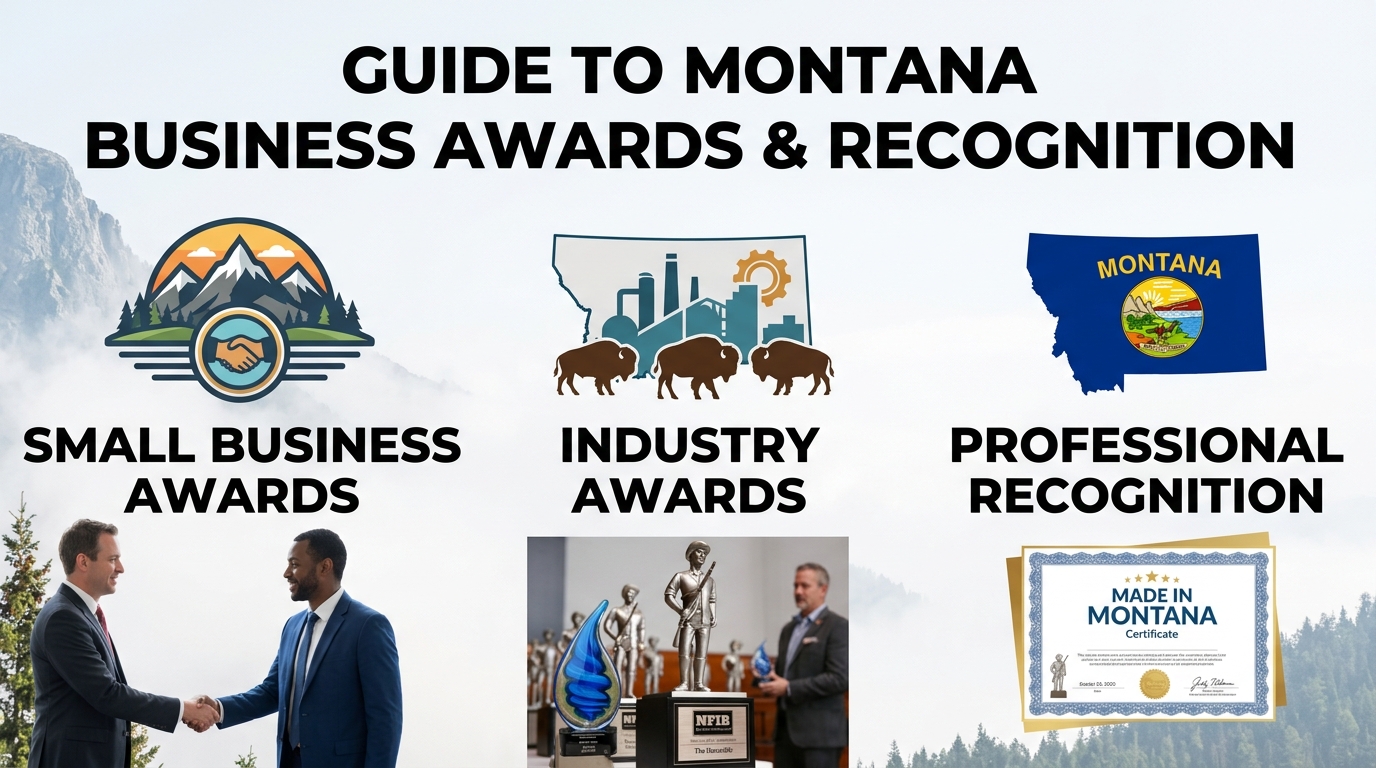
Introduction
Montana has one of the most geographically dispersed business economies in the United States.
From Billings and Bozeman to Missoula, Great Falls, Helena, Kalispell, Butte, Havre, Miles City and Sidney, Montana businesses operate in very different markets. The state is also home to thousands of businesses serving rural communities, agricultural producers, tourism destinations, Native American communities, manufacturing operations, professional-service markets, contractors, retailers, technology companies and family-owned enterprises.
That diversity matters when considering Montana business awards.
A recognition program that makes sense for a technology company in Bozeman may be completely different from the right opportunity for a ranching operation in Beaverhead County, a manufacturer in Missoula, a contractor in Great Falls, a retailer in Cut Bank or a tourism company near Glacier National Park.
Montana’s business economy also makes recognition particularly interesting from a credibility perspective. According to the U.S. Small Business Administration Office of Advocacy, Montana has one of the country’s highest concentrations of small-business employment. The SBA’s state profile reports that small businesses account for approximately 66.3% of Montana employment.
That means small-business recognition is not merely a niche subject in Montana.
It is relevant to a substantial portion of the state’s workforce and business community.
But there is an important distinction between receiving an award and creating meaningful business value from recognition.
An award does not automatically produce customers, revenue, search rankings, investment or contracts. Instead, legitimate recognition can function as one piece of a broader credibility strategy.
The quality of the organization granting the recognition matters. So do the judging standards, transparency, relevance, selectivity, evidence requirements and the way the business communicates the recognition afterward.
This guide examines the business-award landscape throughout Montana, explains what research says about recognition and credibility, identifies legitimate recognition opportunities, discusses local and rural businesses, and provides a practical framework for deciding whether an award is worth pursuing.
What Are Montana Business Awards?
Montana business awards are recognition programs that identify businesses, entrepreneurs, executives, employees, projects or organizations for notable accomplishments.
Depending on the program, recognition may focus on:
- Business excellence
- Entrepreneurship
- Innovation
- Customer service
- Community involvement
- Economic development
- Industry leadership
- Growth
- Safety
- Professional achievement
- Hospitality
- Retail excellence
- Manufacturing
- Construction
- Agricultural achievement
- Leadership
- Workforce development
- Sustainability
- Product development
- Corporate citizenship
Awards can be offered by:
- Chambers of commerce
- Trade associations
- State agencies
- Universities
- Industry organizations
- Economic-development groups
- Tourism organizations
- Business publications
- Professional associations
- Independent award organizations
Not every recognition program is equivalent.
A state agency recognizing a business for economic development is different from a chamber’s community award. A construction association’s project award is different from a consumer-voted local award. A professional certification is different from an award.
Understanding those differences is essential.
The Montana Business Awards Landscape
Montana’s business-recognition environment reflects the state’s unusual economic structure.
The Montana Department of Commerce identifies industries including healthcare, construction, education, tourism and information technology as important parts of the state’s economy. Its business-development resources also identify advanced and traditional manufacturing, agriculture and ag tech, B2B technology, life sciences, data centers, e-commerce and logistics, energy technology and technology startups as areas of economic opportunity.
That creates multiple potential recognition paths.
A Montana company could pursue:
- Local chamber recognition
- Regional business recognition
- Industry-specific awards
- Statewide awards
- Entrepreneur awards
- Product awards
- Manufacturing awards
- Agricultural recognition
- Tourism recognition
- Family-business recognition
- Community-impact recognition
- Independent business awards
The best strategy is generally not to apply everywhere.
Instead, businesses should identify recognition programs whose judging standards actually correspond with what the company does well.
Montana Business Facts and Figures
Montana’s small-business economy is particularly important.
The SBA Office of Advocacy reports that small businesses account for approximately 66.3% of Montana employment. That is among the highest small-business employment shares in the United States.
That statistic changes how statewide recognition should be viewed.
In a state where small businesses account for such a large share of employment, recognition opportunities for smaller companies are not peripheral. They potentially apply to a major component of Montana’s economy.
The SBA’s Montana profile also reports substantial business ownership by women, veterans and American Indian and Alaska Native owners.
The underlying data includes:
- Approximately 48,574 women-owned businesses
- Approximately 9,555 veteran-owned businesses
- Approximately 3,481 American Indian and Alaska Native-owned businesses
- Thousands of additional businesses owned across other demographic categories
These figures demonstrate why recognition strategies should not focus exclusively on large corporations.
Montana’s business landscape contains substantial numbers of:
- Women-owned businesses
- Veteran-owned businesses
- Native American-owned businesses
- Family-owned businesses
- Independent businesses
- Rural businesses
- Microbusinesses
- Agricultural enterprises
The U.S. Census Bureau’s Business Dynamics Statistics also provides business-opening, business-closing, startup, shutdown and employment-dynamics data at state and county levels.
That geographic detail is important in Montana because business opportunity extends well beyond the state’s largest population centers.
Why Business Recognition Matters
Business recognition can serve several purposes.
Credibility
An unfamiliar business faces an obvious challenge.
A prospective customer may ask:
Why should I trust this company?
An award cannot answer that question by itself. But credible third-party recognition can provide another piece of evidence.
This is particularly relevant for:
- New businesses
- Professional-service firms
- B2B companies
- Consultants
- Contractors
- Technology companies
- Businesses entering new markets
The recognition effectively says that someone outside the company evaluated some aspect of its performance.
The credibility of that evaluator matters.
Differentiation
Montana has thousands of businesses competing for attention.
An award can give a business another differentiating message.
Instead of saying:
“We provide excellent service.”
a company can potentially say:
“Our company was recognized for customer service by an established organization.”
The second statement has a different evidentiary structure.
It is still not proof that the business is objectively superior in every respect, but it is an externally generated signal.
Marketing
Recognition can be repurposed across multiple channels.
A legitimate award may appear on:
- A website
- Homepage
- About page
- Email signature
- Proposal
- RFP response
- Sales presentation
- Social media
- Press release
- Company brochure
- Digital advertisement
- Recruiting materials
- Case studies
The same underlying accomplishment can therefore become a reusable marketing asset.
What Scholarly Research Says About Awards and Third-Party Validation
The academic literature provides a much more nuanced picture than typical marketing articles.
One important line of research examines quality awards.
Hendricks and Singhal’s research published in Management Science studied the market reaction to announcements that firms had won quality awards. Their research found statistically significant positive abnormal stock returns on award-announcement dates, ranging from approximately 0.59% to 0.67% depending on the model.
The effect was stronger among smaller firms, where abnormal returns ranged from approximately 1.16% to 1.26%. The effect was also stronger for awards from independent organizations, where abnormal returns ranged from approximately 1.31% to 1.65%.
This is interesting for Montana’s small-business economy.
But it needs an important qualification.
This research involved publicly traded companies and quality awards. It does not mean that a Montana roofing company, restaurant or accounting firm can expect a particular revenue increase from winning an award.
The research does, however, support the broader idea that credible external recognition can convey information to stakeholders.
Award Winners Were Often Already Performing Better
Another important study by Hendricks and Singhal examined more than 500 firms over a ten-year period, covering six years before and three years after companies won quality awards.
The researchers found that award-winning firms performed better than control firms on several operating measures.
But the most important finding for interpreting awards was that winners were already outperforming control firms before receiving the awards.
This is a crucial distinction.
If an award-winning company subsequently performs well, it is tempting to say:
“The award caused the company’s success.”
The research does not justify that conclusion.
A more defensible interpretation is:
Companies that had already developed strong quality-management capabilities were more likely to win recognition and continued to perform strongly afterward.
For business owners, this suggests that an award may sometimes be better understood as a signal of underlying capability rather than a magic growth mechanism.
Research on Smaller Firms
Research has also identified differences between smaller and larger businesses.
Hendricks and Singhal’s research found that smaller firms could experience particularly strong performance effects associated with effective total quality management in the research setting. The research also found stronger results for firms receiving awards from independent award organizations compared with supplier awards.
That is particularly relevant to Montana.
Because small businesses account for such a high percentage of Montana employment, independent recognition can potentially be useful as a communication mechanism for companies that do not have the brand familiarity of national corporations.
Again, however, the research should not be converted into a guarantee.
A small business should not assume that receiving an award will produce a specific financial result.
Awards and Operating Performance
Research has also examined awards connected with specific capabilities.
Research published in the Journal of Supply Chain Management examined firms receiving service-quality and environmental-sustainability awards in logistics.
The researchers found that award-recognized capabilities were associated with improved operating performance during the three-year post-award period. Service-quality recognition was associated with sales growth and cost efficiency, while environmental-sustainability recognition was associated with sales growth.
The important word is associated.
The study does not establish that simply receiving a trophy caused the improvement.
Rather, recognition may identify companies that possess capabilities that are themselves valuable.
That distinction is fundamental to responsible business-award marketing.
What the Research Does NOT Prove
Research does not establish a universal formula such as:
“Winning a business award increases revenue by 20%.”
There is no credible basis for applying such a statistic universally to Montana businesses.
Research also does not prove that:
- Every award increases sales
- Every award improves SEO
- Every award improves customer conversion
- Every award helps recruiting
- Every award improves investor confidence
- Every award creates media coverage
- Every award creates new contracts
The outcome depends heavily on the recognition itself.
A prestigious, independently judged award can communicate something different from a little-known award with weak criteria.
That is why award credibility should be treated as a major consideration.
Third-Party Validation Is Broader Than Awards
Business awards are only one form of third-party validation.
Businesses can also demonstrate credibility through:
Certifications
Certifications generally indicate compliance with a defined standard or competency requirement.
Accreditations
Accreditation generally involves recognition of an organization or program by an authoritative accrediting body.
Licenses
Licenses demonstrate that a business or professional has satisfied legally required conditions.
Customer Reviews
Reviews communicate the experiences of customers.
Testimonials
Testimonials provide qualitative evidence from customers or clients.
Media Recognition
Media coverage can provide external attention and editorial validation.
Rankings
Rankings compare businesses according to specified criteria.
Industry Credentials
Professional organizations may establish qualifications within a specific industry.
Awards
Awards generally communicate that a third party recognized an accomplishment, capability or contribution.
These signals should not be treated as interchangeable.
When Awards May Not Help
An award can actually be weak if the underlying recognition has little credibility.
Businesses should be cautious when evaluating programs that have:
- Unclear judging criteria
- No explanation of who judges applications
- No meaningful eligibility standards
- Excessive numbers of winners
- Little distinction between winners
- Poor transparency
- No substantive application process
- Recognition that appears primarily transactional
- Unrelated categories
- Weak documentation
- Little evidence of independent evaluation
There is also a difference between:
“We won an award.”
and:
“We were selected after an independently evaluated process based on documented performance.”
The second statement communicates substantially more.
Small Business Awards in Montana
Small businesses should not assume awards are designed only for major corporations.
Montana’s economy makes small-business recognition particularly relevant.
The SBA reports that small businesses account for approximately 66.3% of Montana employment.
A small Montana company can consider recognition for:
- Growth
- Customer service
- Innovation
- Community involvement
- Entrepreneurship
- Product development
- Local economic impact
- Industry achievement
A five-person company may have a stronger award story than a 500-person company if it can demonstrate unusually strong results.
Startup and Entrepreneur Recognition
Startups should focus on accomplishments rather than simply being new.
Strong startup applications often explain:
Challenge → Action → Result
For example:
Challenge: Customers faced an expensive or inefficient process.
Action: The startup developed a new technology or service.
Result: Customers experienced measurable savings, improved efficiency or another documented outcome.
Entrepreneurial recognition can also help founders communicate a business story to audiences that may not know the company.
Montana has an example in its statewide youth entrepreneurship ecosystem.
The Montana Chamber Foundation’s The Prospects competition is a statewide entrepreneurship competition for students with new ideas and existing small businesses. The competition has included categories for new and existing businesses and has distributed cash prizes and scholarships.
This is primarily youth entrepreneurship recognition rather than a general adult business award, but it illustrates Montana’s broader emphasis on entrepreneurship.
Established and Growing Businesses
Established companies should not assume that awards are only for startups.
Longstanding companies can compete based on:
- Longevity
- Growth
- Customer loyalty
- Innovation
- Workforce development
- Community investment
- Operational improvement
- Industry leadership
- New products
- Expansion
A 40-year-old Montana company may have an entirely different award narrative from a two-year-old startup.
Both can be compelling.
Rural Business Recognition
Rural Montana deserves specific attention.
Businesses operate across large geographic areas, often serving communities where there are fewer competitors and fewer opportunities for traditional media exposure.
Recognition can therefore serve an additional communications function.
A rural business may use recognition to explain its economic role to:
- Customers
- Local residents
- Employees
- Potential employees
- Suppliers
- Regional partners
- Economic-development organizations
For rural companies, a statewide award may provide recognition beyond the immediate community.
Industry-Specific Montana Business Awards
Construction
Montana’s construction sector is substantial and has experienced significant employment growth.
Construction companies can pursue recognition for:
- Project excellence
- Safety
- Innovation
- Infrastructure
- Workforce development
- Rural projects
- Commercial construction
- Civil construction
- Concrete
- Highway work
The Montana Contractors Association offers MCA Excellence in Construction Awards recognizing members in areas including building, concrete, environmental, highway, partnering and workforce development.
The categories include agricultural concrete, industrial/commercial projects and rural highway projects.
Manufacturing
Manufacturing is another important Montana opportunity.
The Montana Manufacturing Association sponsors the Montana Manufacturer of the Year Awards with the Montana Chamber.
The program recognizes manufacturing leaders in areas including:
- Innovation
- Growth
- Corporate citizenship
- Environmental excellence
The program specifically positions recognition as a way to highlight achievements to employees, suppliers, customers and other stakeholders.
Agriculture and Agribusiness
Agriculture remains central to Montana’s economy.
Agricultural businesses can pursue recognition connected with:
- Innovation
- Product development
- Agricultural technology
- Food production
- Ranching
- Farming
- Rural economic development
- Value-added products
Montana’s Growth Through Agriculture program is primarily a funding program rather than a recognition award. The distinction is important. It provides grants and loans to support agricultural development.
Therefore, a company should not present Growth Through Agriculture funding as if it were an excellence award.
Technology and Startups
Montana’s technology ecosystem includes:
- Software
- SaaS
- AI
- Data
- Cybersecurity
- Life sciences
- Ag tech
- Energy technology
The Department of Commerce specifically identifies B2B technology companies, data centers, technology startups, life sciences and energy technology among Montana’s business opportunities.
Technology businesses should consider awards emphasizing:
- Innovation
- Product development
- Entrepreneurship
- Technology implementation
- Economic impact
- Customer outcomes
Women-Owned Businesses
Women represent a substantial share of Montana business ownership.
The SBA’s Montana profile reports that women owned approximately 45.9% of businesses in the underlying ownership data.
Women-owned companies should therefore consider both general business awards and recognition programs specifically emphasizing:
- Women entrepreneurship
- Leadership
- Community impact
- Innovation
- Growth
- Industry achievement
A company should not automatically choose a demographic award simply because it qualifies.
The strongest recognition is generally the recognition most relevant to the accomplishment being demonstrated.
Veteran-Owned Businesses
Veterans owned approximately 8.5% of Montana businesses in the SBA’s underlying data.
Veteran-owned businesses may consider:
- Veteran entrepreneurship awards
- General business awards
- Industry awards
- Community leadership awards
- Economic-development recognition
The veteran-owned status can be part of a broader story, but the application should still demonstrate measurable business accomplishment.
Native American-Owned Businesses
Montana’s business landscape includes a substantial Native American entrepreneurial community.
The SBA’s Montana data identifies thousands of American Indian and Alaska Native-owned businesses.
Recognition opportunities can include:
- Native American entrepreneurship
- Indigenous tourism
- Native-owned retail
- Arts and crafts
- Agriculture
- Hospitality
- Community development
- Technology
- Professional services
Montana’s Department of Commerce also operates programs specifically serving Indian Country.
The Native American Made in Montana initiative recognizes qualifying products made, created or enhanced in Montana by enrolled members of Montana tribes.
That is an important example of why businesses need to understand the distinction between product recognition and company awards.
Family-Owned Businesses
Family business is deeply embedded in Montana’s economy.
Montana State University’s Jake Jabs College of Business and Entrepreneurship has operated a statewide family-business recognition program that has honored more than 150 Montana family-run businesses, according to the Montana Chamber’s description of the program.
Recognition categories have historically included very small, small, medium, large, old and new family businesses.
The program’s historical descriptions indicate that recognized businesses have included farms, ranches, breweries and manufacturers.
This demonstrates the breadth of family-business recognition in Montana.
Businesses interested in this type of recognition should verify current program availability directly with the university.
Restaurants, Hospitality and Tourism
Tourism is an important component of Montana’s economy.
The Montana Department of Commerce administers statewide tourism initiatives and research and has recognized businesses and communities through Montana Tourism Awards.
The Tourism Awards recognize businesses, communities, organizations and individuals contributing to Montana’s tourism industry and its economic impact.
Tourism businesses can include:
- Hotels
- Lodges
- Restaurants
- Outfitters
- Guides
- Attractions
- Destination businesses
- Cultural organizations
- Outdoor recreation companies
Retail and E-Commerce
Retail businesses have opportunities to pursue recognition based on:
- Customer service
- Product quality
- Community impact
- Montana-made products
- Retail innovation
- Entrepreneurship
The Made in Montana program is particularly relevant.
It helps Montana businesses develop and market products made, created, grown or enhanced in the state. The program also includes Grown in Montana and Native American Made in Montana.
The program is product-focused rather than a general certification for an entire company.
That distinction should be preserved in marketing.
Montana Cities and Business Communities
Montana’s business recognition landscape extends well beyond Billings and Bozeman.
The Montana State Library identifies 56 counties and 127 incorporated cities and towns in its statewide geographic data.
Major business centers include:
- Billings
- Bozeman
- Missoula
- Great Falls
- Helena
- Kalispell
- Butte
- Havre
- Anaconda
- Miles City
- Belgrade
- Livingston
- Sidney
- Glendive
- Laurel
- Whitefish
- Hamilton
- Dillon
- Lewistown
- Polson
- Columbia Falls
- Hardin
Montana’s business community also extends through smaller cities, towns and communities including:
Absarokee, Alberton, Alder, Alzada, Amsterdam, Arlee, Ashland, Augusta, Avon, Babb, Bainville, Baker, Basin, Bearcreek, Belfry, Belgrade, Belt, Big Arm, Big Sandy, Big Sky, Big Timber, Bigfork, Birney, Black Eagle, Bloomfield, Bonner, Boulder, Box Elder, Bridger, Broadus, Broadview, Brockton, Browning, Buffalo, Butte, Cascade, Charlo, Chester, Chinook, Choteau, Circle, Clyde Park, Colstrip, Columbia Falls, Columbus, Conrad, Culbertson, Custer, Cut Bank, Darby, Deer Lodge, Denton, Dillon, Dodson, Drummond, Dutton, East Helena, Ekalaka, Ennis, Fairfield, Fairview, Flaxville, Florence, Forsyth, Fort Benton, Fort Peck, Fortine, Frazer, Frenchtown, Froid, Fromberg, Glasgow, Glendive, Grass Range, Great Falls, Hamilton, Hardin, Harlem, Harlowton, Havre, Helena, Hot Springs, Hysham, Ismay, Joliet, Jordan, Judith Gap, Kalispell, Kevin, Kila, Kremlin, Lakeside, Lakeview, Lame Deer, Laurel, Lavina, Lewistown, Libby, Lima, Lincoln, Lindsay, Livingston, Lodge Grass, Lolo, Loma, Malta, Manhattan, Marion, Martinsdale, Marysville, Melrose, Melstone, Miles City, Missoula, Moore, Musselshell, Nashua, Neihart, Noxon, Opheim, Outlook, Ovando, Pablo, Park City, Philipsburg, Plains, Plentywood, Polson, Poplar, Pryor, Red Lodge, Reed Point, Richey, Ronan, Roundup, Roy, Saco, Scobey, Seeley Lake, Shelby, Sheridan, Sidney, Simms, Stevensville, Superior, Thompson Falls, Three Forks, Townsend, Troy, Twin Bridges, Ulm, Valier, Vaughn, Victor, Virginia City, West Yellowstone, Westby, White Sulphur Springs, Whitefish, Whitehall, Wibaux, Winifred, Winnett, Wolf Point and many additional communities.
The breadth of Montana’s geography is important because a statewide business-award resource should not treat recognition as something available only to companies in the state’s largest metropolitan areas.
Montana’s 56 Counties and Business Recognition
Montana has 56 counties.
Below is a statewide recognition framework for each county.
Beaverhead County
Businesses in Dillon and surrounding communities can consider regional chamber recognition, agricultural awards, tourism recognition, professional awards and statewide business programs.
Big Horn County
Businesses around Hardin, Lodge Grass, Crow Agency and surrounding communities may consider agricultural, tourism, Native American entrepreneurship, community-impact and statewide recognition.
Blaine County
Businesses in Chinook, Harlem, Hays and surrounding communities can explore agricultural, rural-business, Native American, retail and professional recognition.
Broadwater County
Townsend-area businesses can consider rural entrepreneurship, agriculture, professional services and community recognition.
Carbon County
Businesses in Red Lodge, Bridger, Joliet, Fromberg and surrounding areas may pursue tourism, hospitality, construction, retail and community awards.
Carter County
Businesses in Ekalaka and rural communities can pursue agriculture, ranching, rural entrepreneurship and statewide recognition.
Cascade County
Great Falls and surrounding businesses have access to broader commercial, manufacturing, construction, professional and community recognition opportunities.
Chouteau County
Businesses in Fort Benton, Big Sandy, Geraldine and surrounding communities can consider agriculture, tourism, rural business and manufacturing recognition.
Custer County
Miles City and surrounding businesses can pursue agriculture, ranching, retail, professional services and regional recognition.
Daniels County
Scobey, Flaxville and surrounding businesses can consider agricultural and rural recognition.
Dawson County
Glendive-area companies can consider energy, agriculture, retail, professional services and regional awards.
Deer Lodge County
Anaconda-area businesses can consider manufacturing, historic-community, tourism, construction and economic-development recognition.
Fallon County
Baker and surrounding businesses can pursue energy, agriculture, retail and rural-business recognition.
Fergus County
Lewistown and surrounding communities can consider agriculture, healthcare, professional services, retail and rural recognition.
Flathead County
Kalispell, Whitefish, Columbia Falls, Bigfork and surrounding businesses have opportunities in tourism, hospitality, technology, retail, construction and professional services.
Gallatin County
Bozeman, Belgrade, Big Sky, Manhattan and surrounding communities represent one of Montana’s strongest technology, entrepreneurship, tourism and professional-service regions.
Garfield County
Jordan and rural communities can consider agricultural, ranching and rural entrepreneurship recognition.
Glacier County
Cut Bank, Browning and surrounding communities can pursue Native American business, tourism, agriculture, retail and rural recognition.
Golden Valley County
Businesses around Ryegate and rural communities can consider agriculture, energy, transportation and rural-business recognition.
Granite County
Philipsburg and surrounding businesses can pursue tourism, hospitality, retail, mining-related and rural recognition.
Hill County
Havre and surrounding communities can consider agriculture, transportation, healthcare, education, retail and professional recognition.
Jefferson County
Businesses in Boulder, Clancy and surrounding communities can consider construction, professional services, agriculture, tourism and regional recognition.
Judith Basin County
Businesses in Stanford, Hobson and surrounding communities can consider agriculture, ranching and rural-business awards.
Lake County
Polson, Ronan and surrounding communities can pursue tourism, Native American entrepreneurship, agriculture, retail and hospitality recognition.
Lewis and Clark County
Helena-area businesses can pursue professional services, technology, retail, construction, entrepreneurship and statewide recognition.
Liberty County
Chester and surrounding businesses can consider agriculture, transportation, rural business and community recognition.
Lincoln County
Libby, Troy and Eureka-area businesses can consider forestry, tourism, retail, outdoor recreation, professional services and rural recognition.
Madison County
Ennis, Twin Bridges, Sheridan and surrounding communities can pursue agriculture, tourism, outdoor recreation, retail and rural-business recognition.
McCone County
Circle and rural communities can consider agriculture, energy, ranching and rural entrepreneurship awards.
Meagher County
White Sulphur Springs and surrounding communities can consider tourism, hospitality, agriculture and small-business recognition.
Mineral County
Superior, Alberton and surrounding businesses can pursue transportation, forestry, tourism, outdoor recreation and rural recognition.
Missoula County
Missoula represents a major regional center for technology, healthcare, education, manufacturing, professional services, retail and entrepreneurship.
Musselshell County
Roundup and surrounding communities can pursue agriculture, ranching, energy and rural-business recognition.
Park County
Livingston and surrounding communities have opportunities in tourism, hospitality, arts, outdoor recreation, professional services and entrepreneurship.
Petroleum County
Winnett and surrounding businesses can consider agriculture, ranching, energy and rural recognition.
Phillips County
Malta and surrounding communities can pursue agriculture, ranching, retail, transportation and rural-business recognition.
Pondera County
Conrad and surrounding communities can consider agriculture, manufacturing, retail and rural recognition.
Powder River County
Broadus and surrounding ranching communities can pursue agriculture, livestock and rural-business recognition.
Powell County
Deer Lodge-area businesses and surrounding communities can consider manufacturing, construction, professional services and tourism recognition.
Prairie County
Terry and surrounding businesses can consider agriculture, ranching, transportation and rural entrepreneurship recognition.
Ravalli County
Hamilton, Stevensville and surrounding communities can pursue agriculture, healthcare, construction, tourism, retail and professional-service recognition.
Richland County
Sidney and Fairview-area businesses can pursue agriculture, energy, manufacturing, healthcare, retail and professional awards.
Roosevelt County
Wolf Point, Poplar and surrounding businesses can consider agriculture, Native American entrepreneurship, retail and community recognition.
Rosebud County
Forsyth, Colstrip and surrounding communities can pursue energy, agriculture, construction, community and economic-development recognition.
Sanders County
Thompson Falls, Plains, Hot Springs and surrounding communities can consider forestry, tourism, hospitality, outdoor recreation and rural recognition.
Sheridan County
Plentywood and surrounding communities can pursue agriculture, energy, transportation and rural-business recognition.
Silver Bow County
Butte-area businesses can pursue manufacturing, technology, construction, historic preservation, tourism, professional services and entrepreneurship recognition.
Stillwater County
Columbus and surrounding businesses can consider manufacturing, agriculture, mining, professional services and rural recognition.
Sweet Grass County
Big Timber and surrounding businesses can pursue agriculture, tourism, ranching and professional recognition.
Teton County
Choteau, Fairfield and surrounding businesses can consider agriculture, tourism, ranching, retail and rural-business recognition.
Toole County
Shelby and surrounding communities can pursue energy, transportation, agriculture, manufacturing and rural recognition.
Treasure County
Hysham-area businesses can consider agriculture, energy, rural entrepreneurship and community recognition.
Valley County
Glasgow, Fort Peck and surrounding businesses can pursue agriculture, energy, tourism, retail and rural-business recognition.
Wheatland County
Harlowton and surrounding communities can consider agriculture, transportation, ranching and rural entrepreneurship.
Wibaux County
Wibaux and surrounding businesses can pursue agriculture, ranching, retail and rural-business recognition.
Yellowstone County
Billings is Montana’s largest major commercial center, providing businesses with opportunities across healthcare, construction, professional services, retail, manufacturing, technology, hospitality and entrepreneurship.
Other Business Award Programs and Organizations in Montana
Billings Chamber Business Excellence Awards
The Billings Chamber operates Business Excellence Awards recognizing people and organizations making contributions to the Billings business community.
The program includes recognition such as Small Business of the Year and other business-excellence categories.
Businesses in Billings and Yellowstone County should monitor the chamber’s current awards information for eligibility and timing.
Montana Manufacturer of the Year Awards
The Montana Manufacturer of the Year Awards are sponsored by the Montana Manufacturing Association in conjunction with the Montana Chamber’s business-award activities.
The program recognizes manufacturing leadership in areas including innovation, growth, corporate citizenship and environmental excellence.
This makes it particularly relevant to Montana manufacturers seeking industry-specific recognition.
MCA Excellence in Construction Awards
The Montana Contractors Association’s Excellence Awards recognize exceptional work by members across multiple construction categories, including building, concrete, environmental, highway, partnering and workforce development.
Contractors should review the association’s current eligibility requirements before applying.
Montana Tourism Awards
The Montana Department of Commerce’s Tourism Awards recognize businesses, communities, organizations and individuals contributing to Montana’s tourism industry and economic impact.
This creates a particularly relevant recognition pathway for:
- Hotels
- Lodges
- Restaurants
- Outfitters
- Guides
- Attractions
- Tourism organizations
- Destination businesses
Made in Montana Trade Show Awards
The Made in Montana Trade Show includes recognition categories such as Best in Show, Best in Show for a New Exhibitor, Honorable Mention and Retailer of the Year.
Judging evaluates aspects of the exhibitor’s presentation, including originality, visual presence and buyer engagement.
Businesses should distinguish this type of product and trade-show recognition from a general company excellence award.
Family Business Recognition
Montana State University’s family-business program has historically recognized Montana family-owned companies across multiple size and longevity categories.
The Montana Chamber has supported the program, which has recognized more than 150 family-run businesses according to its published historical description.
Businesses interested in current family-business recognition should verify whether the program is presently accepting nominations.
The Prospects
The Montana Chamber Foundation’s The Prospects competition is designed around youth entrepreneurship, including students with new business ideas and existing small businesses.
It is therefore not a general adult business award, but it is an important statewide entrepreneurial recognition opportunity for eligible students.
Recognition Awards vs. Grants and Funding Awards
This distinction deserves its own section.
A business might receive an “award” that is actually funding.
For example:
- Grants
- Loans
- Economic-development incentives
- Scholarships
- Export assistance
- Agricultural funding
are fundamentally different from recognition awards.
Montana’s Growth Through Agriculture program provides agricultural funding through grants and loans.
The state’s Tribal Tourism Small Business Grant provides financial assistance to eligible Native American-owned tourism businesses.
These programs can be extremely valuable.
But a company should describe them accurately.
Funding received is not automatically a business-excellence award.
Likewise, being accepted into a state business-development program does not necessarily mean a company has won an award.
Accurate terminology strengthens credibility.
How to Choose the Right Montana Business Award
Before applying, ask:
Who operates the program?
Look for:
- Established organizations
- Professional associations
- Chambers
- Universities
- Government agencies
- Independent organizations with transparent processes
What are the judging criteria?
You should be able to understand what makes a winner.
Who judges applications?
Independent judging can add credibility.
Is the award relevant?
An award should correspond to your actual accomplishment.
How selective is it?
A program where nearly every applicant receives recognition communicates something different from a highly competitive program.
What evidence is required?
Strong programs generally require substantive information.
Can you verify past recipients?
A transparent organization should make it possible to understand its history.
How to Write a Strong Award Application
A strong application should not read like an advertisement.
It should read like evidence.
A useful framework is:
Challenge
What problem or opportunity existed?
Action
What did the company actually do?
Result
What happened because of those actions?
For example:
Challenge: Customer wait times were excessive.
Action: The company redesigned its scheduling system.
Result: Average response time fell from three days to one day.
That is substantially stronger than:
“We are committed to outstanding customer service.”
How to Demonstrate Business Results
Whenever possible, quantify:
- Revenue growth
- Customer growth
- Employee growth
- Retention
- Productivity
- Cost savings
- Delivery times
- Customer satisfaction
- Safety improvements
- Market expansion
- Jobs created
- Community investment
- Production increases
Not every accomplishment needs a dollar figure.
For example:
“Created 12 new jobs.”
is a measurable result.
So is:
“Reduced project completion time by 18%.”
So is:
“Served 1,400 additional customers.”
Evidence makes an application stronger.
How to Use Recognition After Winning
Winning is only the beginning.
Businesses can responsibly incorporate legitimate recognition into:
Website
Create an awards or recognition section.
Homepage
Mention major recognition where relevant.
About Page
Explain what the award recognized.
Press Release
Tell the story behind the accomplishment.
Social Media
Share the recognition without exaggerating what it means.
Sales Presentations
Include recognition when relevant to a prospect.
Proposals
Use relevant recognition as supporting evidence.
RFP Responses
Mention awards where they directly reinforce qualifications.
Recruiting
Use recognition as one component of employer branding.
Local Media
Rural and local recognition may be particularly relevant to community newspapers and regional publications.
Awards, Marketing, SEO and Public Relations
An award can generate useful content.
One legitimate recognition can produce:
- An announcement
- A website update
- Social posts
- A press release
- A company-news article
- An email campaign
- A case study
- A sales presentation update
That can increase a company’s overall content footprint.
However, an award does not automatically improve SEO.
Search engines do not have a universal rule saying:
“Award winner = higher ranking.”
Instead, the business may benefit indirectly if recognition creates:
- Legitimate media coverage
- Links from credible sites
- Brand mentions
- Useful content
- Increased branded searches
- Stronger reputation
Those outcomes depend on what actually happens after the award.
Awards and B2B Credibility
B2B purchasing frequently involves uncertainty.
A buyer may not immediately know whether a vendor will:
- Deliver on time
- Maintain quality
- Provide adequate support
- Meet specifications
- Stay financially stable
- Solve the customer’s problem
Third-party evidence can help reduce uncertainty.
That does not make an award equivalent to a certification or customer reference.
But it can provide another signal.
For Montana companies selling outside the state, this can be particularly useful because a prospective buyer in another state may have little prior familiarity with the company.
Awards and Customer Trust
Trust is contextual.
A customer buying a $10 product may make a different decision from a company considering a $500,000 B2B contract.
An award may therefore have different relevance depending on:
- Purchase price
- Risk
- Industry
- Customer familiarity
- Award credibility
- Relevance of the award
- Other trust signals
A business should never rely on an award as its only credibility mechanism.
Reviews, references, testimonials, licenses, certifications and demonstrated results can all matter.
Awards and Recruiting
Recognition can also contribute to employer branding.
A company recognized for:
- Workplace culture
- Community impact
- Innovation
- Employee development
- Leadership
may have another story to tell prospective employees.
Academic research has examined employee reactions to performance awards, including the experiences of people nominated but not selected.
One Academy of Management Journal study specifically examined the effects of performance awards on employees who were nominated but did not receive the award, illustrating that recognition systems can have complex effects inside organizations.
That is another reason companies should avoid treating awards as universally positive.
Recognition programs need thoughtful internal communication.
Awards for Montana Family-Owned Businesses
Family-owned businesses can use recognition to communicate both longevity and community impact.
A strong family-business application might explain:
- When the company was founded
- How ownership transitioned
- How many generations are involved
- Jobs created
- Community involvement
- Business growth
- Innovation
- Customer relationships
- Challenges overcome
The goal should be to show why the company is noteworthy, rather than simply stating that it is family-owned.
Awards for Montana Professional Services
Professional-service businesses include:
- Accounting firms
- CPA firms
- Law firms
- Insurance agencies
- Financial advisers
- Consulting companies
- Marketing agencies
- Engineering firms
- Architects
- Real estate companies
- IT providers
For these businesses, recognition can be particularly relevant because customers may find service quality difficult to evaluate before purchasing.
Useful evidence can include:
- Client retention
- Measurable outcomes
- Growth
- Professional credentials
- Client testimonials
- Industry contributions
- Community service
Awards should complement rather than replace professional credentials.
Awards for Montana Healthcare Businesses
Healthcare organizations operate under particularly high expectations for trust and professionalism.
Potential recognition areas include:
- Patient experience
- Innovation
- Community health
- Workforce development
- Safety
- Leadership
- Specialized services
Healthcare businesses should be especially careful about making claims that imply clinical superiority unless the award specifically establishes that conclusion.
Awards for Montana Contractors and Home-Service Businesses
Contractors often compete on:
- Reliability
- Workmanship
- Safety
- Customer service
- Project management
- Communication
A credible award can complement:
- Reviews
- Licensing
- Insurance
- References
- Project photographs
- Before-and-after documentation
- Testimonials
For contractors, project-specific recognition may be particularly powerful because it gives an award a concrete story.
Awards for Montana Restaurants and Hospitality Businesses
Restaurants and hospitality businesses can pursue recognition for:
- Customer experience
- Culinary excellence
- Community involvement
- Tourism impact
- Sustainability
- Local sourcing
- Design
- Innovation
Tourism-specific recognition may be particularly relevant for businesses serving Montana visitors.
Awards for Montana Retail and E-Commerce Businesses
Retail and e-commerce businesses can pursue recognition for:
- Product quality
- Customer service
- Montana-made products
- Innovation
- Community impact
- Entrepreneurship
Businesses should distinguish between recognition for a specific product and recognition for the company as a whole.
Recognition for Rural Montana Businesses
A statewide recognition strategy can be especially useful for rural companies.
A rural business may have excellent accomplishments but limited exposure outside its immediate market.
Recognition can help provide a story that travels beyond the local community.
That can matter when the business wants to:
- Enter a new market
- Recruit employees
- Attract partners
- Sell to larger companies
- Develop media coverage
- Establish credibility with customers outside the region
International Association for Business Excellence
The International Association for Business Excellence provides another option for Montana businesses seeking business recognition.
Businesses can learn about the organization through its official homepage:
Businesses interested in recognition can review the application process at:
More information about the organization is available at:
Businesses with questions can use:
For a Montana business considering recognition, the important question is not simply whether an organization offers an award.
The business should evaluate the award against the same criteria discussed throughout this guide:
- What does the organization recognize?
- What standards are applied?
- How does the evaluation process work?
- Is the recognition relevant?
- Can the business accurately explain what it means?
- Does the recognition fit the company’s broader credibility strategy?
How to Start Pursuing Montana Business Recognition
A practical strategy can be simple.
Step 1: List Your Accomplishments
Write down measurable achievements from your business.
Step 2: Identify Your Strongest Story
Look for:
- Growth
- Innovation
- Customer outcomes
- Community impact
- Operational improvements
- Leadership
- Product development
Step 3: Identify Relevant Programs
Search:
- Local chambers
- State organizations
- Industry associations
- Universities
- Tourism organizations
- Agricultural organizations
- Independent award organizations
Step 4: Evaluate Credibility
Do not apply simply because an award exists.
Step 5: Build Your Evidence
Collect:
- Numbers
- Testimonials
- Customer outcomes
- Employee results
- Growth statistics
- Photos
- Press coverage
- Project documentation
Step 6: Apply Selectively
Quality is more important than quantity.
Step 7: Use the Recognition Properly
Explain exactly what the award recognized.
Long-Term Recognition Strategy
The best business-award strategy is not necessarily the strategy with the largest number of trophies.
A stronger approach is to create a recognition portfolio.
For example, a Montana company might combine:
- Local chamber recognition
- Industry recognition
- Statewide recognition
- Customer testimonials
- Professional credentials
- Certifications
- Media coverage
- Community recognition
Each signal communicates something different.
The goal is to create a consistent body of evidence.
Conclusion
The opportunity for Montana business awards extends far beyond the state’s largest cities.
Montana’s business economy includes large employers, small businesses, family companies, agricultural operations, manufacturers, contractors, technology startups, healthcare providers, professional-service firms, retailers, tourism businesses and Native American-owned enterprises.
The state’s small-business economy is particularly important. SBA data indicates that small businesses account for approximately 66.3% of Montana employment.
That makes credible business recognition relevant to businesses throughout the state.
But the strongest recognition strategy is not simply collecting awards.
It is building a credible body of evidence.
That evidence can include:
- Customer reviews
- Testimonials
- Certifications
- Professional credentials
- Licensing
- Measurable business results
- Industry recognition
- Community involvement
- Third-party awards
Research into quality awards and organizational performance suggests that credible recognition can provide meaningful signals, but it also shows why causation must be treated carefully. Award-winning companies may already possess strong capabilities before recognition occurs.
For Montana businesses, the most useful question is therefore not:
“Will an award make my company successful?”
It is:
“Does this recognition credibly communicate something valuable about what my company has accomplished?”
When the answer is yes, an award can become a useful addition to a larger reputation, marketing and business-development strategy.
Frequently Asked Questions About Montana Business Awards
1. What are Montana business awards?
Montana business awards are recognition programs that honor companies, entrepreneurs, employees, projects or organizations for accomplishments such as innovation, growth, customer service, community impact or industry leadership.
2. Are Montana business awards only for large companies?
No. Many recognition opportunities are appropriate for small businesses, startups, family companies and rural businesses.
3. Can a small business win a Montana business award?
Yes. Small businesses can compete for recognition based on accomplishments, innovation, customer service, growth, community involvement and other criteria.
4. Are business awards expensive?
Costs vary. Some programs are free to enter, while others charge application, membership, ceremony or participation fees.
5. Should a business pay to enter an award?
Not necessarily. Businesses should evaluate the credibility, judging process, visibility and potential value before paying any fee.
6. How do I find business awards in Montana?
Start with chambers of commerce, industry associations, state agencies, universities, tourism organizations and established independent recognition organizations.
7. Are there business awards in Billings?
Yes. The Billings Chamber operates Business Excellence Awards recognizing businesses and organizations in the Billings community.
8. Are there business awards in Bozeman?
Bozeman businesses can pursue local, regional, industry and statewide recognition, including entrepreneurship and technology-related opportunities.
9. Are there business awards in Missoula?
Yes. Missoula businesses can consider local, statewide and industry-specific recognition, including manufacturing, professional services and entrepreneurship opportunities.
10. Can Montana startups apply for awards?
Yes. Startups can pursue entrepreneurship, innovation, technology, industry and general business recognition.
11. Can established businesses win awards?
Yes. Established companies can compete based on longevity, growth, innovation, leadership, customer service and community impact.
12. Are there awards for Montana manufacturers?
Yes. The Montana Manufacturer of the Year Awards recognize manufacturing leaders in categories including innovation, growth, corporate citizenship and environmental excellence.
13. Are there awards for Montana contractors?
Yes. The Montana Contractors Association offers Excellence in Construction Awards for qualifying members and projects.
14. Are there tourism awards in Montana?
Yes. Montana Tourism Awards recognize businesses, communities, organizations and individuals contributing to the state’s tourism industry.
15. Are there awards for family-owned businesses?
Montana has had statewide family-business recognition through Montana State University’s Jake Jabs College of Business and Entrepreneurship. Businesses should verify current program availability directly.
16. Are there awards for women-owned businesses?
Women-owned businesses can pursue general business awards as well as recognition programs specifically focused on women entrepreneurs or leaders.
17. Are there awards for veteran-owned businesses?
Veteran-owned companies can pursue veteran-focused recognition as well as general industry and business awards.
18. Are there awards for Native American-owned businesses?
Yes. Native American-owned businesses can consider Native entrepreneurship, tourism, product and community recognition opportunities.
19. What makes an award credible?
Credibility generally depends on factors such as transparent criteria, meaningful judging, independent evaluation, organizational reputation and relevance.
20. Does winning an award increase revenue?
Not automatically. Research suggests some forms of credible recognition are associated with positive outcomes, but an award does not guarantee revenue growth.
21. Can awards improve customer trust?
They can potentially contribute to trust by providing another external signal, but the effect depends on the credibility and relevance of the award.
22. Do awards improve SEO?
Not automatically. An award may indirectly support SEO if it generates legitimate media coverage, links, content or brand interest.
23. Should I put an award on my website?
If the award is legitimate and relevant, displaying it can be appropriate.
24. Should I put an award in my email signature?
A relevant, credible award can be included in an email signature if it does not make the signature excessively promotional.
25. Can awards help B2B companies?
Potentially. Third-party recognition may provide another signal when buyers have limited information about a supplier.
26. Can rural Montana businesses win awards?
Yes. Rural companies can pursue statewide, regional, industry and rural-business recognition.
27. What should an award application include?
A strong application generally explains the challenge, actions taken, results achieved and evidence supporting the claims.
28. What is the Challenge–Action–Result framework?
It is an application-writing structure that explains the problem, what the company did and what measurable outcome resulted.
29. Should I include statistics in an award application?
Yes, when accurate and relevant. Specific numbers often communicate accomplishments more effectively than vague descriptions.
30. Can a business apply for multiple awards?
Yes, but businesses should prioritize quality and relevance instead of submitting applications indiscriminately.
31. Are grants the same as business awards?
No. Grants primarily provide financial assistance, while recognition awards primarily honor accomplishments.
32. Is Made in Montana a business award?
No. Made in Montana is primarily a product-focused state program, not a general business-excellence award.
33. Can an award help with recruiting?
Potentially. Recognition may contribute to employer branding, particularly when it relates directly to workplace culture, leadership or employee development.
34. Should I mention every award my company wins?
Not necessarily. Businesses should emphasize the recognition most relevant and credible to their audience.
35. Can awards replace customer reviews?
No. Awards, reviews and testimonials communicate different forms of evidence.
36. Can an award replace professional certification?
No. Awards and certifications serve different purposes.
37. What should I look for before paying an award fee?
Evaluate the organization’s reputation, criteria, judging process, selectivity, transparency and marketing value.
38. Are local awards valuable?
They can be, particularly when the business serves a local market and the organization giving the award is respected within that community.
39. Are statewide awards better than local awards?
Not automatically. The best award depends on the company’s audience and objective.
40. Where can Montana businesses learn about business recognition?
Businesses can research chambers, trade associations, universities, government programs, industry organizations and independent recognition programs.
Additional Montana Business Awards Q&A
41. Should a Montana company create an annual award strategy?
It can be useful. A structured strategy helps businesses identify appropriate programs rather than applying randomly.
42. How many awards should a business pursue?
There is no universal ideal number. A few highly relevant awards may be more useful than a large collection of weakly relevant recognitions.
43. What is the difference between an award and a ranking?
An award recognizes an accomplishment or recipient, while a ranking generally compares entities according to a defined methodology.
44. What is the difference between an award and certification?
Certification generally verifies compliance with a standard or competency requirement, while an award recognizes an accomplishment or achievement.
45. Should companies use award badges?
They can, provided the badge accurately identifies the award and does not imply credentials the business does not possess.
46. Can too many awards weaken credibility?
Potentially. A long list of poorly understood badges can create confusion rather than confidence.
47. Should businesses explain what an award means?
Yes. Explaining the criteria and accomplishment helps customers understand why the recognition matters.
48. What is the strongest evidence in an award application?
Usually evidence directly connected to the award criteria, particularly measurable outcomes and independently verifiable accomplishments.
49. Should a company mention award nominations?
A nomination is different from winning. Businesses should clearly distinguish finalist, nominee and winner status.
50. Can being a finalist be useful?
Yes, particularly when the program is credible and competitive. Businesses should accurately describe finalist status.
51. Should a business announce every award publicly?
No. Companies should prioritize meaningful recognition relevant to their audience.
52. How can an award become a public-relations asset?
A company can explain the accomplishment, the judging criteria, the business story and the measurable results behind the recognition.
53. How can rural companies maximize recognition?
Rural companies can combine local recognition with statewide and industry awards to communicate accomplishments beyond their immediate market.
54. Should Montana companies prioritize Montana awards?
Not necessarily. Businesses should consider Montana, regional, national and industry-specific opportunities depending on their goals.
55. When should a company apply for industry awards?
Industry awards are particularly useful when the company’s accomplishment requires specialized expertise to evaluate.
56. How can a company measure an award’s value?
Track relevant outcomes such as website referral traffic, inquiries, media mentions, backlinks, proposal responses, recruiting interest and customer feedback.
57. Can an award strengthen a company’s reputation?
It can contribute to reputation when the award is credible, relevant and supported by actual performance.
58. Can an award overcome poor customer reviews?
Generally, recognition should not be treated as a substitute for resolving customer-service or quality problems.
59. What makes third-party validation persuasive?
Independence, relevance, credibility, transparency and evidence all contribute to the usefulness of an external signal.
60. What is the best long-term recognition strategy for a Montana company?
Build real business performance first, document measurable accomplishments, pursue credible recognition selectively and use awards alongside reviews, testimonials, certifications, credentials and demonstrated results.
Sources and Further Reading
Government and Montana Business Data
U.S. Small Business Administration Office of Advocacy
The SBA Office of Advocacy provides state-specific small-business profiles containing data on business counts, employment, ownership, industry composition and other measures.
SBA Montana Small Business Profile
The Montana state profile provides detailed ownership and business information.
U.S. Census Bureau — Business Dynamics Statistics
Business Dynamics Statistics provides measures of establishment openings and closings, firm startups and shutdowns, and job creation and destruction.
U.S. Census Bureau — Small Business Data
Montana Department of Commerce
Montana State Library — Administrative Boundaries
The Montana State Library provides statewide geographic data covering Montana’s counties, cities and towns.
Montana Association of Counties
Scholarly Research
Hendricks and Singhal — Quality Awards and the Market Value of the Firm
Published in Management Science, this research examined market reactions to quality-award announcements and identified statistically significant abnormal returns, with stronger effects for smaller firms and awards from independent organizations.
Hendricks and Singhal — Does Quality Still Pay?
This research examined more than 500 firms over a ten-year period and compared quality-award winners with control firms. Importantly, the research found that winning firms were already outperforming controls before receiving awards.
Hendricks and Singhal — Firm Characteristics, Total Quality Management and Financial Performance
This Journal of Operations Management research examined differences in performance associated with quality-management practices and firm characteristics.
Journal of Supply Chain Management — Service Quality and Environmental Sustainability
Research examined firms receiving service-quality and environmental-sustainability recognition and the relationship between recognized capabilities and later operating performance.
Academy of Management Journal — Employee Reactions to Performance Awards
Research examined the experiences and reactions of employees who were nominated for but did not receive performance awards, illustrating that organizational recognition can have complex effects.
Quality Awards and Stock Market Reaction
Additional research has examined the relationship between quality-award announcements and stock-market responses in different geographic and institutional contexts.
Montana Recognition Programs
Billings Chamber Business Excellence Awards
Montana Manufacturer of the Year Awards
Montana Contractors Association Excellence in Construction Awards
Montana Tourism
Made in Montana
Made in Montana Trade Show
Montana Chamber Foundation — The Prospects
Montana Family Business Recognition
Agricultural and Funding Resources
Montana Growth Through Agriculture
Growth Through Agriculture provides financial assistance rather than general business-excellence recognition.
Montana Tribal Tourism Small Business Grant
International Association for Business Excellence
International Association for Business Excellence
Application
About
Contact
Research Interpretation
The academic research discussed in this article should be interpreted carefully. Much of the strongest quantitative evidence concerns particular quality-award systems, publicly traded firms or specialized industries. Those findings should not be generalized into guaranteed outcomes for every Montana business or every business-award program.
The strongest defensible conclusion is that credible external recognition can function as a signal of organizational capabilities, quality or reputation under certain conditions. The evidence does not establish that receiving any particular award automatically causes increased revenue, improved SEO, more customers or business growth.
For Montana businesses, the most responsible approach is to treat awards as one component of a broader credibility strategy built around actual performance, customer evidence, professional credentials, transparent business practices and measurable results.