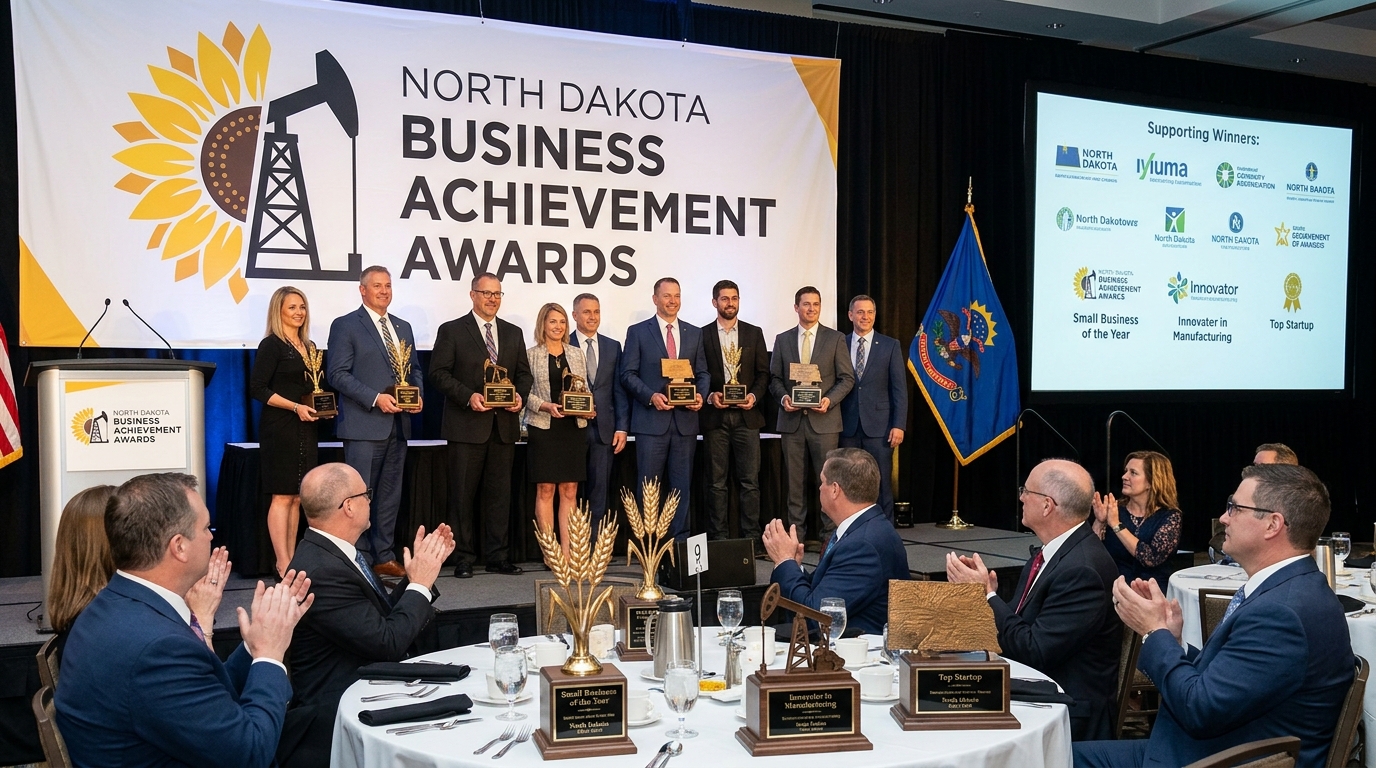
North Dakota business awards are becoming an increasingly useful part of the state’s broader business recognition landscape.
For a company in Fargo, a manufacturer in Grand Forks, an energy company in Williston, an agricultural business in Jamestown, a contractor in Bismarck, a technology startup in West Fargo, a healthcare practice in Minot, a family-owned retailer in a small rural community, or an emerging entrepreneur in one of North Dakota’s hundreds of incorporated cities, recognition can provide another way to communicate credibility, accomplishments, leadership and community impact.
But business awards are more than trophies.
A credible award or recognition program can create an independent signal that helps a company explain what it has accomplished to customers, employees, prospective employees, referral partners, investors, lenders and other stakeholders.
That distinction matters.
A company can say that it provides excellent service. A company can say that it is innovative. A company can say that it is a trusted local business. An external recognition program can provide an additional piece of evidence that someone outside the company evaluated some aspect of its work.
Academic research on third-party certification and recognition helps explain why these signals can matter. Research has found that external certifications and recognition can communicate information about organizational attributes, reduce uncertainty and influence perceptions of credibility. At the same time, research also shows that recognition is not automatically valuable simply because a company displays a badge or receives an award. The credibility of the organization providing the recognition, the criteria used, the timing, the industry and the way the company uses the recognition all matter.
That makes the search for North Dakota business awards more nuanced than simply finding the largest trophy program.
The better question is:
Which recognition opportunities provide a credible way for a North Dakota business to document and communicate genuine achievement?
This statewide guide explores that question.
It covers North Dakota business awards, North Dakota business recognition, North Dakota small business awards, entrepreneur recognition, startup recognition, industry awards, local business recognition and statewide programs. It also examines the research behind third-party validation, explains how companies can evaluate an award program and provides a practical framework for preparing a strong application.
For companies interested in a statewide business recognition opportunity, the International Association for Business Excellence homepage provides information about its broader recognition platform.
What Are North Dakota Business Awards?
North Dakota business awards are formal recognition programs that acknowledge businesses, entrepreneurs, executives, employees, organizations, products, services, innovations or community contributions.
They can be offered by:
- Statewide business organizations
- Chambers of commerce
- Industry associations
- Economic development organizations
- Professional associations
- Universities
- Trade organizations
- Publications
- Government agencies
- Nonprofit organizations
- Independent business-recognition organizations
- Regional organizations
- Local business groups
The programs can also have very different purposes.
One award may recognize a rapidly growing company.
Another may recognize a small-business owner.
Another may recognize innovation.
Another may recognize economic development.
Another may focus on technology.
Another may recognize tourism or hospitality.
Another may recognize agricultural entrepreneurship.
Another may recognize leadership.
Another may recognize a company’s community contribution.
This means there is no single definition of a “best” North Dakota business award.
The right award depends on what the business has actually accomplished and which audience needs to understand that accomplishment.
A Fargo software company may be better positioned for a technology or innovation award than a general small-business award.
A Williston contractor may have a stronger application for an industry or construction-related recognition opportunity.
A family-owned retailer in rural North Dakota may have a compelling story around longevity, customer service and community impact.
An agricultural technology company may be appropriate for entrepreneurship, innovation, agriculture or technology recognition.
A nonprofit organization may belong in a community-impact category rather than a traditional commercial-business category.
The objective should be alignment.
The North Dakota Business Landscape
Understanding the scale of North Dakota’s business community helps explain why statewide recognition can be valuable.
According to the U.S. Small Business Administration’s 2025 North Dakota profile, the state has 78,219 small businesses. Those businesses represent 98.8% of North Dakota businesses and employ 197,212 people, equal to 57.6% of the state’s employment.
Those numbers demonstrate that small business recognition is not a niche subject in North Dakota.
It is central to the state’s economy.
The SBA also reports that between March 2023 and March 2024:
- 3,199 North Dakota establishments opened.
- 2,787 establishments closed.
- The state experienced a net increase of 412 establishments.
- Small businesses accounted for 2,940 openings.
- Small businesses accounted for 2,522 closings.
- Opening and expanding establishments added 36,555 jobs.
- Closing and contracting establishments lost 30,530 jobs.
- Small businesses gained 29,523 jobs and lost 23,165.
- Small businesses therefore experienced a net employment gain of 6,358 jobs.
This is an important reason to think about recognition beyond established corporations.
North Dakota has a large population of businesses that are building, adapting, hiring, experimenting, expanding and competing.
Recognition programs can give those businesses another way to document their progress.
North Dakota’s Broader Business Economy
Census QuickFacts reports 25,402 employer establishments in North Dakota in 2023, along with 60,342 nonemployer establishments. The state recorded $21.9 billion in annual payroll for employer establishments in 2023.
North Dakota also has substantial economic activity in sectors including:
- Agriculture
- Energy
- Oil and gas
- Manufacturing
- Transportation
- Healthcare
- Retail
- Food service
- Professional services
- Technology
- Construction
- Real estate
- Logistics
- Tourism
- Financial services
Census data show more than $19.1 billion in retail sales in 2022, approximately $9.5 billion in healthcare and social-assistance receipts, $5.08 billion in transportation and warehousing receipts and approximately $2.24 billion in accommodation and food-services sales.
That diversity creates a broad recognition environment.
There is no reason to think of North Dakota business awards as something reserved for technology companies or large corporations.
A recognition strategy can apply to a farm-related business, a manufacturer, a trucking company, an accounting firm, a roofing contractor, a restaurant, a medical practice, a construction company, a SaaS provider or a locally owned retail store.
Why Third-Party Business Recognition Can Matter
The strongest argument for business recognition is not that an award magically creates sales.
It does not.
A credible recognition program is better understood as a signal.
A business operates with information asymmetry.
The company knows its internal capabilities.
Customers often do not.
A prospective client may not know:
- How long the company has operated
- How many customers it has served
- How it handles quality
- Whether it invests in employees
- Whether it has developed something innovative
- Whether its claims are independently supported
- Whether it has contributed to its community
- Whether its leadership has demonstrated meaningful results
This is where third-party recognition can become useful.
Research in organizational and marketing literature frequently examines these situations through signaling theory.
The basic concept is straightforward:
When one party knows more about quality than another party, an observable signal can help reduce uncertainty.
A credible award can become one such signal.
Research published in the Journal of Marketing examined third-party recognition for design excellence and concluded that such recognition can create firm value in B2B markets, while also finding that its effect depends on characteristics of the firm and the criteria used by the recognizing organization.
That is particularly relevant for North Dakota companies selling to other businesses.
A local contractor, manufacturer, technology provider, engineering firm or professional-services company may not sell directly to thousands of consumers.
Instead, it may compete for a handful of valuable contracts.
In those situations, credibility can matter considerably.
Research on Awards and Business Performance
There is also research examining the relationship between awards and actual business performance.
A study in the Journal of Operations Management reexamined quality management and business performance using data from more than 500 firms. Researchers found that firms receiving quality awards had significantly better operating performance than control groups over the period examined. Importantly, the researchers also found that award-winning firms already had stronger performance before winning, meaning the findings should not be interpreted as proof that the award itself caused the superior performance.
That distinction is critical for responsible business-award marketing.
A business should not say:
“Winning this award caused our revenue to increase.”
Unless there is actual evidence establishing that relationship, that is too strong.
A more defensible statement is:
“Our company was recognized for accomplishments in a year in which we also experienced measurable growth.”
That communicates the achievement without pretending that the trophy caused the growth.
Third-Party Validation and Consumer Trust
The evidence becomes even more interesting in digital commerce.
An empirical study published in Decision Support Systems examined 288,169 shopping transactions across 493 online retailers and found that third-party trust seals can partially substitute for shopper experience and seller sales volume. The research also found that the effectiveness of trust seals varies according to circumstances and that displaying too many seals can reduce purchase completion.
This is especially relevant for small North Dakota businesses.
A young company may not have:
- Thousands of reviews
- Twenty years of operating history
- A nationally recognized brand
- A huge advertising budget
- A massive customer base
A credible third-party recognition can potentially contribute another trust signal.
That does not make the company automatically trustworthy.
But it can give prospective customers another piece of information to evaluate.
Recognition, Credibility and Skepticism
Modern consumers are increasingly exposed to marketing claims.
Businesses regularly describe themselves as:
- Best
- Leading
- Trusted
- Award-winning
- Innovative
- Customer-focused
- Industry-leading
- High-quality
- Community-minded
The problem is that consumers cannot independently verify every claim.
Third-party verification can help because it moves at least part of the evaluation outside the company’s own marketing department.
A 2025 study published in Corporate Communications: An International Journal examined third-party certification and the credibility and authenticity of corporate social-responsibility communication. The researchers used an experiment involving 184 participants and examined whether external certification changed perceptions of communication credibility and authenticity.
The lesson for a North Dakota business is not “get any badge.”
The lesson is:
The credibility of the validator matters.
A recognition program should have identifiable criteria, a legitimate organization behind it and a process that can be explained.
Third-Party Recognition Is Not Automatically Valuable
Research also provides an important warning.
Third-party certifications can create value, but they can also lose value under certain conditions.
A study published in the Academy of Management Journal examined third-party certifications as a potential organizational performance liability. The research argued that accreditation can lose value when stakeholders interpret it as an attempt at superficial image management rather than genuine quality improvement.
That provides a useful framework for North Dakota businesses.
Recognition works best when it is connected to reality.
A company should not pursue recognition simply to cover weaknesses.
Instead, the company should use recognition to document strengths it can actually demonstrate.
For example:
Weak approach:
“We won an award, therefore we are the best contractor in North Dakota.”
Stronger approach:
“Our company was recognized for customer service and operational performance after documenting our service processes, customer outcomes and business practices.”
The second statement provides context.
Awards as Information Signals
A 2008 study in the Journal of Purchasing and Supply Management examined industrial awards and their relationship to financial performance. The researchers found that operational awards were associated with return on equity during the growth stage, while new-product awards were associated with growth.
Again, correlation is not causation.
But the research supports an important concept:
Awards can contain information about business capabilities.
An award for innovation can tell a prospective customer something about innovation.
An award for operational excellence can communicate something about operations.
An award for customer service can communicate something about customer experience.
An award for entrepreneurship can communicate something about leadership and growth.
The category matters.
The North Dakota Small Business Opportunity
Because nearly 99% of North Dakota businesses are classified as small businesses in the SBA’s 2025 profile, the state’s business-recognition ecosystem cannot reasonably focus only on large corporations.
Small businesses can include:
- One-person companies
- Family businesses
- Independent contractors
- Professional practices
- Restaurants
- Retailers
- Construction firms
- Roofing companies
- HVAC businesses
- Landscaping companies
- Agricultural businesses
- Manufacturers
- Technology firms
- SaaS businesses
- Marketing agencies
- Consulting companies
- Accounting firms
- CPA practices
- Law firms
- Healthcare practices
- Transportation companies
- Logistics businesses
- Real estate companies
- E-commerce companies
For a small company, recognition can also help organize its own story.
A strong award application forces management to answer questions such as:
- What did we accomplish?
- What changed?
- What problem did we solve?
- Who benefited?
- What measurable results did we create?
- What makes the company different?
- How did we improve?
- How did we contribute to our community?
Those are useful questions even if the company ultimately does not win.
North Dakota Startup Awards and Entrepreneur Recognition
North Dakota has a significant environment for entrepreneurs working in areas connected to agriculture, technology, energy, healthcare, manufacturing and other industries.
The state’s Department of Commerce operates programs designed to support innovation and entrepreneurship.
For example, the department’s LIFT program supports North Dakota companies commercializing intellectual property and has supported businesses in areas including advanced computing, agriculture technology, autonomous and unmanned technologies, energy, healthcare and value-added industries. In March 2026, the state announced a recommended $100,000 LIFT award for Tactical Brands, a LaMoure-based company commercializing an innovative product for the apiary industry. The department reported that LIFT had recommended $47.5 million to North Dakota companies since inception.
A LIFT award is different from an honorary business award.
It is a financing mechanism.
That distinction matters.
North Dakota entrepreneurs should distinguish between:
Recognition awards
and
Funding awards.
Both can be valuable, but they serve different purposes.
North Dakota Business Awards for Technology Companies
North Dakota’s technology ecosystem creates opportunities for companies involved in:
- Software
- SaaS
- Artificial intelligence
- Agricultural technology
- Data
- Cybersecurity
- Automation
- Robotics
- Engineering technology
- Health technology
- Financial technology
- Autonomous systems
- Advanced manufacturing
Technology companies should monitor organizations such as technology associations, universities, economic-development organizations and industry groups.
Historical examples demonstrate that North Dakota’s technology community has used formal recognition to highlight companies making significant contributions.
Technology Council of North Dakota materials, for example, have documented awards recognizing businesses and individuals making an impact on the state’s technology landscape, including a Premier Technology Business Award recognizing an ag-software company.
For technology companies, a strong application should not merely describe the product.
It should explain:
- The problem
- The technology
- The innovation
- The market
- The customer
- The measurable result
- The company’s North Dakota impact
North Dakota Agriculture and Ag-Tech Recognition
Agriculture remains one of North Dakota’s defining economic industries.
That makes agricultural innovation a natural area for business recognition.
Potential recognition candidates include:
- Farmers
- Agricultural producers
- Agribusinesses
- Grain businesses
- Equipment companies
- Agricultural manufacturers
- Food processors
- Agricultural technology companies
- Precision agriculture companies
- Ag software companies
- Agricultural logistics companies
- Agricultural consultants
- Value-added agriculture businesses
The North Dakota Department of Agriculture’s Agriculture Diversification and Development Fund provides another example of how the state recognizes and supports business investment. In June 2026, the department announced $1.33 million in awards for eight projects designed to support value-added agriculture, job creation and economic development.
Again, these are economic-development awards rather than traditional honorary awards.
For a business seeking recognition, that distinction should be made clear.
Energy, Oil and Gas and Industrial Businesses
North Dakota’s energy economy creates another important business-award audience.
Businesses may operate in:
- Oil and gas
- Energy services
- Equipment
- Engineering
- Environmental services
- Pipeline services
- Industrial construction
- Safety
- Manufacturing
- Transportation
- Workforce services
- Technology
- Renewable energy
- Energy efficiency
For these companies, measurable evidence can be especially powerful.
Examples include:
- Safety improvements
- Downtime reduction
- Efficiency improvements
- New equipment
- Production improvements
- Cost savings
- Workforce growth
- Training
- Environmental improvements
- New technology
- Customer retention
- Expansion into new markets
A strong application does not need to make the company sound glamorous.
It needs to make the company’s accomplishments understandable.
Manufacturing and Industrial Business Awards
North Dakota manufacturers can be strong candidates for recognition because manufacturing success often produces measurable outcomes.
A manufacturer might document:
- New product development
- Automation
- Productivity improvements
- Workforce development
- Quality improvements
- New markets
- Export growth
- Customer retention
- Energy efficiency
- Safety
- Investment in equipment
- Local hiring
- Supply-chain improvements
The most compelling applications usually combine numbers with narrative.
For example:
“Over the past year, the company invested in new automated equipment, reduced production bottlenecks and added employees.”
is more informative than:
“We are an innovative manufacturer.”
The numbers give the claim substance.
Construction, Roofing and Contracting Awards
North Dakota’s construction sector includes contractors working across residential, commercial, industrial and infrastructure markets.
Recognition can be relevant for:
- General contractors
- Roofing contractors
- Electrical contractors
- Plumbing contractors
- HVAC contractors
- Excavation companies
- Concrete companies
- Commercial builders
- Residential builders
- Specialty contractors
- Engineering firms
- Architecture firms
- Construction suppliers
A contractor’s application can focus on:
- Project complexity
- Safety
- Customer satisfaction
- Scheduling
- Cost management
- Workforce development
- Community projects
- Innovation
- Quality
- Longevity
- Local economic impact
For a roofing company, for example, the strongest story may not be “we install roofs.”
It may be:
“The company developed a process that improved project communication, reduced callbacks and expanded its workforce while maintaining customer satisfaction.”
That is a recognition story.
Professional Services Recognition
North Dakota’s professional-services businesses should not overlook business awards.
Potential candidates include:
- Attorneys
- CPAs
- Accounting firms
- Financial advisors
- Insurance companies
- Consultants
- Marketing agencies
- Advertising agencies
- Human-resource companies
- Recruiting firms
- IT providers
- Engineering companies
- Architects
- Business coaches
- Management consultants
Professional services are often difficult for customers to evaluate before purchasing.
That makes reputation particularly important.
A credible external recognition can become another information signal alongside:
- Reviews
- Referrals
- Certifications
- Experience
- Case studies
- Credentials
- Industry memberships
- Awards
No single signal should carry the entire burden.
The strongest reputation strategy combines several forms of evidence.
Healthcare Business Recognition in North Dakota
Healthcare organizations and healthcare-related businesses may also have opportunities for recognition.
Potential categories include:
- Healthcare innovation
- Patient experience
- Community health
- Medical technology
- Healthcare leadership
- Employee development
- Operational improvement
- Rural healthcare
- Senior care
- Behavioral health
- Dental practices
- Veterinary businesses
- Medical-device companies
A healthcare award application should be especially careful about claims.
Patient outcomes and clinical results should be supported by appropriate evidence.
Businesses should avoid presenting marketing language as clinical proof.
Restaurants, Hospitality and Tourism
North Dakota also has recognition opportunities connected to hospitality and tourism.
The North Dakota Department of Commerce presents the Governor’s Travel and Tourism Awards annually to recognize individuals, organizations and communities contributing to the state’s travel and tourism economy. The 2026 awards recognized seven recipients across tourism-related categories.
The state’s Travel Industry Conference describes the awards as part of a longstanding recognition program dating back to 1996.
This creates potential recognition relevance for:
- Hotels
- Attractions
- Restaurants
- Tourism operators
- Visitor experiences
- Destination organizations
- Events
- Hospitality employees
- Tourism marketers
For restaurants, recognition can be particularly useful when it is connected to a clear customer experience or community story.
Native-Owned Businesses and Recognition
North Dakota’s business-recognition landscape also includes programs supporting Native American entrepreneurs.
In June 2026, the North Dakota Department of Commerce announced $600,000 in awards through the Native American Small Business Support Program. The program provides flexible financial assistance to Native American-owned businesses for purposes including working capital, equipment, technology, expansion, workforce development and marketing.
This is another example of why businesses should distinguish recognition from financial assistance.
A grant or funding award can demonstrate that a business was selected for support under a public program.
A traditional business award usually has a different purpose.
Both may be worth communicating, but they should never be described inaccurately.
Rural North Dakota Business Recognition
Rural business recognition is particularly important in North Dakota.
The state has hundreds of incorporated cities, many of them very small.
North Dakota’s government identifies 53 counties, 1,314 township governments and 357 city governments.
The North Dakota League of Cities identifies 355 incorporated cities in its current city facts material. It reports that 77% of North Dakota residents lived in cities based on the 2020 Census and that a substantial portion of the state’s cities have very small populations.
That means “local business” can mean something very different in North Dakota than it does in a major metropolitan state.
In a small community, a business may be:
- An employer
- A community gathering point
- A sponsor
- A local supplier
- A family legacy
- A tax base
- A volunteer organization
- A service provider
Recognition of that contribution can have meaning beyond traditional marketing.
North Dakota’s 53 Counties and Business Recognition
North Dakota has 53 counties.
The counties are:
- Adams County
- Barnes County
- Benson County
- Billings County
- Bottineau County
- Bowman County
- Burke County
- Burleigh County
- Cass County
- Cavalier County
- Dickey County
- Divide County
- Dunn County
- Eddy County
- Emmons County
- Foster County
- Golden Valley County
- Grand Forks County
- Grant County
- Griggs County
- Hettinger County
- Kidder County
- LaMoure County
- Logan County
- McHenry County
- McIntosh County
- McKenzie County
- McLean County
- Mercer County
- Morton County
- Mountrail County
- Nelson County
- Oliver County
- Pembina County
- Pierce County
- Ramsey County
- Ransom County
- Renville County
- Richland County
- Rolette County
- Sargent County
- Sheridan County
- Sioux County
- Slope County
- Stark County
- Steele County
- Stutsman County
- Towner County
- Traill County
- Walsh County
- Ward County
- Wells County
- Williams County
The official North Dakota Century Code lists the state’s counties and their statutory names, while Census geographic data provides current county boundaries and identifiers.
For SEO purposes, businesses should understand that county-level recognition can be relevant even when a business is not located in one of the state’s largest cities.
North Dakota’s Major Business Centers
North Dakota’s largest business centers include:
Fargo
Fargo is North Dakota’s largest city and a major center for technology, healthcare, manufacturing, financial services, retail, professional services, education and entrepreneurship.
Companies in Fargo may consider:
- Technology awards
- Entrepreneur awards
- Small-business awards
- Manufacturing awards
- Professional-services recognition
- Healthcare recognition
- Local chamber recognition
- Community-impact awards
Bismarck
Bismarck serves as the state capital and a major center for government, healthcare, professional services, construction, energy and business services.
Grand Forks
Grand Forks has major connections to education, aerospace, technology, agriculture, manufacturing, healthcare and transportation.
Minot
Minot serves as a regional center for energy, agriculture, healthcare, retail, professional services and defense-related economic activity.
West Fargo
West Fargo is a rapidly developed business community within the Fargo-Moorhead area, with opportunities spanning construction, manufacturing, professional services, retail, healthcare and entrepreneurship.
Williston
Williston is strongly associated with energy, oil and gas, construction, transportation, industrial services and entrepreneurship.
Dickinson
Dickinson serves southwestern North Dakota and has business activity connected to energy, agriculture, construction, healthcare, retail and professional services.
Mandan
Mandan’s business environment includes construction, healthcare, retail, professional services, manufacturing and its connection to the Bismarck-Mandan regional economy.
Jamestown
Jamestown serves central North Dakota and has businesses across agriculture, manufacturing, healthcare, tourism, retail and professional services.
Wahpeton
Wahpeton serves southeastern North Dakota and has business activity tied to manufacturing, agriculture, education, healthcare and regional services.
North Dakota’s Smaller Cities Matter Too
The state’s recognition ecosystem should not stop at the largest ten cities.
North Dakota’s official city resources include communities such as:
Abercrombie, Adams, Alamo, Alexander, Alice, Almont, Alsen, Ambrose, Amenia, Amidon, Anamoose, Aneta, Antler, Ardoch, Argusville, Arnegard, Arthur, Ashley, Ayr, Balfour, Balta, Barney, Bathgate, Beach, Belfield, Benedict, Bergen, Berlin, Berthold, Beulah, Binford, Bisbee, Bismarck, Bottineau, Bowbells, Bowdon, Bowman, Braddock, Briarwood, Brinsmade, Brocket, Buffalo, Burlington, Buxton, Cando, Carrington, Carson, Casselton, Cavalier, Center, Cooperstown, Crosby, Devils Lake, Dickinson, Drayton, Edgeley, Edinburg, Ellendale, Enderlin, Epping, Fargo, Fessenden, Finley, Flaxton, Fordville, Forman, Fort Ransom, Gackle, Garrison, Gilby, Glen Ullin, Glenburn, Golva, Grafton, Grand Forks, Granville, Gwinner, Hampden, Hankinson, Hannaford, Harvey, Harwood, Hatton, Hazen, Hebron, Hettinger, Hillsboro, Hope, Jamestown, Kenmare, Killdeer, Kramer, LaMoure, Lakota, Langdon, Larimore, Leeds, Leonard, Lidgerwood, Lignite, Lincoln, Linton, Lisbon, Maddock, Mandan, Mapleton, Marmarth, Max, Mayville, McClusky, McVille, Medora, Michigan, Milnor, Minnewaukan, Minot, Minto, Mohall, Mott, Napoleon, New England, New Leipzig, New Rockford, New Salem, New Town, Northwood, Oakes, Page, Park River, Parshall, Pekin, Pembina, Pick City, Portal, Portland, Powers Lake, Ray, Regent, Reile’s Acres, Richardton, Riverdale, Rolla, Rutland, Sentinel Butte, Sherwood, Souris, St. John, Stanley, Stanton, Steele, Strasburg, Surrey, Thompson, Tioga, Tolna, Tower City, Turtle Lake, Valley City, Velva, Venturia, Verona, Voltaire, Wahpeton, Walhalla, Washburn, Watford City, West Fargo, Westhope, White Earth, Wildrose, Williston, Willow City, Wilton, Wimbledon, Wing, Wishek, Wolford, Woodworth, Wyndmere, York, Zap and Zeeland.
The state maintains an official city website directory, while the North Dakota League of Cities provides statewide municipal information.
North Dakota’s official geographic resources should be used when distinguishing incorporated cities from census-designated places and other communities. Census geographic guidance identifies incorporated places separately from CDPs.
This distinction matters for SEO and accuracy.
A business located in an unincorporated community should not be falsely described as being located in an incorporated city simply to target a city keyword.
Western North Dakota Business Awards
Western North Dakota includes areas strongly connected to energy, agriculture, tourism, construction, manufacturing and transportation.
Important business centers include:
- Dickinson
- Williston
- Watford City
- Beach
- Bowman
- Belfield
- Killdeer
- New England
- Medora
- Mott
- Regent
- Sentinel Butte
- Hettinger
- Richardton
- Beach
Businesses in western North Dakota can emphasize:
- Energy services
- Oil-field support
- Industrial services
- Agriculture
- Construction
- Transportation
- Tourism
- Hospitality
- Manufacturing
- Rural entrepreneurship
Eastern North Dakota Business Awards
Eastern North Dakota includes Fargo, West Fargo, Grand Forks, Wahpeton, Valley City, Devils Lake, Grafton and numerous smaller communities.
Business opportunities include:
- Technology
- Manufacturing
- Agriculture
- Healthcare
- Education
- Retail
- Financial services
- Professional services
- Logistics
- Transportation
- Entrepreneurship
Fargo in particular provides a significant environment for technology, entrepreneurship and business services.
Central North Dakota Business Awards
Central North Dakota includes Bismarck, Mandan, Jamestown and surrounding communities.
Businesses can compete for recognition based on:
- Government contracting
- Professional services
- Healthcare
- Construction
- Energy
- Agriculture
- Manufacturing
- Retail
- Leadership
- Entrepreneurship
- Community involvement
Northern North Dakota Business Awards
Northern communities include Minot, Williston’s broader regional market, Devils Lake, Rugby, Bottineau, Stanley, Tioga and many smaller communities.
Recognition may be particularly relevant for:
- Energy
- Agriculture
- Defense-related businesses
- Transportation
- Manufacturing
- Healthcare
- Construction
- Technology
- Retail
How to Choose a North Dakota Business Award
Not every award is worth pursuing.
A business should evaluate a program before submitting an application.
Consider:
1. Who operates the program?
Is the organization identifiable?
Does it have an established history?
Does it publish information about its mission?
2. What are the judging criteria?
Strong programs should provide understandable criteria.
3. Who judges applications?
The business should be able to understand the general nature of the evaluation.
4. Is the award competitive?
An award becomes more informative when there is a meaningful selection process.
5. Is the category appropriate?
A roofing company should not force itself into an unrelated technology category simply because that category sounds prestigious.
6. Does the recognition matter to the audience?
A local award may be extremely valuable to a local business.
A national award may be more useful to a company selling nationwide.
7. What does it cost?
Review:
- Entry fees
- Winner fees
- Event costs
- Travel
- Sponsorship requirements
- Optional promotional packages
8. What happens after winning?
Can the business:
- Use the recognition in marketing?
- Receive a certificate?
- Receive a trophy?
- Receive digital assets?
- Participate in publicity?
- Share the recognition publicly?
9. Is the program transparent?
This is especially important given the academic research showing that the credibility of third-party validation affects its value.
How to Prepare a Strong North Dakota Business Award Application
The strongest applications generally answer five questions:
What did the company face?
What did it do?
How did it do it?
What changed?
Why does it matter?
One effective structure is:
Challenge → Action → Result
Challenge
Explain the business problem.
Action
Explain what the company actually did.
Result
Explain what happened.
For example:
A manufacturer faced a production bottleneck.
The company invested in automation and redesigned its workflow.
Production capacity increased, employee responsibilities changed and delivery times improved.
That is much stronger than saying:
“We are an innovative manufacturing company.”
Use Numbers Whenever Possible
Numbers make applications easier to evaluate.
Useful evidence includes:
- Revenue growth
- Customer growth
- Customer retention
- Employee growth
- Jobs created
- Cost savings
- Productivity
- Production volume
- Projects completed
- Customer satisfaction
- Repeat business
- New markets
- Geographic expansion
- Product launches
- Patents
- Certifications
- Community contributions
- Volunteer hours
- Training hours
- Safety improvements
Not every business needs to reveal revenue.
Other measurements can be equally useful.
A nonprofit might report people served.
A restaurant might report repeat customers.
A contractor might report completed projects and safety performance.
A technology company might report adoption.
A manufacturer might report production improvements.
A professional-services firm might report client retention.
Tell the Human Story
Data matters, but awards are often evaluated by people.
A compelling application should explain why the accomplishment mattered.
Consider:
- Who benefited?
- Why was the problem difficult?
- What did employees contribute?
- How did leadership respond?
- What did the company learn?
- What happened afterward?
The goal is not to write corporate poetry.
The goal is to make the accomplishment understandable.
How North Dakota Companies Can Use Recognition After Winning
Winning is not the end.
The recognition can become part of a broader marketing system.
A company may use legitimate recognition in:
- Website content
- About pages
- Email signatures
- Social media
- News releases
- Customer proposals
- Sales presentations
- Recruiting
- Employer branding
- Presentations
- Company profiles
- Local media outreach
However, the company should accurately state:
- The name of the award
- The organization providing it
- The year
- The category
- What was actually recognized
Avoid turning a specific award into a broad unsupported claim.
If a company won an award for customer service, it should not automatically claim that the award proves it is the best business in North Dakota.
The Difference Between “Award-Winning” and “Best”
This distinction is important for SEO and marketing.
“2026 North Dakota Business Award Winner”
is a factual recognition statement if the company actually received that award.
“North Dakota’s Best Business”
is a much broader claim.
The second statement requires evidence supporting the ranking methodology.
Businesses should therefore prefer precise recognition language.
Other North Dakota Business Awards and Recognition Programs
North Dakota companies should look beyond one organization.
The statewide landscape includes government programs, industry organizations, tourism recognition, economic-development programs, technology organizations and local groups.
Governor’s Travel and Tourism Awards
The North Dakota Department of Commerce administers the Governor’s Travel and Tourism Awards, recognizing individuals, organizations and communities contributing to North Dakota’s tourism economy. The 2026 program recognized seven recipients.
Businesses in hospitality, attractions, tourism, events and destination marketing should monitor this program.
Technology Recognition
Technology Council of North Dakota materials document recognition for companies and individuals contributing to the state’s technology sector, including technology business awards.
Technology companies should monitor the organization’s current programming and successor organizations or industry groups as applicable.
North Dakota Department of Commerce Programs
The Department of Commerce operates numerous programs supporting entrepreneurs, innovation, workforce development, rural development and business expansion.
The state’s grant-program resources include programs supporting entrepreneurship and economic development.
These are not all traditional business awards.
Businesses should carefully distinguish:
Recognition
from
Financial assistance.
Native American Small Business Support Program
The Native American Small Business Support Program provides financial assistance to qualifying Native American-owned businesses. In 2026, Commerce announced $600,000 in awards supporting 15 businesses.
Agriculture Diversification and Development Fund
The North Dakota Department of Agriculture provides awards through the ADD Fund for qualifying value-added agriculture projects. In 2026, eight projects received a combined $1.33 million.
LIFT
The Legacy Investment for Technology program supports commercialization and technology advancement. It is another example of an award/financing mechanism rather than a traditional honorary business award.
Rural Catalyst Grants
The North Dakota Department of Commerce announced $2.5 million in Rural Catalyst Grant awards to nine communities in 2026. These awards support community-led projects and economic resilience rather than serving as conventional business trophies.
Local Chambers
North Dakota businesses should also monitor their local chambers of commerce.
Depending on the community and year, chambers may recognize:
- Businesses of the year
- Entrepreneurs
- Community leaders
- New businesses
- Employers
- Young professionals
- Community contributions
- Economic-development achievements
Because local programs can change from year to year, businesses should verify current eligibility and nomination periods directly with their local chamber.
International Association for Business Excellence and North Dakota Businesses
The International Association for Business Excellence provides another avenue for companies seeking external business recognition.
The organization evaluates businesses through its own recognition framework rather than serving as a North Dakota government agency or chamber.
North Dakota companies interested in exploring the program can:
learn about the International Association for Business Excellence
Businesses interested in beginning an application can:
apply for North Dakota business recognition
The important consideration is fit.
A company should evaluate recognition based on:
- Its accomplishments
- Its goals
- The audience it wants to reach
- The credibility of the recognizing organization
- The evaluation process
- The cost
- The marketing value
- The category
Why Independent Recognition Is Different From Self-Promotion
A company website saying:
“We are excellent.”
is self-promotion.
A third party saying:
“We evaluated this company under our published criteria and selected it for recognition.”
is a different type of communication.
That distinction is precisely why researchers study certification and recognition through signaling theory.
The external source creates an additional layer of information between the company and the audience.
Research on third-party certification has found that such signals can affect perceived credibility and reduce uncertainty, but the effect is conditional and dependent on the credibility of the certification itself.
For North Dakota companies, the practical takeaway is simple:
Do not collect badges. Build evidence.
Then use credible recognition to help communicate that evidence.
Recognition and Search Engine Optimization
Business awards can also create useful content opportunities.
A legitimate award can support:
- Winner announcements
- Company news
- About-page updates
- Press releases
- Social media
- Local search content
- Employee recruiting
- Case studies
- Company biographies
A business can create a page such as:
“[Company Name] Receives 2026 North Dakota Business Award Recognition”
The page can explain:
- What the company does
- Where it operates
- What the award recognized
- What the company accomplished
- Who founded it
- How long it has operated
- What customers it serves
- What happens next
That creates useful original content.
But companies should avoid keyword stuffing.
The goal is not to repeat “North Dakota business awards” 50 times.
The goal is to produce useful information about a real recognition event.
North Dakota Business Awards and Reputation
Awards are only one component of reputation.
A strong company reputation can include:
- Customer reviews
- Testimonials
- Certifications
- Awards
- Industry memberships
- Years in business
- Case studies
- Media coverage
- Community involvement
- Professional credentials
- Transparent business information
Third-party recognition works best when it complements those other signals.
Research on eco-labels, for example, has found that consumer trust in certification affects whether consumers actually use the label as information.
That reinforces the broader point:
The trustworthiness of the validator matters.
Don’t Overload Your Website With Awards
More recognition is not always better.
The Decision Support Systems research on third-party trust seals found that too many seals could reduce purchase completion in the studied context.
For businesses, that means the goal should be selective credibility.
Instead of displaying 25 unrelated badges, consider highlighting the few recognitions most relevant to customers.
For example:
2026 Business Recognition
2025 Industry Award
Professional Certification
Local Chamber Recognition
That is easier for visitors to understand.
A Practical North Dakota Award Strategy
A North Dakota business can develop an annual recognition strategy.
Step One: Build an Achievement Inventory
List everything accomplished during the previous year.
Step Two: Identify Categories
Separate achievements into:
- Growth
- Innovation
- Leadership
- Customer service
- Community impact
- Employee development
- Industry performance
- Product development
- Operational excellence
Step Three: Research Recognition Programs
Look for:
- Statewide awards
- Local awards
- Chamber programs
- Industry awards
- Technology recognition
- Entrepreneurship programs
- Government recognition
- Professional awards
Step Four: Check Eligibility
Make sure the business qualifies.
Step Five: Build the Application
Use Challenge → Action → Result.
Step Six: Collect Documentation
Keep:
- Metrics
- Testimonials
- Photos
- Press coverage
- Certifications
- Customer data
- Employee data
- Project results
Step Seven: Submit Selectively
Do not apply to every program.
Apply where the company’s accomplishments genuinely fit.
North Dakota Business Awards for Family-Owned Businesses
Family-owned companies should consider recognition based on:
- Longevity
- Succession
- Community contribution
- Employee retention
- Customer loyalty
- Growth
- Innovation
- Multi-generational leadership
A family business may have an advantage because its story often combines business performance with a longer community history.
But the application should still provide evidence.
“Third-generation company” is interesting.
“Third-generation company that has expanded from five employees to 42 while maintaining operations in the same North Dakota community” is much stronger.
Women-Owned and Veteran-Owned Businesses
Women-owned and veteran-owned businesses should also monitor recognition programs where eligibility permits.
Potential themes include:
- Entrepreneurship
- Leadership
- Community service
- Innovation
- Growth
- Workforce development
- Industry achievement
Businesses should verify eligibility requirements because ownership definitions can differ between programs.
Young Entrepreneurs and Emerging Companies
Emerging businesses should not assume they are too young for recognition.
Some programs specifically recognize:
- Startup founders
- Young entrepreneurs
- Emerging companies
- New products
- Innovation
- High-growth businesses
A young company should emphasize what it has accomplished relative to its stage.
A startup does not need the revenue of a 30-year-old corporation.
It needs a compelling record of progress.
Nonprofit and Mission-Driven Organizations
Business recognition can also apply to nonprofit organizations and social enterprises where award rules allow.
Potential themes include:
- Community impact
- Innovation
- Leadership
- Volunteerism
- Program effectiveness
- Economic development
- Workforce development
The application should explain outcomes rather than simply activities.
“Provided 5,000 meals” is measurable.
“Helped the community” is vague.
The Role of Local Business Awards
A local award may not have national recognition.
That does not make it worthless.
For a local contractor, restaurant, retailer or professional-service provider, a community-level recognition may be highly relevant to the people who actually buy its services.
A Fargo restaurant may care more about Fargo customers than national brand recognition.
A rural contractor may care more about local homeowners.
A regional accounting firm may care about businesses within its service area.
Recognition should therefore be evaluated against the company’s actual market.
North Dakota Business Awards as a Recruiting Tool
Recognition can also support employer branding.
A company that has received credible recognition can potentially use it in:
- Job postings
- Recruiting presentations
- Careers pages
- Employee communications
- University recruiting
- Apprenticeship outreach
But the same principle applies:
The award should support the company’s employment story rather than replace it.
Employees still care about:
- Pay
- Benefits
- Management
- Culture
- Advancement
- Stability
- Work-life balance
- Training
An award is one piece of that picture.
Recognition and Business Development
For B2B companies, recognition may be especially useful in proposals.
Imagine a North Dakota engineering company competing for a major contract.
Its proposal might include:
- Years in business
- Relevant projects
- Certifications
- Safety record
- Customer references
- Industry awards
- Technical credentials
The award does not win the contract by itself.
But it can contribute to the overall credibility package.
This is consistent with research showing that third-party recognition can function as a signal in B2B markets.
How to Write a North Dakota Business Award Winner Announcement
A strong winner announcement should identify:
- Company name
- City
- State
- Award name
- Year
- Category
- What the company does
- Why it was recognized
- Leadership
- Supporting accomplishments
For example:
[Company Name] Receives 2026 North Dakota Business Recognition
Then explain the recognition.
Avoid unsupported claims such as:
- Best in North Dakota
- Number one company
- State’s leading business
- Most trusted
- Guaranteed quality
unless the recognition program specifically establishes those claims.
How to Make a North Dakota Award Application More Credible
Use evidence.
Instead of:
“We care about customers.”
Use:
“Customer retention increased from X to Y during the period.”
Instead of:
“We support our employees.”
Use:
“The company invested X hours in training and added X new employees.”
Instead of:
“We are innovative.”
Use:
“The company launched X product, implemented X technology and reduced processing time by X%.”
Evidence transforms marketing language into an application.
North Dakota Business Recognition in 2026
The 2026 environment demonstrates that North Dakota continues to use recognition and award mechanisms across several sectors.
Examples include:
- Governor’s Travel and Tourism Awards
- Native American Small Business Support awards
- Agriculture Diversification and Development awards
- LIFT awards
- Rural Catalyst Grants
- Technology recognition
- Local business and chamber recognition
Some are traditional recognition programs.
Others are funding awards.
Businesses should never conflate them.
The distinction actually makes an article like this more useful because it tells business owners where to look and what each type of opportunity is designed to accomplish.
Apply for North Dakota Business Recognition
A North Dakota business does not have to be headquartered in Fargo or Bismarck to pursue recognition.
Companies across the state can build recognition around measurable accomplishment.
That includes businesses in:
- Adams County
- Barnes County
- Benson County
- Billings County
- Bottineau County
- Bowman County
- Burke County
- Burleigh County
- Cass County
- Cavalier County
- Dickey County
- Divide County
- Dunn County
- Eddy County
- Emmons County
- Foster County
- Golden Valley County
- Grand Forks County
- Grant County
- Griggs County
- Hettinger County
- Kidder County
- LaMoure County
- Logan County
- McHenry County
- McIntosh County
- McKenzie County
- McLean County
- Mercer County
- Morton County
- Mountrail County
- Nelson County
- Oliver County
- Pembina County
- Pierce County
- Ramsey County
- Ransom County
- Renville County
- Richland County
- Rolette County
- Sargent County
- Sheridan County
- Sioux County
- Slope County
- Stark County
- Steele County
- Stutsman County
- Towner County
- Traill County
- Walsh County
- Ward County
- Wells County
- Williams County
Businesses interested in beginning the International Association for Business Excellence process can start a business award application.
Companies with questions can contact the International Association for Business Excellence.
Frequently Asked Questions About North Dakota Business Awards
1. What are North Dakota business awards?
North Dakota business awards are recognition programs that honor companies, entrepreneurs, leaders, employees, organizations, products or services for documented achievements.
2. Who can receive a North Dakota business award?
Eligibility depends on the program, but potential recipients can include corporations, small businesses, startups, entrepreneurs, family-owned companies, nonprofits and professional organizations.
3. Are North Dakota business awards only for large companies?
No. The SBA reports that 98.8% of North Dakota businesses are small businesses, making small-company recognition an important part of the state’s business landscape.
4. Are there North Dakota small business awards?
Yes. Small businesses can find opportunities through state agencies, chambers, industry groups, economic-development organizations and independent recognition programs.
5. Can a startup apply for a business award?
Yes. Some programs specifically recognize startups, entrepreneurs, emerging companies and innovation.
6. Can a family-owned business receive recognition?
Yes. Family-owned companies may qualify for recognition based on longevity, growth, leadership, community impact, innovation or industry achievement.
7. Can a rural North Dakota business win recognition?
Yes. Rural companies can be strong candidates for recognition because many programs evaluate accomplishment rather than population size.
8. Can a contractor apply for a business award?
Yes. Construction, roofing, electrical, plumbing, HVAC, engineering and other contractors may qualify for appropriate business or industry awards.
9. Can a North Dakota restaurant receive business recognition?
Yes. Restaurants can pursue hospitality, tourism, customer-service, entrepreneurship and local-business recognition where eligible.
10. Are business awards the same as grants?
No. A grant provides financial assistance for an eligible purpose. A recognition award generally honors an achievement. Some North Dakota programs use the word “award” while functioning primarily as financial assistance programs.
11. Does winning an award guarantee more customers?
No. An award can provide a credibility or marketing signal, but it does not guarantee customers, sales or revenue.
12. Does academic research support third-party recognition?
Yes. Multiple studies have examined third-party certification, recognition, trust signals and awards and found that external signals can reduce uncertainty or influence perceptions under appropriate conditions.
13. Can awards help online businesses?
Potentially. Research involving hundreds of online retailers found that third-party trust seals can influence trust dynamics, although the effectiveness varies by context.
14. Should a company display every award it receives?
Not necessarily. Businesses should prioritize relevant and credible recognition.
15. What makes an award credible?
Credibility can depend on the organization, judging process, criteria, transparency, reputation and relevance of the award.
16. Should an award application include statistics?
Yes. Measurable results can make an application more persuasive and easier to evaluate.
17. What statistics can a business use?
Possible metrics include growth, customers, retention, jobs, productivity, efficiency, cost savings, projects, satisfaction, community impact and innovation.
18. Can a one-person company apply?
Some programs permit very small companies and entrepreneurs, but eligibility varies.
19. Can a nonprofit receive business recognition?
Some programs allow nonprofits or mission-driven organizations, particularly for community impact or leadership categories.
20. Can a veteran-owned company apply?
Yes, when the specific recognition program permits veteran-owned businesses or has a relevant category.
21. Can women-owned businesses receive recognition?
Yes. Depending on the program, women-owned businesses may qualify for entrepreneurship, leadership, industry or business awards.
22. Are technology businesses eligible?
Technology companies may qualify for innovation, technology, entrepreneurship, startup and general business awards.
23. Can an agriculture business apply?
Yes. Agricultural businesses can potentially qualify for agriculture, entrepreneurship, innovation, manufacturing, business and community awards.
24. Can an oil and gas service company apply?
Yes. Energy businesses may qualify for industry, innovation, entrepreneurship, safety, leadership and general business recognition.
25. Can manufacturers apply?
Yes. Manufacturers can highlight innovation, quality, productivity, workforce development, expansion and operational achievements.
26. Can professional-service companies receive awards?
Yes. Accounting, law, consulting, marketing, engineering, financial and other professional-service firms may qualify.
27. What is the best way to write an award application?
A useful structure is Challenge → Action → Result.
28. Should an application say a company is “the best”?
Only when the award methodology actually establishes that claim. Otherwise, use precise recognition language.
29. Should businesses pay for awards?
Businesses should evaluate the cost, credibility, judging process, marketing value and relevance before paying an entry fee.
30. Are paid award programs automatically bad?
No. A fee does not automatically determine credibility. The evaluation process and value proposition should be examined.
31. Can a business award help recruiting?
It can contribute to employer branding by giving candidates another external signal about the company.
32. Can awards help B2B companies?
Potentially. Research indicates third-party recognition can create value in B2B settings, depending on the circumstances.
33. How should a business announce an award?
Identify the company, award, year, category and accomplishment, then explain the company’s story and supporting evidence.
34. Can an award be used in a proposal?
Yes, when relevant and accurately described.
35. Should awards be listed on a company website?
Relevant awards can be listed on appropriate pages such as About, News, Careers or dedicated recognition sections.
36. How many awards should a company pursue?
There is no universal number. Select programs where the company’s accomplishments genuinely fit.
37. Can awards improve a company’s reputation?
They can contribute to reputation by providing another external information signal, but reputation depends on many factors.
38. Can awards replace customer reviews?
No. Awards and reviews provide different types of information.
39. Does an award prove that a company is high quality?
It provides evidence of recognition under a particular program and criteria. It does not establish every aspect of company quality.
40. Where can North Dakota companies start researching business recognition?
Businesses can begin with chambers, industry associations, state agencies, economic-development organizations, professional organizations and established independent recognition programs.
North Dakota Business Awards Q&A
1. What is the biggest advantage of winning a North Dakota business award?
One potential advantage is the ability to communicate an independently granted recognition as another credibility signal alongside reviews, experience, certifications and documented accomplishments.
2. Is third-party validation more credible than a company making its own claim?
Generally, an external evaluation can provide information that a company’s own marketing claim cannot. Research on certification and signaling supports the idea that external information can reduce uncertainty, although the credibility of the validator matters.
3. Can a small North Dakota business compete against a large corporation?
Depending on the award criteria, yes. A small business may have a stronger story in areas such as entrepreneurship, customer service, community impact or innovation.
4. What should a small business emphasize?
It should emphasize measurable accomplishments relative to its size and stage.
5. What makes a business-award story memorable?
A clear challenge, meaningful action and measurable result usually create a stronger story than generic promotional language.
6. Should a company include customer testimonials?
When allowed, relevant testimonials can provide supporting evidence of customer impact.
7. Should companies include financial information?
Only when appropriate and permitted. Businesses can often demonstrate impact through nonfinancial metrics as well.
8. What if a company does not have dramatic growth?
Growth is only one possible measure. Innovation, customer retention, efficiency, employee development, community impact and quality improvements can also be meaningful.
9. Can a long-established company still pursue recognition?
Absolutely. Established businesses can highlight longevity, adaptation, innovation, leadership and continued relevance.
10. Can a new company compete for recognition?
Yes, when the program allows newer companies. Startups should focus on progress and measurable accomplishment.
11. Does geography matter?
It depends on the award. Some programs are local, some statewide, some regional and some national.
12. Should businesses apply for local and statewide awards?
They can, provided each program is relevant and credible.
13. Can a North Dakota company pursue recognition outside the state?
Yes. Companies serving national or international markets may benefit from appropriate industry or national recognition.
14. Can an award improve SEO?
An authentic award can create legitimate content opportunities, including company news, recognition pages and media coverage, but an award does not automatically improve search rankings.
15. Should businesses put awards in email signatures?
A relevant, current recognition can be included when it is presented accurately and does not overwhelm the signature.
16. Can an award help with sales proposals?
Yes. Recognition can be included as one element of a broader credibility package.
17. What is the biggest mistake businesses make with awards?
One common mistake is choosing recognition based solely on the trophy or title rather than evaluating the organization’s credibility and judging process.
18. Can too many awards hurt credibility?
Potentially. A collection of poorly relevant or weakly explained badges can create less clarity than a smaller number of meaningful recognitions.
19. What is the best evidence for an award application?
The strongest evidence is generally specific, relevant and verifiable, such as measurable business results, customer outcomes, documented projects or independently supported achievements.
20. What should a North Dakota business do after receiving recognition?
Document the award accurately, communicate it through appropriate channels, thank employees and supporters, and use the recognition as one part of a broader reputation and marketing strategy.
Final Takeaway: North Dakota Business Recognition Is About Evidence
North Dakota has an unusually broad business landscape.
It includes major metropolitan centers, small cities, rural communities, agricultural businesses, energy companies, manufacturers, technology startups, professional-service firms, contractors, healthcare organizations, restaurants, retailers and family-owned companies.
With 78,219 small businesses representing 98.8% of the state’s businesses, the opportunity for small-business recognition is particularly significant.
The research surrounding third-party recognition provides a useful framework.
Recognition can act as an information signal.
It can potentially reduce uncertainty.
It can contribute to perceived credibility.
It can provide useful evidence in B2B markets.
It can support reputation.
But recognition is not magic.
An award does not guarantee sales.
It does not guarantee customers.
It does not guarantee investment.
It does not guarantee rankings.
It does not prove that one company is universally better than another.
The strongest use of business awards is more straightforward:
Do good work. Measure the results. Have credible organizations evaluate it. Then communicate the recognition accurately.
For North Dakota companies, that approach can make business awards more than a trophy.
It can make recognition part of a broader business-development, reputation and communication strategy.
Businesses interested in exploring recognition through the International Association for Business Excellence can apply for business award recognition or learn more about the organization.
Sources and Further Reading
- U.S. Small Business Administration, Office of Advocacy — 2025 North Dakota Small Business Profile. North Dakota small-business counts, employment and business dynamics. SBA North Dakota 2025 Small Business Profile
- U.S. Census Bureau — QuickFacts North Dakota. State business establishments, employment, payroll and industry-related economic statistics. U.S. Census Bureau North Dakota QuickFacts
- North Dakota State Government — Local Government. Statewide information on North Dakota’s county and city governments. North Dakota Local Government
- North Dakota Century Code — Names and Boundaries of Counties. Official listing of North Dakota’s 53 counties. North Dakota Century Code County Listing
- North Dakota League of Cities — Facts About North Dakota Cities. Current municipal facts and population information. North Dakota League of Cities City Facts
- North Dakota Department of Commerce — Governor’s Travel and Tourism Awards. State tourism recognition program and 2026 award information. Governor’s Travel and Tourism Awards
- North Dakota Department of Commerce — Native American Small Business Support Program. 2026 business-support awards and program information. Native American Small Business Support Program
- North Dakota Department of Agriculture — Agriculture Diversification and Development Fund. 2026 awards supporting value-added agriculture projects. North Dakota Agriculture Diversification and Development awards
- North Dakota Department of Commerce — LIFT Loan Program. Technology commercialization and innovation financing. North Dakota LIFT Program
- Azadegan, A. & Pai, D. — “Industrial awards as manifests of business performance: An empirical assessment,” Journal of Purchasing and Supply Management. Research examining the relationship between industrial awards and business performance. Journal article on industrial awards and business performance
- Boyd, D. E. & Kannan, P. K. — “When Does Third-Party Recognition for Design Excellence Affect Financial Performance in Business-to-Business Markets?” Journal of Marketing. Research examining the signaling and firm-value effects of third-party recognition. Journal of Marketing study on third-party recognition
- Zhang, G. P. & Xia, Y. — “Does Quality Still Pay? A Reexamination of the Relationship Between Effective Quality Management and Firm Performance.” Research using more than 500 firms to examine quality awards and operating performance. Research on quality awards and firm performance
- Desai, V. M. — “Third-Party Certifications as an Organizational Performance Liability.” Academy of Management Journal. Research examining when third-party accreditation can strengthen or weaken organizational performance perceptions. Third-party certification research
- Lamin, A. & Livanis, G. — “Do third-party certifications work in a weak institutional environment?” Journal of International Management. Research examining certification, legitimacy and organizational performance. Third-party certification and firm performance research
- “Getting the most out of third party trust seals: An empirical analysis,” Decision Support Systems. Study involving 288,169 transactions across 493 online retailers. Third-party trust seal research
- “Sustainable consumption and third-party certification labels: Consumers’ perceptions and reactions,” European Management Journal. Research examining third-party labels as information and risk-reduction signals. Third-party certification and consumer perceptions research
- Marschlich, S. & Hurtado, E. — “The effect of third-party certifications on corporate social responsibility communication authenticity and credibility.” Corporate Communications: An International Journal. 2025 experimental research involving third-party certification and perceived communication credibility. 2025 certification credibility study
- “What determines consumers’ use of eco-labels? Taking a close look at label trust.” Research examining institutional trust, certification trust and consumer use of third-party labels. Research on consumer trust in certification labels
- North Dakota Department of Commerce — Rural Catalyst Grant. 2026 rural-community awards and economic-development information. North Dakota Rural Catalyst Grants
- North Dakota Department of Commerce — Travel Industry Conference. State tourism conference and Governor’s Travel and Tourism Awards information. North Dakota Travel Industry Conference