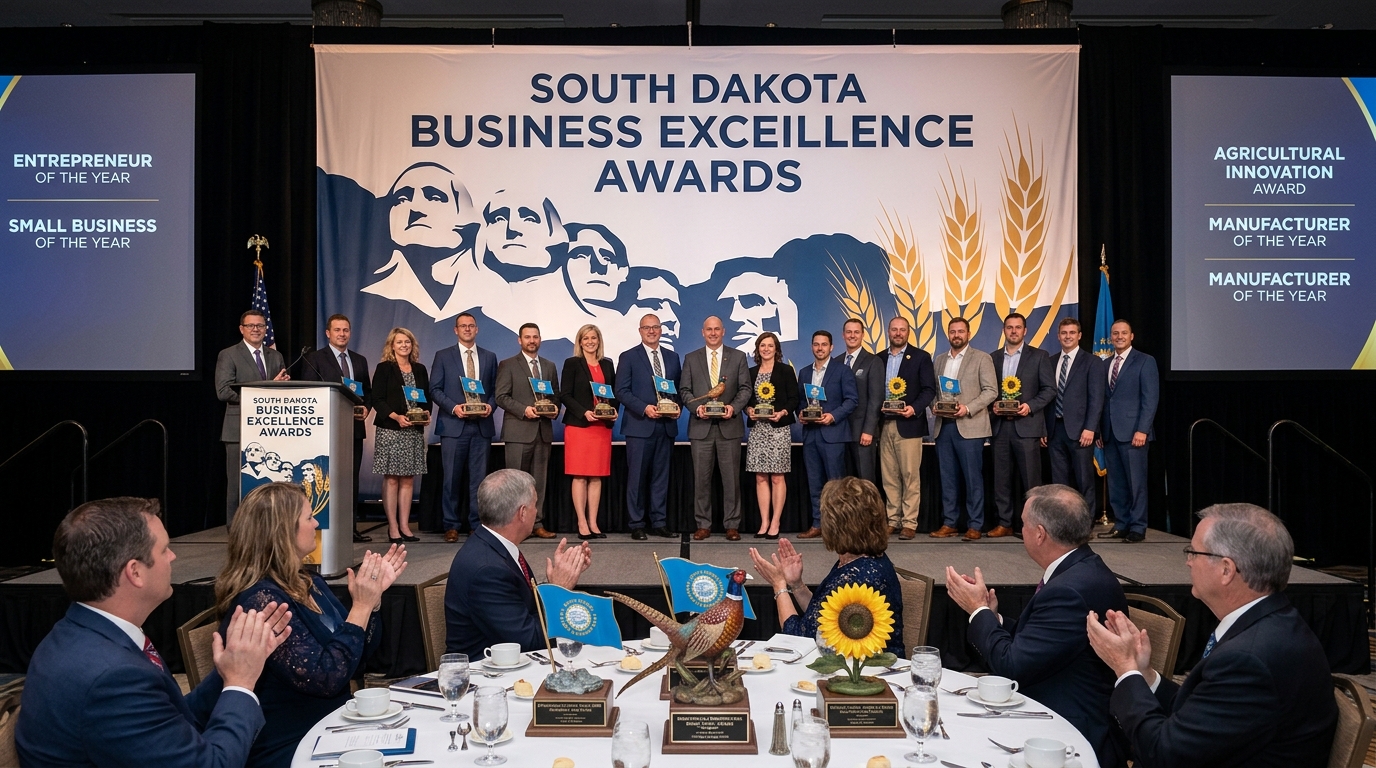
South Dakota business awards provide companies across the state with opportunities to document achievements, recognize leadership, strengthen professional credibility and communicate accomplishments to customers, employees, partners and other stakeholders.
From Sioux Falls and Rapid City to Aberdeen, Brookings, Watertown, Pierre, Mitchell, Yankton, Spearfish, Brandon and hundreds of smaller communities, South Dakota businesses operate across a remarkably diverse economy.
That includes agriculture, ranching, financial services, healthcare, manufacturing, construction, technology, software, cybersecurity, tourism, hospitality, professional services, transportation, logistics, retail, restaurants, energy, mining, real estate, law, accounting, marketing, consulting and many other fields.
For those businesses, recognition can take several forms.
A company might receive a statewide business award.
An entrepreneur might receive leadership recognition.
A manufacturer might be recognized for innovation.
An agricultural leader might receive a Governor’s award.
A tourism organization might receive state recognition.
A local company might receive recognition from a chamber of commerce.
A technology company might be recognized by an industry organization.
A business might also receive a grant or economic-development award.
These are not all the same thing.
A grant is generally intended to provide financial support for a project or business activity. A recognition award is generally intended to acknowledge an achievement, contribution or distinction.
That difference is important when evaluating the South Dakota business awards landscape.
It is also important when evaluating the potential value of third-party recognition.
Academic research provides evidence that external recognition and certification can function as signals of quality, credibility or legitimacy under certain conditions. Research also demonstrates that the value of a signal depends heavily on the credibility of the organization providing it, the criteria used, the audience receiving the signal and the context in which it is presented.
This guide examines the South Dakota business awards landscape through that broader lens.
It covers South Dakota business awards, South Dakota business recognition, South Dakota small business awards, entrepreneur awards, startup recognition, industry awards, local business awards, rural business recognition and statewide programs.
It also examines what research actually says about third-party validation and how South Dakota businesses can use recognition responsibly.
South Dakota Business Awards
South Dakota has a business community that extends far beyond its largest cities.
The U.S. Small Business Administration’s 2025 South Dakota profile provides a useful snapshot of that economy. The profile includes business ownership, employment, entrepreneurship, rural and urban businesses, industry data and business dynamics.
According to the SBA profile, women owned 42.6% of South Dakota businesses, while veterans owned 9.5%. The profile also identifies substantial numbers of rural businesses, with approximately 32,801 businesses classified in the rural category used in the profile.
That matters for business recognition.
A statewide recognition strategy cannot focus exclusively on large corporations in Sioux Falls.
It must also account for:
- Rural businesses
- Family-owned companies
- Agricultural businesses
- Independent contractors
- Small professional-service firms
- Restaurants
- Retailers
- Manufacturers
- Technology startups
- Veteran-owned businesses
- Women-owned businesses
- Native American-owned businesses
- Healthcare practices
- Construction companies
- Transportation companies
- Energy businesses
- Tourism companies
South Dakota’s business-award ecosystem is therefore best understood as a network rather than a single awards market.
What Are South Dakota Business Awards?
South Dakota business awards are programs that formally recognize business accomplishments, leadership, innovation, community impact, industry achievement, entrepreneurship, economic development or other forms of performance.
They may be organized by:
- Chambers of commerce
- Industry associations
- State agencies
- Economic-development organizations
- Universities
- Professional organizations
- Tourism organizations
- Publications
- Nonprofit organizations
- Independent business-recognition organizations
- Local organizations
- Government agencies
The award itself may recognize:
- A company
- An entrepreneur
- A CEO
- A founder
- An employee
- A product
- A project
- An organization
- A community
- An industry contribution
Some awards are competitive.
Some are nomination-based.
Some involve judging panels.
Some are based on measurable criteria.
Others focus primarily on leadership, service or community contribution.
Because the structures differ, businesses should evaluate the award program itself before assuming that all recognition has the same value.
Why Third-Party Validation Matters
One of the strongest reasons businesses pursue external recognition is simple:
A company talking about itself is different from an independent organization evaluating the company.
A business can say:
“We are innovative.”
It can say:
“We provide exceptional service.”
It can say:
“We are one of the best companies in South Dakota.”
Those are marketing claims.
An external organization can potentially provide another form of information:
“This company was evaluated according to these criteria and received recognition.”
That difference is connected to a large body of academic research involving signaling theory.
The basic idea is that markets often contain information asymmetry.
The seller knows more about its capabilities than a potential buyer does.
The buyer therefore looks for signals.
Those signals might include:
- Reviews
- Certifications
- Awards
- Professional licenses
- Industry memberships
- Years in business
- Customer testimonials
- Case studies
- References
- Published results
Third-party recognition can be one of those signals.
Research in the Journal of Marketing examined third-party recognition for design excellence and concluded that recognition can create firm value in B2B markets, while emphasizing that its effect varies according to the circumstances and the criteria used by the recognizing organization.
That is particularly relevant to South Dakota’s B2B economy.
A manufacturer selling to another manufacturer has different trust requirements than a restaurant selling dinner to a consumer.
A construction company bidding on a major commercial project has different credibility requirements than a local boutique.
A software company trying to acquire its first major enterprise client faces different uncertainty than a 50-year-old regional company.
Recognition can potentially address some of that uncertainty.
Research Does Not Say Every Award Creates Revenue
This is one of the most important points in this article.
It would be irresponsible to tell a South Dakota business:
“Win an award and your revenue will increase.”
The academic literature does not support such a blanket claim.
Research examining quality awards and firm performance has found associations between recognition and stronger operating performance, but researchers have also found that award-winning companies may already be better performers before receiving recognition.
In other words, correlation does not necessarily establish causation.
That means an award can sometimes be better understood as a signal of existing performance rather than the direct cause of that performance.
For a South Dakota company, that distinction produces much better marketing language.
Instead of:
“Our award caused our revenue to increase.”
A company could say:
“Our company received recognition during a year in which we expanded our operations, increased employment and grew our customer base.”
That statement separates the recognition from the underlying business results.
Third-Party Recognition and B2B Business
The B2B environment is especially relevant in South Dakota.
The state has businesses involved in:
- Agriculture
- Manufacturing
- Financial services
- Construction
- Engineering
- Professional services
- Technology
- Transportation
- Logistics
- Healthcare
- Energy
- Industrial services
Many of these companies sell to other businesses rather than relying exclusively on walk-in consumers.
The research by Boyd and Kannan in the Journal of Marketing specifically examined third-party recognition in B2B markets and found evidence that design recognition can create firm value, while noting that the effect depends on the situation and judging criteria.
That makes credible recognition potentially useful in:
- Sales proposals
- Vendor qualification
- Company presentations
- Procurement materials
- Website credibility sections
- Investor materials
- Recruiting
- Partnership discussions
It should still be only one part of the overall credibility package.
Third-Party Trust Signals and Online Businesses
The relevance becomes even clearer online.
A small South Dakota e-commerce company may be competing against national brands with enormous marketing budgets.
A new online retailer does not have years of customer history.
A startup may have few reviews.
A young SaaS company may not yet have hundreds of enterprise customers.
Third-party validation can potentially provide an additional information signal.
Research published in Decision Support Systems examined randomized field experiments involving 288,169 shopping transactions across 493 online retailers. The researchers found that third-party trust seals could partially substitute for shopper experience and seller sales volume, especially for smaller retailers and less-experienced shoppers. The research also found that displaying too many seals could have the opposite effect.
That last point is worth emphasizing.
More recognition is not necessarily better.
The objective should be credible recognition, not a wall of badges.
Third-Party Certification and Initial Trust
Another study published in the Journal of Interactive Marketing examined third-party privacy certification and initial trust in unfamiliar online retailers.
The researchers conducted an experiment involving 223 participants and found evidence that a well-known third-party seal could transfer trust to an unfamiliar retailer website.
This provides a useful principle for small South Dakota businesses:
When customers do not know you yet, external signals can potentially help them evaluate you.
That does not mean an award replaces reputation.
It means recognition can become one piece of the information customers use.
Trust Seals and Consumer Decision-Making
Earlier research in Decision Support Systems examined Web assurance seals and their influence on consumers’ initial trust in online vendors.
The study found that third-party assurance mechanisms can influence initial trust, while also showing that different assurance functions interact with each other.
Another study examined security and privacy assurance mechanisms in online purchasing and found that consumer concerns can mediate the relationship between assurance mechanisms and purchase intentions.
The practical lesson is broader than online security.
Consumers routinely look for evidence that reduces uncertainty.
Business recognition can potentially play that role when it is relevant and credible.
Recognition Works Best When People Understand the Validator
A badge by itself has limited explanatory value.
If a customer sees an unfamiliar symbol, the customer may not know:
- Who issued it
- What it means
- Who judged the business
- What criteria were used
- Whether the company paid for it
- Whether the company had to compete
- How selective the program is
That is why businesses should make recognition understandable.
Instead of placing a badge on a website with no explanation, consider:
2026 Business Award Recipient
Recognized by [Organization] for [specific category or achievement].
Then link to the awarding organization’s information.
Research into certification labels supports this general concept. A study published in Ecological Economics found that knowledge of third-party certification was positively associated with trust in and use of certification labels.
In other words, people need to understand what the signal means.
Third-Party Validation and Credibility
Recent research continues to examine how external verification affects perceptions of credibility.
A 2025 study concerning third-party certification and corporate social-responsibility communication found that external certification can influence perceptions of communication credibility and authenticity.
The broader lesson is useful for South Dakota businesses:
An external source can make a claim more informative, but only when the external source itself is credible.
That means companies should examine the award provider.
What Makes a South Dakota Business Award Credible?
A credible award program should ideally make its process understandable.
Businesses should ask:
Who operates the award?
Is the organization identifiable?
What does the organization do?
Does it have a legitimate mission?
What are the criteria?
Are businesses judged on identifiable factors?
Who evaluates applications?
Is there a meaningful judging or review process?
Is the award competitive?
Does the organization actually select recipients based on defined standards?
Is the category appropriate?
Does the award match the company’s accomplishments?
What does recognition mean?
Is the company being recognized for a specific accomplishment or simply purchasing a marketing package?
These questions do not automatically determine whether an award is good or bad.
They help a business understand what the recognition actually represents.
Too Many Badges Can Dilute the Message
One of the more interesting findings from online trust research is that more third-party seals do not necessarily produce more trust.
The study involving 288,169 transactions found that displaying more than two trust seals could reduce purchase completion in the studied context.
That does not mean a company should never display multiple recognitions.
It means businesses should think strategically.
A South Dakota company may be better served by highlighting:
- One strong industry award
- One meaningful local recognition
- One professional certification
rather than displaying fifteen unrelated badges.
Relevance matters.
South Dakota Small Business Awards
Small businesses make up a substantial portion of South Dakota’s business economy.
The SBA’s 2025 profile provides detailed information on business ownership and the state’s small-business environment. It shows that women-owned, veteran-owned, rural and other ownership categories represent meaningful portions of the state’s business community.
That makes small-business recognition particularly important.
A South Dakota small business might be:
- A family restaurant
- A roofing company
- A construction contractor
- A local manufacturer
- An accounting firm
- A CPA
- A law firm
- A marketing agency
- A farm business
- A ranching operation
- A trucking company
- A technology company
- A software startup
- A retail store
- An e-commerce business
- A healthcare practice
- A real estate company
- A consulting firm
These companies should not assume that awards are designed only for large employers.
Many recognition opportunities focus on entrepreneurial achievement, community impact, innovation, leadership or industry contribution.
South Dakota Rural Business Recognition
Rural business recognition deserves special attention.
South Dakota has 66 counties, and state labor-market data show that only 24 counties experienced population growth between 2000 and 2024. The same state analysis reports that 59 counties are outside metropolitan statistical areas.
That creates a distinctive rural business environment.
A company operating in a small community may have a very different definition of success from a company in Sioux Falls.
A rural business may be:
- A major local employer
- A supplier
- A community sponsor
- A family legacy
- A service provider
- A tax-base contributor
- A source of specialized expertise
An award recognizing those contributions can have value beyond traditional marketing.
South Dakota Agriculture and Business Recognition
Agriculture is central to South Dakota’s economy and identity.
That is reflected in the state’s formal recognition programs.
The South Dakota Department of Agriculture and Natural Resources operates the Governor’s Ag Ambassador Award, which recognizes an individual or organization that has made a positive contribution to South Dakota agriculture.
In 2026, Governor Larry Rhoden selected Jerry Schmitz of Vermillion as the Governor’s Ag Ambassador. The state described the award as one of South Dakota’s highest honors for agricultural leadership, service and advocacy.
The award was presented at the 2026 Governor’s Agricultural Summit in Pierre.
This illustrates how recognition can extend beyond conventional “business of the year” awards.
Agricultural businesses and leaders may be recognized for:
- Innovation
- Leadership
- Industry service
- Community contribution
- Advocacy
- Market development
- Research
- Producer support
- Economic contribution
Ag-Tech and Agricultural Innovation
Agriculture and technology increasingly overlap.
South Dakota companies may operate in:
- Precision agriculture
- Agricultural software
- Farm management
- Agricultural equipment
- Data analytics
- Drones
- Automation
- Livestock technology
- Food processing
- Agricultural logistics
- Agricultural finance
A company in this sector may fit several award categories.
It could potentially qualify for:
- Agriculture recognition
- Technology awards
- Innovation awards
- Entrepreneur awards
- Manufacturing awards
- Startup awards
The best category is generally the one that accurately represents the accomplishment.
South Dakota Technology and Startup Awards
Technology businesses should look beyond general business awards.
Potential areas include:
- Software
- SaaS
- Artificial intelligence
- Cybersecurity
- Data
- Fintech
- Ag-tech
- Health technology
- Automation
- Robotics
- Engineering technology
South Dakota also has a strong university and entrepreneurship ecosystem.
The Governor’s Office of Economic Development’s statewide economic-development activities include entrepreneurship and business-growth initiatives, while organizations associated with universities and technology communities can provide additional opportunities for entrepreneurs.
Historical South Dakota business-award programs have also included entrepreneurship competitions. The South Dakota Chamber of Commerce and Industry previously sponsored the Governor’s Giant Vision Business Awards Program, a competition that included business and student business-idea competitions.
Because programs change over time, companies should verify whether a particular competition is currently active before assuming that an older award program has an open 2026 cycle.
Manufacturing Awards in South Dakota
Manufacturing businesses have several potential recognition stories.
A manufacturer might emphasize:
- Productivity
- Innovation
- Automation
- Workforce growth
- Quality
- Safety
- New products
- Expansion
- Exporting
- Supply-chain improvements
- Energy efficiency
The best manufacturing award applications usually contain measurable outcomes.
For example:
“We invested in automation.”
is less persuasive than:
“The company invested in automation that reduced processing time, increased production capacity and allowed the company to add new customers.”
The second statement gives the evaluator evidence.
Construction and Contractor Awards
South Dakota’s business community includes contractors across:
- Construction
- Roofing
- Electrical
- Plumbing
- HVAC
- Excavation
- Concrete
- Commercial construction
- Residential construction
- Industrial construction
- Engineering
- Architecture
- Landscaping
- Specialty contracting
A contractor can build a recognition application around:
- Safety
- Customer service
- Project complexity
- Quality
- Scheduling
- Workforce development
- Innovation
- Community work
- Growth
- Longevity
A roofing company, for example, might emphasize reduced callbacks, improved customer communication, workforce growth and project performance.
The point is to demonstrate accomplishment.
South Dakota Healthcare Business Recognition
Healthcare is another important recognition category.
Potential businesses and organizations include:
- Medical practices
- Dental practices
- Veterinary practices
- Senior-care organizations
- Medical technology companies
- Healthcare technology companies
- Pharmacies
- Clinics
- Healthcare service providers
Recognition themes can include:
- Patient experience
- Innovation
- Rural healthcare
- Community service
- Operational improvement
- Employee development
- Leadership
Healthcare companies should be particularly careful about evidence.
Claims involving patient outcomes should be supported appropriately.
Financial Services and Professional Services
South Dakota’s professional-services community includes:
- Accounting firms
- CPAs
- Attorneys
- Financial advisors
- Insurance businesses
- Consultants
- Marketing agencies
- IT companies
- Engineering firms
- Architects
- Recruiting firms
- Business consultants
Recognition can help these businesses communicate accomplishments that are otherwise difficult for prospective customers to observe.
A client cannot necessarily determine the quality of an accounting firm’s internal processes before hiring it.
A third-party recognition can become one additional piece of information.
But it should be combined with:
- Credentials
- Experience
- Reviews
- Referrals
- Case studies
- Client results
Restaurants and Hospitality
South Dakota’s tourism economy also creates recognition opportunities.
The state has a formal Governor’s Tourism Award program recognizing contributions to South Dakota’s travel and tourism industry. The state’s official tourism materials document the Governor’s Tourism Awards as part of the annual Travel Industry Conference.
This can be relevant to:
- Hotels
- Restaurants
- Attractions
- Tourism operators
- Visitor organizations
- Event organizations
- Destination marketers
- Hospitality businesses
A hospitality business should consider recognition related to:
- Guest experience
- Innovation
- Tourism impact
- Community contribution
- Marketing
- Accessibility
- Events
- Destination development
Safety Awards for South Dakota Employers
Safety is another area where formal recognition can be especially meaningful.
Historical South Dakota Governor’s Safety Awards recognized employers with better-than-average safety records. The program used injury information compared with state and national data as well as the employer’s prior performance.
This illustrates a particularly useful type of recognition:
Recognition supported by objective performance data.
For industries such as:
- Construction
- Manufacturing
- Transportation
- Agriculture
- Energy
- Industrial services
safety metrics can provide powerful evidence.
Women-Owned South Dakota Businesses
The SBA’s 2025 South Dakota profile reports that women owned 42.6% of businesses in the state using its business-ownership measures.
That makes women entrepreneurs a major part of the South Dakota business landscape.
Women-owned businesses can pursue recognition based on:
- Entrepreneurship
- Leadership
- Growth
- Innovation
- Community impact
- Industry achievement
Eligibility varies by award program, so companies should check the requirements carefully.
Veteran-Owned South Dakota Businesses
Veteran ownership is also significant.
The SBA profile reports that veterans owned 9.5% of South Dakota businesses under its ownership measures.
Veteran-owned companies may be appropriate for:
- Entrepreneurship awards
- Leadership recognition
- Community awards
- Industry awards
- Veteran-business recognition
- Small-business awards
A strong application should focus on actual accomplishments rather than relying solely on ownership status.
Native American-Owned Businesses
South Dakota’s business landscape also includes Native American entrepreneurs and businesses operating throughout tribal and non-tribal communities.
Potential recognition categories include:
- Entrepreneurship
- Economic development
- Community impact
- Agriculture
- Tourism
- Professional services
- Retail
- Construction
- Leadership
Programs and eligibility should always be verified directly with the organization offering the recognition.
Family-Owned South Dakota Businesses
Family-owned companies can tell a particularly strong recognition story.
They may emphasize:
- Generational ownership
- Longevity
- Succession
- Employee retention
- Customer relationships
- Community involvement
- Adaptation
- Expansion
A family business should avoid making longevity the entire application.
“Operating for 50 years” is interesting.
“Operating for 50 years while adapting to new technology, expanding employment and continuing to serve the same South Dakota community” is much stronger.
South Dakota Business Awards by Region
South Dakota’s geography makes regional recognition important.
Sioux Falls and Southeast South Dakota
Sioux Falls is the state’s largest business center.
Companies operate across:
- Finance
- Healthcare
- Technology
- Construction
- Retail
- Professional services
- Manufacturing
- Logistics
- Real estate
Nearby business communities include:
- Brandon
- Harrisburg
- Tea
- Hartford
- Dell Rapids
- Canton
- Madison
- Lennox
- Beresford
Recognition opportunities can include local chamber awards, statewide programs, industry recognition and entrepreneurship awards.
Rapid City and the Black Hills
Rapid City is a major western South Dakota business center.
The region has strong connections to:
- Tourism
- Construction
- Healthcare
- Professional services
- Manufacturing
- Retail
- Defense
- Technology
- Outdoor recreation
Businesses in Rapid City, Box Elder, Spearfish, Sturgis, Deadwood, Belle Fourche and surrounding communities can consider both local and statewide recognition.
Aberdeen and Northeastern South Dakota
Aberdeen serves as a regional center for:
- Agriculture
- Manufacturing
- Healthcare
- Education
- Retail
- Professional services
Businesses can pursue recognition around agriculture, entrepreneurship, manufacturing, community impact and leadership.
Brookings
Brookings has important connections to:
- Higher education
- Research
- Agriculture
- Technology
- Manufacturing
- Entrepreneurship
That makes innovation and technology recognition particularly relevant.
Watertown
Watertown has a diversified economy involving:
- Manufacturing
- Agriculture
- Healthcare
- Retail
- Professional services
Companies can build recognition stories around workforce development, manufacturing innovation and community impact.
Mitchell
Mitchell’s business environment includes:
- Agriculture
- Tourism
- Manufacturing
- Healthcare
- Retail
- Professional services
Its nationally recognized tourism attractions also create opportunities for hospitality and tourism recognition.
Pierre
As South Dakota’s capital, Pierre has a business environment connected to:
- Government
- Professional services
- Agriculture
- Tourism
- Healthcare
- Economic development
Statewide awards are particularly relevant to businesses and organizations located in the capital.
Yankton
Yankton has businesses across:
- Manufacturing
- Healthcare
- Tourism
- Retail
- Professional services
- Agriculture
Companies can consider local, regional and statewide recognition.
Spearfish and the Northern Black Hills
Spearfish combines tourism, professional services, retail, education, healthcare and entrepreneurship.
Businesses can pursue recognition around:
- Tourism
- Entrepreneurship
- Community impact
- Small business
- Professional services
Sturgis and Deadwood
These communities have especially strong tourism and hospitality economies.
Recognition opportunities can relate to:
- Tourism
- Hospitality
- Events
- Retail
- Restaurants
- Community development
Huron
Huron is an important regional center with connections to:
- Agriculture
- Manufacturing
- Healthcare
- Retail
- Events
- Professional services
Businesses can emphasize regional economic impact and community contribution.
Vermillion
Vermillion has strong connections to:
- Education
- Agriculture
- Professional services
- Entrepreneurship
- Healthcare
The 2026 Governor’s Ag Ambassador, Jerry Schmitz, was from Vermillion, demonstrating how South Dakota’s agricultural leadership recognition can emerge from communities outside the largest population centers.
South Dakota’s 66 Counties
South Dakota has 66 counties. State labor-market information and state geographic resources identify the statewide county structure.
They are:
- Aurora County
- Beadle County
- Bennett County
- Bon Homme County
- Brookings County
- Brown County
- Brule County
- Buffalo County
- Butte County
- Campbell County
- Charles Mix County
- Clark County
- Clay County
- Codington County
- Corson County
- Custer County
- Davison County
- Day County
- Deuel County
- Dewey County
- Douglas County
- Edmunds County
- Fall River County
- Faulk County
- Grant County
- Gregory County
- Haakon County
- Hamlin County
- Hand County
- Hanson County
- Harding County
- Hughes County
- Hutchinson County
- Hyde County
- Jackson County
- Jerauld County
- Jones County
- Kingsbury County
- Lake County
- Lawrence County
- Lincoln County
- Lyman County
- McCook County
- McPherson County
- Marshall County
- Meade County
- Mellette County
- Miner County
- Minnehaha County
- Moody County
- Oglala Lakota County
- Pennington County
- Perkins County
- Potter County
- Roberts County
- Sanborn County
- Spink County
- Stanley County
- Sully County
- Todd County
- Tripp County
- Turner County
- Union County
- Walworth County
- Yankton County
- Ziebach County
The South Dakota State Historical Society maintains a statewide county listing, while South Dakota’s geographic information systems maintain official county boundary data.
For businesses, this means that statewide recognition should not be reduced to Sioux Falls, Rapid City and a handful of other cities.
A business in Harding County or Ziebach County can have an equally legitimate recognition story.
South Dakota Cities and Municipal Business Communities
South Dakota’s Department of Revenue maintains current municipal tax information covering cities throughout the state, including communities ranging from Aberdeen, Brookings, Brandon and Sioux Falls to very small municipalities.
The statewide municipal landscape includes communities such as:
Aberdeen, Akaska, Alcester, Alexandria, Alpena, Andover, Arlington, Armour, Artesian, Ashton, Astoria, Aurora, Avon, Baltic, Belle Fourche, Belvidere, Beresford, Big Stone City, Bison, Blunt, Bonesteel, Bowdle, Box Elder, Bradley, Brandon, Brandt, Bridgewater, Bristol, Britton, Brookings, Bruce, Bryant, Buffalo, Burke, Camp Crook, Canistota, Canova, Canton, Carthage, Castlewood, Cavour, Centerville, Central City, Chamberlain, Chancellor, Dallas, Dante, Davis, Deadwood, Dell Rapids, Delmont, DeSmet, Dimock, Doland, Dupree, Eagle Butte, Eden, Edgemont, Egan, Elk Point, Elkton, Emery, Erwin, Estelline, Ethan, Eureka, Fairfax, Fairview, Faith, Faulkton, Flandreau, Florence, Fort Pierre, Frankfort, Frederick, Freeman, Garretson, Gary, Gayville, Geddes, Gettysburg, Glenham, Gregory, Grenville, Interior, Ipswich, Irene, Iroquois, Isabel, Java, Jefferson, Kadoka, Kennebec, Keystone, Kimball, Kranzburg, La Bolt, Lake Andes, Lake City, Lake Norden, Lake Preston, Lane, Langford, Lead, Lemmon, Lennox, Leola, Lesterville, Letcher, Madison, Marion, Martin, McCook Lake, McIntosh, McLaughlin, Mellette, Menno, Midland, Milbank, Miller, Mission, Mitchell, Mobridge, Monroe, Montrose, Morristown, Mound City, Mount Vernon, Murdo, New Effington, New Underwood, Newell, Nisland, North Sioux City, Oacoma, Oelrichs, Oldham, Olivet, Onida, Orient, Parker, Parkston, Revillo, Roscoe, Rosholt, Roslyn, Saint Lawrence, Salem, Scotland, Selby, Sherman, Sioux Falls, Sisseton, South Shore, Spearfish, Spencer, Springfield, Stickney, Stratford, Sturgis, Summerset, Summit, Tabor, Tea, Timber Lake, Toronto, Trent, Tripp, Tulare, Tyndall, Utica, Valley Springs, Veblen, Vermillion, Viborg and Volga.
The Department of Revenue’s official municipal-tax database is useful for verifying the current municipal landscape because it lists municipalities throughout South Dakota rather than limiting coverage to the largest cities.
Businesses in smaller communities should therefore not assume that statewide business recognition is limited to the largest markets.
Why Rural Recognition Matters
The state labor-market analysis provides an important demographic context.
Only 24 of South Dakota’s 66 counties experienced population growth from 2000 through 2024, while 59 counties were outside metropolitan statistical areas.
That means rural economic development remains an important part of the state’s business story.
A business in a small community may have an outsized local economic role.
For example, a company employing 25 people in a small town may have a very different community impact from a company employing 25 people in Sioux Falls.
Award programs that recognize:
- Community impact
- Economic development
- Entrepreneurship
- Workforce development
- Rural leadership
can therefore be particularly meaningful.
Other South Dakota Business Awards and Recognition Programs
Businesses researching South Dakota business awards should not limit their search to one organization.
Several state and industry programs demonstrate the range of recognition available.
Governor’s Ag Ambassador Award
The Governor’s Ag Ambassador Award recognizes South Dakota citizens or organizations making positive contributions to agriculture.
The Department of Agriculture and Natural Resources describes the award as recognizing qualities including servant leadership, hard work, honesty, humility and respect.
The 2026 recipient was Jerry Schmitz of Vermillion.
Businesses and agricultural leaders should monitor the official program for future nomination information.
Governor’s Tourism Awards
The South Dakota tourism program recognizes contributions to the state’s travel and tourism industry.
The awards are presented through the state’s Travel Industry Conference.
This can be relevant to:
- Tourism businesses
- Hotels
- Restaurants
- Attractions
- Destination organizations
- Events
- Hospitality companies
Governor’s Safety Awards
South Dakota’s safety-award tradition demonstrates another model of data-supported recognition.
Historical program information states that recognized employers were evaluated using injury data compared with state and national data and the employer’s previous performance.
This type of award can be particularly relevant to:
- Construction
- Manufacturing
- Transportation
- Agriculture
- Industrial companies
South Dakota Chamber of Commerce and Industry
The South Dakota Chamber has historically operated recognition and entrepreneurship programs, including the Awards in Business Excellence and Governor’s Giant Vision Business Awards Program. Historical Chamber materials document the ABEX program and its role in recognizing business excellence and entrepreneurship.
Because award programming can change, businesses should verify current 2026 offerings directly with the organization.
Governor’s Office of Economic Development
The Governor’s Office of Economic Development is another important organization for South Dakota companies to monitor.
Its programs can include economic-development initiatives, business expansion resources, entrepreneurship support and community-development activities.
Not every GOED award is a traditional recognition award.
Some are financial or economic-development awards.
Businesses should distinguish the two.
For example, in 2026 the Governor announced a $1 million Future Fund award supporting development of a new industrial park in Rapid City. That award was economic-development funding, not an honorary award given to a company for business excellence.
That distinction is important when researching “South Dakota business awards.”
South Dakota Business Awards vs. Business Grants
The word “award” creates confusion.
A business may receive:
Recognition award
or
Funding award.
A recognition award may say:
“We selected your business because of its achievement.”
A funding award may say:
“We selected your project to receive financial support.”
Both can be significant.
But they communicate different things.
A company should never market a grant as though it were a competitive business-excellence honor unless the issuing organization actually describes it that way.
How to Choose the Right South Dakota Business Award
Before submitting an application, evaluate the program.
Organization
Research who operates it.
Criteria
Read the actual judging criteria.
Eligibility
Confirm that your business qualifies.
Audience
Ask who will care about the recognition.
Cost
Understand entry fees and other costs.
Selectivity
Find out how recipients are chosen.
Reputation
Research the organization’s history.
Marketing rights
Determine how winners can accurately describe the award.
Relevance
Choose categories that match actual accomplishments.
How to Write a South Dakota Business Award Application
A strong application should tell a story.
One of the simplest structures is:
Challenge → Action → Result
Challenge
What problem existed?
Action
What did the business do?
Result
What changed?
For example:
A South Dakota manufacturer struggled with production delays.
The company redesigned its workflow and invested in new equipment.
The result was improved throughput, fewer delays and increased customer capacity.
That is a recognition story.
Use Real Evidence
Good award applications often include:
- Revenue growth
- Customer growth
- Customer retention
- Employment growth
- Production improvements
- Efficiency
- Cost savings
- Safety results
- Customer satisfaction
- Projects completed
- New products
- New markets
- Community contributions
- Training
- Certifications
- Partnerships
Not every business needs to disclose revenue.
A business can demonstrate impact in many other ways.
What If the Company Is Small?
Being small does not mean the accomplishment is insignificant.
Suppose a five-person company creates ten new jobs.
That is meaningful.
Suppose a rural manufacturer adds 15 employees.
That can have a substantial local impact.
Suppose a restaurant survives a difficult period and doubles its workforce.
That is measurable progress.
Awards should evaluate achievement in context.
What If the Company Is New?
Startups should focus on progress.
A new company may not have:
- Ten years of revenue
- Hundreds of employees
- Thousands of customers
But it may have:
- A new technology
- A new product
- Early customer adoption
- Investment
- Patents
- Partnerships
- Jobs
- Innovation
- Market expansion
Those can be strong recognition stories.
What If the Company Does Not Have Huge Growth?
Growth is not the only measure.
A company can demonstrate:
- Better customer retention
- Improved quality
- Better safety
- Higher employee retention
- New technology
- Community service
- Operational improvements
- Product innovation
- Workforce training
A strong award application does not have to pretend that the business accomplished something it did not.
How to Use a Business Award After Winning
Recognition becomes more useful when the company communicates it correctly.
Possible uses include:
- Website
- News release
- Social media
- Email signature
- Company presentation
- Sales proposal
- Recruiting materials
- Careers page
- Company profile
- Customer proposal
- Annual report
The award should be described precisely.
Include:
- Award name
- Year
- Category
- Issuing organization
- Achievement recognized
Awards and Search Engine Optimization
Business awards can also generate useful SEO content.
A company could create:
“[Company Name] Receives 2026 South Dakota Business Award”
The article can include:
- Company history
- Location
- Services
- Leadership
- Award category
- Accomplishments
- Community impact
That creates original content around a real business event.
But businesses should avoid keyword stuffing.
A winner announcement should sound like a real announcement.
Awards and Reputation Management
Recognition can become one part of a larger reputation strategy.
A strong reputation may include:
- Customer reviews
- Awards
- Certifications
- Professional credentials
- Media coverage
- Case studies
- Testimonials
- Years in business
- Community involvement
The goal is consistency.
If a company has excellent recognition but poor customer reviews, the award will not solve the reputation problem.
External recognition works best when it aligns with what customers actually experience.
Awards and Employee Recruiting
Recognition can also support employer branding.
A company might mention a legitimate award on:
- Job postings
- Careers pages
- Recruiting presentations
- University outreach
- Employee newsletters
But candidates still care about:
- Compensation
- Benefits
- Management
- Advancement
- Stability
- Training
- Culture
An award is evidence, not a replacement for good employment practices.
Awards and B2B Sales
B2B businesses can incorporate recognition into sales materials.
A proposal might contain:
- Company history
- Certifications
- Relevant projects
- References
- Safety data
- Industry recognition
- Customer results
Research in the Journal of Marketing provides evidence that certain forms of third-party recognition can create value in B2B markets.
Again, the recognition should be relevant.
A manufacturing award is useful to a manufacturing buyer.
A tourism award may be less relevant to a procurement manager buying industrial equipment.
The Difference Between Recognition and “Best”
Businesses should be careful with language.
If a company receives a:
2026 South Dakota Business Award
it can accurately describe itself as a:
2026 South Dakota Business Award recipient
or
2026 award-winning South Dakota business
provided that description is accurate.
But that does not automatically mean:
South Dakota’s best business.
The latter is a broad comparative claim.
Unless the award’s methodology establishes that ranking, businesses should avoid making unsupported superlative claims.
The International Association for Business Excellence and South Dakota Businesses
The International Association for Business Excellence provides another recognition option for businesses seeking external evaluation.
South Dakota companies can review the organization’s approach through the International Association for Business Excellence homepage.
Businesses interested in learning about the organization can read about the International Association for Business Excellence.
Companies ready to explore recognition can apply for South Dakota business recognition.
The important consideration is fit.
A company should evaluate any award organization based on:
- Criteria
- Credibility
- Process
- Cost
- Relevance
- Audience
- Recognition value
A South Dakota Business Recognition Checklist
Before applying, ask:
Business achievement
What did we actually accomplish?
Evidence
What documentation supports the accomplishment?
Category
Which award category best matches the achievement?
Audience
Who will care about the recognition?
Organization
Who operates the program?
Process
How are recipients selected?
Cost
What does participation cost?
Marketing
How can the award be used afterward?
Accuracy
What exactly will the award allow us to claim?
A One-Year South Dakota Awards Strategy
Businesses can create an annual recognition calendar.
January
Review the previous year’s accomplishments.
February
Identify relevant programs.
March
Prepare applications.
April
Collect supporting documentation.
May
Submit spring nominations.
June
Review summer programs.
July
Update company recognition pages.
August
Research industry-specific opportunities.
September
Prepare year-end applications.
October
Create winner-announcement templates.
November
Document annual accomplishments.
December
Review the year and prepare the next recognition strategy.
This turns awards into a repeatable process rather than an occasional marketing activity.
South Dakota Business Awards Should Be Evidence-Based
The most credible recognition strategy is not:
“Find as many awards as possible.”
It is:
“Find recognition that accurately reflects what the company accomplished.”
Academic research supports the broader idea that external signals can influence trust and perceptions, but it also demonstrates that context, credibility and the strength of the signal matter.
The 2026 research literature continues to examine how verification signals influence consumer trust, including research involving third-party certification and AI-generated advertising. That work found that institutional credibility signals can influence trust and purchase intention, while emphasizing that different verification signals operate differently.
That is increasingly important in an environment where businesses can generate marketing claims quickly.
The more information customers encounter, the more important credible evidence can become.
Why South Dakota Businesses Should Care About Third-Party Recognition
A credible business award can potentially help a company:
- Explain an accomplishment
- Establish an external credibility signal
- Differentiate a company
- Support sales materials
- Strengthen recruiting
- Generate PR content
- Create website content
- Celebrate employees
- Document company history
- Reinforce community involvement
But it should not be treated as a guarantee.
Recognition does not guarantee:
- Revenue
- Customers
- Contracts
- Investment
- Rankings
- Search-engine rankings
- Market share
- Business success
It is a signal.
The underlying business still has to perform.
Final Takeaway: South Dakota Business Awards Are About Credible Recognition
South Dakota has a business economy that reaches from major metropolitan centers to very small rural communities.
The state has 66 counties, hundreds of municipalities, substantial agricultural activity, major tourism markets, manufacturers, healthcare organizations, technology businesses, contractors, professional-service companies, retailers, restaurants and entrepreneurial companies.
The SBA’s 2025 profile demonstrates the importance of small and diverse businesses in the state’s economy, including substantial shares of women-owned, veteran-owned and rural businesses.
The state’s recognition landscape reflects that diversity.
There are agricultural awards.
Tourism awards.
Safety recognition.
Economic-development awards.
Entrepreneurship programs.
Chamber programs.
Industry recognition.
Local recognition.
Independent business awards.
The academic research adds another important layer.
Third-party recognition can serve as an information signal.
Research has found that credible third-party signals can influence trust, reduce uncertainty and potentially create value in specific markets.
But the research also provides a warning.
Not every badge is meaningful.
Not every award causes business growth.
Not every certification carries equal credibility.
And more recognition is not necessarily better.
The strongest strategy is therefore simple:
Do excellent work. Measure the results. Pursue recognition that genuinely fits those results. Choose credible organizations. Then communicate the recognition accurately.
For a South Dakota company, that can turn business awards from a decorative trophy into something much more useful: an additional piece of evidence in the company’s broader reputation, marketing, recruiting and business-development strategy.
Frequently Asked Questions About South Dakota Business Awards
1. What are South Dakota business awards?
South Dakota business awards are programs that recognize companies, entrepreneurs, leaders, employees, products, organizations or projects for documented achievements.
2. Who can receive a South Dakota business award?
Depending on the program, eligible recipients can include corporations, small businesses, startups, entrepreneurs, family-owned businesses, nonprofits and professional organizations.
3. Are South Dakota business awards only for large companies?
No. South Dakota has a large small-business community, and many recognition programs can be relevant to smaller companies.
4. Are there South Dakota small business awards?
Yes. Opportunities can come from chambers, industry associations, state organizations, local groups and independent recognition organizations.
5. Can a startup receive a South Dakota business award?
Yes, when the program permits startups or emerging companies.
6. Can a family-owned business receive recognition?
Yes. Family businesses may qualify based on longevity, growth, leadership, community contribution or innovation.
7. Can rural South Dakota businesses receive recognition?
Yes. Rural businesses can be strong candidates for awards based on entrepreneurship, community impact, economic development and industry achievement.
8. Can contractors receive business awards?
Yes. Contractors may qualify for construction, safety, customer-service, entrepreneurship or general business recognition.
9. Can roofing companies apply for awards?
Yes. Roofing companies can pursue relevant contractor, construction, safety, customer-service or small-business recognition.
10. Can restaurants receive South Dakota business recognition?
Yes. Restaurants may qualify for hospitality, tourism, entrepreneurship, community or local-business awards.
11. Are business awards the same as grants?
No. A recognition award generally acknowledges an achievement, while a grant or funding award provides financial support for an eligible activity.
12. Does an award guarantee more customers?
No. Recognition can provide a credibility signal, but it cannot guarantee customers or sales.
13. Does research support third-party validation?
Yes. Academic research has examined third-party certification, trust signals and recognition and found that external signals can influence trust and perceptions under certain conditions.
14. Can third-party recognition help B2B companies?
Potentially. Research published in the Journal of Marketing found evidence that third-party design recognition can create value in B2B markets, depending on circumstances and evaluation criteria.
15. Can recognition help an online business?
Potentially. Research involving 288,169 transactions across 493 online retailers found that third-party trust seals can substitute partly for shopper experience and seller sales volume in certain situations.
16. Is every award equally credible?
No. Credibility depends on factors including the organization, criteria, judging process, transparency and relevance.
17. Should a business display every award it wins?
No. Businesses should generally highlight recognition that is relevant and credible.
18. Can too many badges hurt credibility?
Potentially. Research on online trust seals found that displaying too many seals could reduce purchase completion in the studied context.
19. What makes a strong award application?
A strong application explains the challenge, the company’s actions and the measurable results.
20. Should applications include statistics?
Yes. Specific evidence can make accomplishments easier to evaluate.
21. What statistics can companies use?
Businesses can use growth, customers, retention, employment, productivity, safety, efficiency, cost savings, projects, community impact and other relevant measurements.
22. Can a one-person business apply?
Some programs permit very small businesses or entrepreneurs, although eligibility varies.
23. Can a nonprofit receive business recognition?
Some programs allow nonprofits, particularly for community impact, leadership or service categories.
24. Can women-owned businesses receive recognition?
Yes, depending on program eligibility. Women-owned businesses represent a substantial part of South Dakota’s business community.
25. Can veteran-owned businesses receive recognition?
Yes, where award rules permit. Veterans owned 9.5% of South Dakota businesses under the SBA’s ownership measures.
26. Can agricultural businesses receive awards?
Yes. South Dakota has formal agricultural recognition including the Governor’s Ag Ambassador Award.
27. Can technology companies receive recognition?
Yes. Technology businesses may qualify for innovation, entrepreneurship, technology or general business awards.
28. Can manufacturers apply for business awards?
Yes. Manufacturers can emphasize quality, innovation, workforce development, safety, productivity and expansion.
29. Can healthcare companies receive recognition?
Yes. Healthcare organizations can pursue appropriate recognition for leadership, innovation, service, community impact and other achievements.
30. Can professional-service firms receive awards?
Yes. Law firms, accounting firms, CPAs, consultants, marketing agencies, engineers and other professional businesses can qualify for relevant recognition.
31. Can awards help employee recruiting?
Recognition can support employer branding by providing another external signal about a company.
32. Can an award be included in a sales proposal?
Yes, if it is relevant and accurately described.
33. Can a business use an award on its website?
Yes. Businesses can include legitimate recognition on appropriate website pages.
34. Can awards help SEO?
Awards can create legitimate company news and recognition content, but receiving an award does not automatically improve search rankings.
35. Should a company call itself “the best” after winning an award?
Only if the award methodology actually establishes that broad ranking. Otherwise, use precise recognition language.
36. Are local awards valuable?
They can be, especially for companies whose customers and employees are concentrated in a particular community.
37. Are statewide awards better than local awards?
Not necessarily. The appropriate award depends on the business’s market and objectives.
38. What should businesses research before applying?
They should research the organization, criteria, eligibility, judging process, cost, audience and how recognition can be used.
39. Where can South Dakota companies find recognition opportunities?
Businesses can monitor chambers, industry associations, state agencies, economic-development organizations, professional organizations, universities and independent recognition organizations.
40. Can South Dakota companies apply for national recognition?
Yes. Companies with national or specialized markets can consider appropriate national and industry awards in addition to South Dakota recognition.
South Dakota Business Awards Q&A
1. What is the main benefit of a credible business award?
It can provide an external recognition signal that complements other evidence such as reviews, credentials, experience and customer results.
2. Why does third-party validation matter?
It can provide information from outside the company rather than relying solely on the company’s own marketing claims.
3. Can a small company compete with a larger company?
Depending on the judging criteria, yes. A smaller company may have a stronger story in entrepreneurship, customer service, innovation or community impact.
4. What should a rural company emphasize?
Rural businesses can emphasize employment, community impact, economic contribution, innovation, customer service and industry achievement.
5. What should a startup emphasize?
A startup should emphasize progress, innovation, customer adoption, product development, partnerships and measurable results.
6. What should an established company emphasize?
Established companies can highlight longevity, adaptation, leadership, workforce development, innovation and continued growth.
7. What if the business did not grow revenue?
The company can emphasize other meaningful outcomes such as customer retention, efficiency, safety, quality, innovation or community impact.
8. Should companies include customer testimonials?
When permitted, relevant testimonials can support claims about customer impact.
9. Should companies disclose revenue?
Only when appropriate and permitted. Other metrics can often demonstrate achievement.
10. What is the strongest award-application structure?
Challenge → Action → Result is a simple and effective framework.
11. What makes an award credible?
Clear criteria, an identifiable organization, a meaningful evaluation process and relevance to the business can strengthen credibility.
12. Is paying an application fee automatically a problem?
No. A fee alone does not establish whether an award is credible. The business should evaluate the complete program.
13. Should businesses pursue many awards?
Not necessarily. Selectivity can be more useful than quantity.
14. Can an award support public relations?
Yes. A legitimate award can provide a newsworthy company announcement.
15. Can recognition help a company attract employees?
It can contribute to employer branding, particularly when the award reflects meaningful company accomplishments.
16. Can recognition help a company sell to other businesses?
Potentially. Research indicates that third-party recognition can act as a signal in B2B markets.
17. Can an award replace reviews?
No. Awards and reviews provide different forms of information.
18. Can an award prove that every service a company provides is excellent?
No. An award recognizes a particular accomplishment or category under a particular program.
19. Can a company use recognition in a proposal?
Yes, provided the recognition is relevant and accurately described.
20. What should a company do after receiving recognition?
Document the award, communicate it accurately, thank employees and supporters, and incorporate the recognition into a broader reputation strategy.
Sources and Further Reading
- U.S. Small Business Administration, Office of Advocacy — South Dakota 2025 Small Business Profile. Business ownership, rural/urban businesses and demographic data. South Dakota 2025 Small Business Profile
- U.S. Small Business Administration, Office of Advocacy — 2025 State Profiles. National and state small-business research methodology and profiles. 2025 SBA State Profiles
- South Dakota Department of Labor and Regulation — Labor Market Overview. Current county and population trends, including 66 counties and rural/metropolitan population changes. South Dakota Labor Market Information
- South Dakota Department of Revenue — Municipal Tax Information. Current statewide municipal information covering cities throughout South Dakota. South Dakota Municipal Tax and City Information
- South Dakota State Historical Society — County List. Statewide county reference. South Dakota County List
- South Dakota GIS — County Boundary Data. Official geographic data for South Dakota counties. South Dakota GIS County Data
- South Dakota Department of Agriculture and Natural Resources — Governor’s Ag Ambassador Award. Official description of the agricultural recognition program. Governor’s Ag Ambassador Award
- South Dakota Governor’s Office — 2026 Governor’s Ag Ambassador. Official announcement of the 2026 agricultural recognition. 2026 Governor’s Ag Ambassador announcement
- South Dakota Governor’s Office — 2026 Governor’s Agricultural Summit. Official information on the summit and award presentation. 2026 Governor’s Agricultural Summit
- South Dakota Department of Tourism — Governor’s Tourism Awards. State tourism recognition program.
- South Dakota Governor’s Office — Economic Development and Future Fund. Example of a 2026 economic-development funding award supporting a Rapid City industrial park.
- South Dakota Chamber of Commerce and Industry — Historical Business Excellence/Giant Vision materials. Documentation of South Dakota’s historical business excellence and entrepreneurship award programs.
- Boyd, D. E. & Kannan, P. K. — Journal of Marketing. “When Does Third-Party Recognition for Design Excellence Affect Financial Performance in Business-to-Business Markets?” Research examining third-party recognition and firm value in B2B markets. Journal of Marketing research on third-party recognition
- Decision Support Systems — “Getting the most out of third party trust seals: An empirical analysis.” Randomized field research involving 288,169 transactions across 493 online retailers. Third-party trust seal research
- Journal of Interactive Marketing — “Third-party Privacy Certification as an Online Advertising Strategy.” Experimental research involving 223 participants examining third-party certification and initial trust. Third-party certification and initial trust research
- Decision Support Systems — “The effects of Web assurance seals on consumers’ initial trust in an online vendor.” Experimental research examining third-party assurance seals and online trust. Web assurance seal research
- Decision Support Systems — “Effects of assurance mechanisms and consumer concerns on online purchase decisions.” Empirical research on assurance mechanisms, privacy/security concerns and purchase decisions. Assurance mechanisms and purchase decisions research
- Ecological Economics — “What determines consumers’ use of eco-labels? Taking a close look at label trust.” Research examining institutional trust, certification knowledge and trust in third-party labels. Research on third-party certification and label trust
- European Management Journal — “Sustainable consumption and third-party certification labels.” Experimental research examining certification labels as information cues and risk-reduction mechanisms. Third-party certification label research
- Corporate Communications: An International Journal — 2025 research on third-party certification and communication credibility. Recent research examining certification, credibility and authenticity.
- Asia Pacific Journal of Marketing and Logistics — 2026 research on certification and consumer trust in cross-border e-commerce. Recent research examining third-party certification and institutional trust.
- South Dakota Department of Revenue — Fiscal Year 2025 Annual Report. Current municipal information and statewide municipal-tax data.
- South Dakota State Government — Local Government and Economic Development Resources. Statewide governmental and economic-development information.
- International Association for Business Excellence. Business recognition information and application resources. International Association for Business Excellence