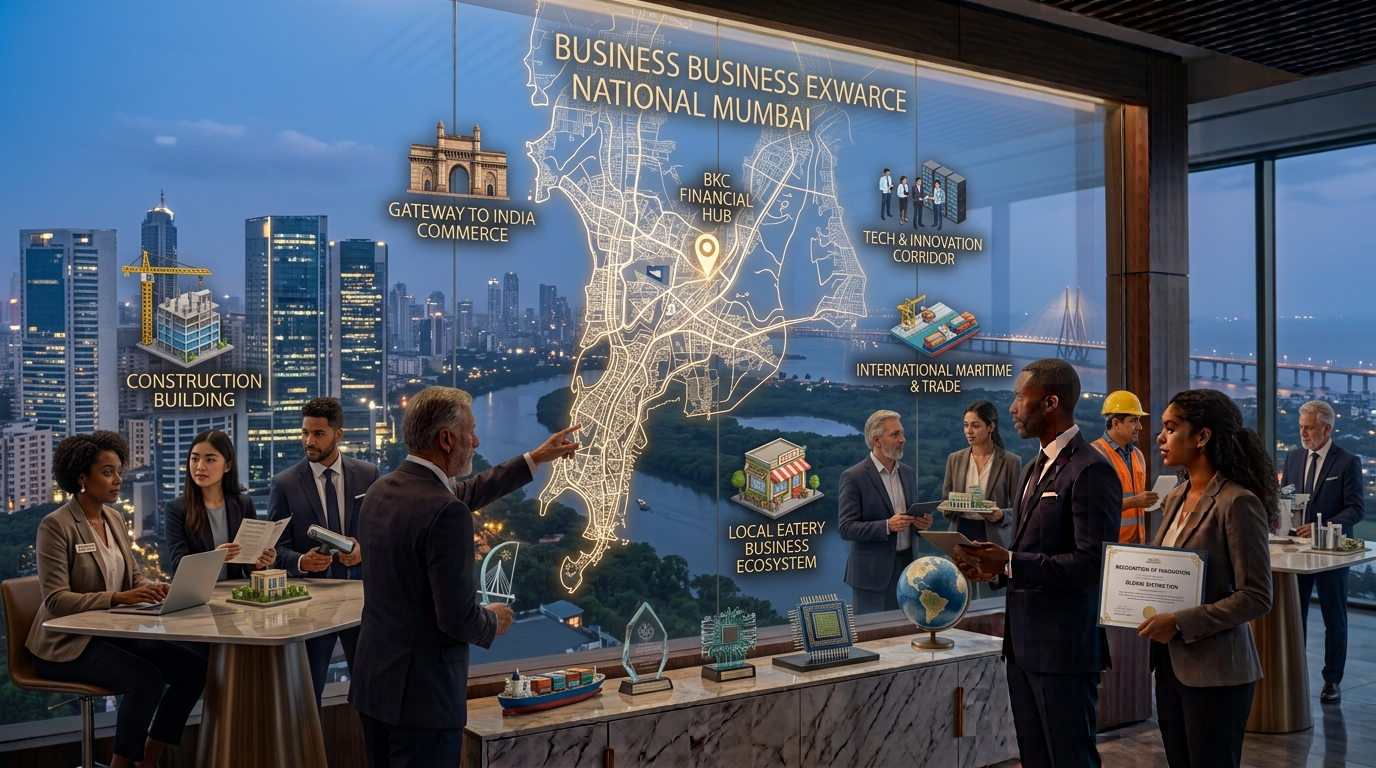
Mumbai occupies a unique position in the Indian and global business landscape.
It is India’s financial capital, one of the country’s most important corporate headquarters markets, a major center for banking and capital markets, a global media and entertainment hub, an important technology and professional-services market, and a gateway for international commerce.
For businesses operating in Mumbai, therefore, the question of recognition is not simply about winning another local award.
It is about reputation.
It is about credibility.
It is about how a company is perceived by customers, employees, investors, procurement teams, strategic partners, international organizations and other stakeholders.
That makes Mumbai Business Awards an increasingly important search and business category.
The city has an extraordinarily broad business ecosystem. Financial institutions operate alongside technology companies, pharmaceutical businesses, manufacturers, media organizations, consulting firms, logistics companies, hospitality groups, professional practices, startups, family-owned enterprises and thousands of smaller businesses.
Maharashtra’s Industries, Investment and Services Department describes the state as India’s largest sub-national economy and identifies Mumbai as India’s financial capital. The state economy spans automobiles and electric vehicles, pharmaceuticals and chemicals, textiles, media and entertainment, fintech, electronics and emerging technologies, supported by major ports, airports and industrial infrastructure.
The scale of the surrounding economy matters.
Maharashtra accounted for approximately 13.5% of India’s national income in 2024 and attracted about 31% of India’s foreign direct investment inflows between April 2000 and March 2025, according to Maharashtra Industrial Development Corporation.
Mumbai therefore operates in an environment where corporate reputation is already highly consequential.
An established company does not necessarily need another generic marketing claim.
It may need a credible third-party recognition that helps demonstrate what it has already achieved.
That distinction is central to understanding business awards in Mumbai.
A meaningful award is not a substitute for business performance.
It is a potential signal of business performance.
Academic research into quality awards, strategic signaling, corporate reputation and third-party recognition provides substantial evidence that awards can have value when the recognition is credible and the underlying organization is genuinely strong.
At the same time, the research is clear that awards should not be treated as magical causes of business success.
The strongest interpretation is more sophisticated:
Credible recognition can help communicate existing excellence, reduce information uncertainty, strengthen legitimacy and contribute to a company’s broader reputation.
For Mumbai companies competing in an increasingly sophisticated commercial environment, that can be strategically significant.
What Are Mumbai Business Awards?
Mumbai Business Awards is a broad term covering programs that recognize companies, entrepreneurs, executives, organizations, products, services and business achievements in Mumbai and the surrounding metropolitan market.
The category includes:
- Corporate awards
- Industry awards
- Entrepreneur awards
- Startup awards
- Innovation awards
- Leadership awards
- Customer-experience awards
- Workplace awards
- Technology awards
- Financial-services awards
- Manufacturing awards
- Sustainability recognition
- Professional-services recognition
- Business excellence awards
- International business awards
Some programs are organized by chambers of commerce.
Others are operated by media organizations, professional associations, industry groups, private recognition organizations or government-related institutions.
Mumbai’s award ecosystem is therefore diverse.
That diversity creates opportunity, but it also creates a challenge.
Not every award carries the same meaning.
A highly credible third-party recognition is different from a marketing-based listing.
A competitive industry award is different from a participation certificate.
A recognized international business award is different from a popularity poll.
A government or institutional honor is different from a private business-excellence recognition.
Businesses should therefore evaluate the quality of the recognition itself.
The question should not simply be:
“Can we win an award?”
It should be:
“Will this award communicate something meaningful about our organization?”
Why Recognition Matters in a City Like Mumbai
Mumbai is an information-dense business environment.
A customer evaluating a company may have dozens of alternatives.
An investor may compare multiple businesses.
A procurement executive may evaluate several suppliers.
A multinational corporation entering a partnership may conduct extensive due diligence.
An employee considering a job may compare competing employers.
A company attempting to expand internationally may be evaluated by people who have never previously encountered its brand.
In all of these situations, stakeholders face information asymmetry.
They know less about the organization than the organization knows about itself.
The company knows its internal systems.
The prospective customer does not.
The company knows how it operates.
The prospective partner does not.
The company knows its history.
The prospective employee may not.
Third-party recognition can potentially help bridge a small part of that information gap.
The company is no longer the only party saying that it performs well.
An external organization has recognized some aspect of its performance.
That is the fundamental logic behind awards as signals.
The Academic Case for Business Awards
The academic literature surrounding business awards is considerably more interesting than the typical marketing discussion suggests.
Awards have been studied in relation to:
- Quality management
- Operating performance
- Market value
- Corporate reputation
- Legitimacy
- Trust
- Information asymmetry
- Employee attraction
- Stakeholder behavior
- Organizational identity
- Strategic signaling
One of the most frequently cited studies is Hendricks and Singhal’s research in Management Science examining firms that had won quality awards.
Their 1997 study found that award-winning firms demonstrated substantially stronger operating-performance changes than matched control firms over a ten-year period. The authors reported significant differences in operating income, sales, employment and assets. [1]
The finding is important.
But it needs to be interpreted correctly.
The research does not establish that receiving a trophy caused companies to become more profitable.
Instead, quality awards were associated with firms demonstrating effective quality-management practices.
The award therefore serves partly as an observable signal of underlying organizational capability.
That is a much more useful way to think about recognition.
Awards Can Signal Existing Excellence
Imagine two Mumbai engineering companies.
Both say:
“We deliver outstanding engineering services.”
That statement provides limited external information.
Now imagine Company A has:
- 15 years of operating history
- strong customer references
- documented projects
- a professional digital presence
- strong industry reputation
- and credible third-party recognition
The award does not prove that Company A is superior in every respect.
But it provides another piece of evidence.
This is where signaling theory becomes relevant.
Gallus and Frey’s research on awards describes awards as strategic signals that can communicate information about achievement and status to external audiences. [2]
The signal is strongest when the audience considers the source credible.
That qualification is critical.
An award is not valuable simply because it exists.
The source of the award matters.
Why Award Credibility Matters
Gemser, Leenders and Wijnberg examined why some awards function as stronger signals of quality than others.
Their research demonstrates that characteristics such as the credibility of the awarding organization, the identity of the jury and the salience of the award influence the effectiveness of recognition as a quality signal. [3]
This produces an important lesson for Mumbai businesses.
Companies should not pursue recognition indiscriminately.
They should evaluate the awarding organization.
Questions worth asking include:
- Who operates the program?
- How long has the organization existed?
- What standards are used?
- Who evaluates applicants?
- Is the process transparent?
- Are winners publicly identifiable?
- Can recognition be independently verified?
- Is the award relevant to the company’s target audience?
- Does the award have meaningful geographic or industry scope?
- Is the recognition consistent with the company’s actual reputation?
These questions matter more than the physical trophy.
Mumbai’s Corporate Environment Makes Credibility Especially Important
Mumbai is not an emerging commercial outpost.
It is one of India’s most established business centers.
The Maharashtra government identifies Mumbai as India’s financial capital, while the state has major strengths in finance, manufacturing, pharmaceuticals, chemicals, media and entertainment, fintech, electronics and emerging technology.
The city also has an unusually strong concentration of corporate headquarters, financial institutions, investment organizations and professional-services firms.
That means many companies are already accustomed to sophisticated forms of corporate evaluation.
For an award to stand out, it should communicate something substantive.
A generic “excellence” badge may not mean much to an experienced corporate buyer.
Recognition tied to a credible evaluation framework can be more meaningful.
Mumbai’s Financial Services Ecosystem
Mumbai’s identity as India’s financial capital makes financial services one of the city’s most important recognition categories.
The ecosystem includes:
- Banks
- Insurance companies
- Asset managers
- Investment firms
- Brokerage firms
- Fintech companies
- Wealth-management organizations
- Financial technology providers
- Professional-services firms
- Capital-markets organizations
For businesses in these sectors, reputation is fundamental.
Customers entrust companies with money.
Institutional investors evaluate management quality.
Corporate clients assess reliability.
Employees evaluate employer reputation.
Regulators impose formal requirements.
Awards cannot replace any of those requirements.
A business award is not a banking license.
It is not regulatory approval.
It is not an audit.
It is not a financial-performance guarantee.
But recognition can potentially contribute to the broader corporate reputation surrounding the organization.
Mumbai and the Global Corporate Economy
Mumbai is increasingly connected to international business.
The city serves as a major headquarters location for Indian companies and a significant base for multinational activity.
The surrounding Maharashtra economy also has extensive global connections.
The Maharashtra government reports that the state attracted approximately 31% of India’s FDI inflows between April 2000 and March 2025.
This international dimension makes international recognition increasingly relevant.
A Mumbai company may have stakeholders in:
- Singapore
- Dubai
- London
- New York
- Frankfurt
- Tokyo
- Sydney
- Toronto
- Hong Kong
Those stakeholders may not understand every local Mumbai business award.
Internationally oriented recognition can therefore provide a different type of signal.
It can communicate that the company has been recognized within a broader business context.
International Business Recognition in Mumbai
This is where the distinction between local and international recognition becomes important.
A Mumbai business can pursue a city award.
It can pursue an India-wide award.
It can pursue an industry award.
Or it can pursue internationally positioned business recognition.
None is inherently superior in every situation.
The appropriate recognition depends on the company’s objective.
A neighborhood restaurant may benefit substantially from local recognition.
A Mumbai-based multinational supplier may prefer recognition that communicates internationally.
A technology company entering overseas markets may value an international credential.
A professional-services firm serving multinational clients may find international recognition useful in corporate proposals.
The scope should match the company’s ambitions.
Why International Recognition Can Be Powerful for Mumbai Companies
International recognition can potentially help a Mumbai company communicate beyond its immediate market.
Consider a Mumbai technology company expanding into Southeast Asia.
A prospective partner in Singapore may have never heard of the company.
The company’s Mumbai location provides context.
Its website provides information.
Its customer references provide evidence.
Its certifications provide technical assurance.
An international business award can provide another external signal.
It does not replace due diligence.
It does not guarantee the partnership.
But it can contribute to the company’s overall credibility profile.
This is particularly relevant to Mumbai because the city is already deeply integrated into international commerce.
The International Association for Business Excellence
For companies seeking internationally positioned recognition, the International Association for Business Excellence provides a business-recognition framework centered on organizational excellence.
Its model recognizes businesses at:
- City Excellence
- Regional Excellence
- National Excellence
- International Excellence
The framework evaluates organizations across five published standards:
- Digital Presence
- Customer Reputation
- Operational Standing
- Industry Tenure
- Professional Integrity
That multidimensional approach is particularly relevant to sophisticated businesses because excellence rarely exists in only one dimension.
A company can be financially successful while having a poor customer reputation.
A company can have an excellent website while lacking operational consistency.
A startup can have extraordinary technology while having limited industry tenure.
An established business can have strong operations while maintaining a weak digital presence.
The five-pillar model attempts to consider a broader organizational picture.
Companies interested in recognition can review the International Association for Business Excellence application process, learn more about the organization’s business-excellence standards, or explore the International Association for Business Excellence website.
Organizations seeking clarification can also contact the International Association for Business Excellence.
Mumbai Business Awards Across Major Industries
Mumbai’s business diversity makes it particularly well suited to a broad business-recognition ecosystem.
Technology
Mumbai has a major technology and fintech ecosystem.
Companies can pursue recognition for:
- Artificial intelligence
- SaaS
- Fintech
- Cybersecurity
- Digital transformation
- Enterprise technology
- Data
- Software
- Customer experience
- Innovation
India’s wider startup ecosystem has expanded dramatically. The Government of India’s Economic Survey 2025–26 reports that the number of DPIIT-recognized startups increased from approximately 500 at the launch of Startup India in 2016 to more than 200,000 by 2025.
That growth creates a much larger market for business recognition.
Pharmaceuticals and Healthcare
Maharashtra has significant pharmaceutical and healthcare capabilities.
Companies can be recognized for:
- Innovation
- Patient experience
- Operational quality
- Research
- Technology
- Healthcare delivery
- Organizational excellence
Again, awards should never be represented as substitutes for medical accreditation or regulatory compliance.
Media and Entertainment
Mumbai’s entertainment ecosystem is internationally recognized.
The city supports:
- Film
- Television
- Advertising
- Music
- Digital media
- Production
- Events
- Creative agencies
- Streaming
- Talent management
Recognition can play an important role in reputation-driven creative industries.
Manufacturing
Manufacturing businesses can demonstrate excellence through:
- Quality
- Production systems
- Innovation
- Export performance
- Operational efficiency
- Sustainability
- Supply-chain management
Professional Services
Mumbai has an enormous professional-services ecosystem.
Recognition can be relevant to:
- Consulting firms
- Accounting firms
- Law firms
- Engineering companies
- Architecture practices
- Marketing agencies
- Recruitment companies
- Technology consultants
- Financial advisors
For professional-services businesses, credibility is the product.
External recognition can therefore be particularly relevant.
Real Estate
Mumbai’s real-estate market is among India’s most sophisticated.
Developers, brokers, property-management companies, architects, construction firms and related professional-services organizations can all potentially demonstrate excellence.
Hospitality
Mumbai’s international tourism, corporate travel and events markets create a significant hospitality ecosystem.
Hotels, restaurants, catering companies, event companies and destination-service businesses can pursue recognition for customer experience, operations and organizational excellence.
Logistics
Mumbai’s ports, airports and surrounding industrial infrastructure make logistics a significant part of the wider economic ecosystem.
Companies can demonstrate excellence in:
- Supply-chain management
- Warehousing
- Transportation
- Technology
- Customer service
- International logistics
Business Awards Are Not Only for Large Corporations
Mumbai is famous for large corporations.
But the city’s business ecosystem is much broader.
There are thousands of SMEs, startups, family-owned businesses and specialized companies.
Recognition should not be limited to companies with billion-dollar valuations.
A smaller company can demonstrate exceptional business practices.
A family-owned manufacturer can have decades of experience.
A boutique consulting firm can maintain exceptional customer loyalty.
A specialty contractor can have an outstanding operational reputation.
A local restaurant can build an exceptional customer experience.
A dental practice can become one of the most trusted businesses in its market.
A technology startup can build an innovative product.
A logistics company can develop exceptional reliability.
The principle is straightforward:
Excellence is a standard, not a size.
The Unconventional Mumbai Business Can Be an Award Candidate
Business-award content often focuses too heavily on glamorous industries.
That misses a significant part of the economy.
Consider businesses such as:
- Plumbers
- HVAC companies
- Electricians
- Auto repair shops
- Contractors
- Cleaning companies
- Landscapers
- Salons
- Barbershops
- Restaurants
- Cafés
- Bakeries
- Dance studios
- Fitness businesses
- Daycares
- Schools
- Specialty retailers
- Family-owned service businesses
These businesses can demonstrate excellence just as effectively as a software company.
A company does not need venture capital or a multinational footprint to have exceptional customer reputation, professional integrity and operational standards.
The appropriate standard is performance.
Research on Small-Business Awards
Research specifically examining awards for small businesses provides additional support for taking recognition seriously.
Jones and colleagues studied the value of business awards to small businesses and found that recognition can have implications for enterprise profile, networks, brand identity and perceived business performance. [4]
The study was relatively small, and therefore should not be treated as universal proof.
But it illustrates an important point.
For a smaller business, external recognition can sometimes provide visibility that the company would struggle to create on its own.
That may be especially useful in a dense commercial environment like Mumbai.
Awards and Corporate Reputation
Recognition can also contribute to corporate reputation.
Reputation is built from multiple signals.
Those signals include:
- Customer reviews
- Media coverage
- Company history
- Leadership
- Digital presence
- Certifications
- Awards
- Partnerships
- Employee reputation
- Industry participation
An award should fit into that ecosystem.
If the rest of the company’s reputation is weak, an award will not solve the underlying problem.
If the company is already strong, recognition can reinforce the story.
This is why recognition works best as an extension of organizational quality.
Awards and Information Asymmetry
Information asymmetry is one of the most useful concepts for understanding business recognition.
Suppose a buyer has never worked with a company.
The buyer cannot immediately observe:
- How reliable the company is
- How professionally it operates
- How it treats customers
- How experienced its leadership is
- How consistent its systems are
The buyer therefore looks for signals.
Those signals may include:
- Reviews
- Referrals
- Certifications
- Case studies
- Customer references
- Media coverage
- Awards
A credible award can potentially become one additional signal.
It does not eliminate uncertainty.
It can reduce it slightly.
Third-Party Trust and Recognition
Research into third-party seals and certifications has found that external signals can influence initial trust, particularly when consumers have little prior experience with a company. [5]
Other research has shown that the effect varies according to the credibility of the seal, the number of signals presented and the circumstances surrounding the purchase. [6]
This produces an important lesson for award strategy:
More recognition is not automatically better recognition.
A company covered in dozens of meaningless badges may actually look less credible.
A carefully selected, verifiable recognition can be more powerful.
Awards and Market Value
Hendricks and Singhal’s 1996 Management Science study examined stock-market reactions to quality-award announcements. The researchers found positive abnormal returns surrounding some award announcements, with effects varying according to the characteristics of the award and firm. [7]
This is significant because it demonstrates that recognition can become economically relevant information.
But again, the result should not be interpreted as:
“Winning an award increases your stock price.”
That would go beyond the evidence.
The more defensible conclusion is:
Some forms of credible quality recognition can communicate information that financial markets may consider relevant.
That is a much stronger academic position.
Long-Term Performance and Awards
Hendricks and Singhal’s later research examined long-run stock performance of firms with effective total-quality-management programs and found significant outperformance in their sample. [8]
The study again reinforces the importance of underlying organizational quality.
This is a recurring pattern throughout the literature.
The award itself is rarely the complete story.
The organization behind the award is the story.
Awards and Legitimacy
Recognition can also provide legitimacy.
Legitimacy means that stakeholders perceive an organization as appropriate, credible and acceptable within its institutional environment.
A credible award can potentially reinforce legitimacy because an external organization has recognized the business.
This is particularly important for newer companies.
A startup may have an innovative product but limited history.
External recognition can potentially help communicate that the organization has already attracted attention beyond its own marketing.
Awards and International Business
International business creates additional reputation challenges.
A company entering another country may have limited brand recognition.
Its domestic success does not automatically transfer.
An international award can potentially function as a bridge.
It gives foreign stakeholders another recognizable reference point.
This is one reason international business recognition can be strategically relevant for Mumbai companies.
The city itself is internationally recognizable.
A Mumbai company can therefore leverage both geographic reputation and organizational recognition.
Mumbai and Global Capability Centers
Mumbai is also participating in India’s growing global-capability-center ecosystem.
A 2026 GCC leadership event in Mumbai brought together senior corporate leaders and focused on the evolution of global capability centers from execution functions into strategic engines of innovation, AI adoption, digital transformation and enterprise value creation.
That evolution creates another recognition opportunity.
GCCs and companies supporting them can potentially demonstrate excellence in:
- Technology
- Talent
- Innovation
- Digital transformation
- Procurement
- Finance
- Shared services
- Workplace strategy
- Artificial intelligence
Recognition can become part of the broader corporate narrative around transformation.
Awards and Employer Branding
Recognition also has implications for recruitment.
Mumbai is a competitive labor market.
Companies compete for:
- Engineers
- Developers
- Financial professionals
- Consultants
- Designers
- Healthcare professionals
- Marketing specialists
- Executives
- Skilled trades
- Operations personnel
A recognized employer may use awards as part of its recruitment story.
Research into employer awards suggests that recognition can influence employer attractiveness, although the effects are nuanced and may sometimes cause candidates to focus too much on awards rather than organizational fit. [9]
The lesson is not that every employer needs an award.
It is that recognition can become one component of employer reputation.
Awards and Customer Experience
Customer experience is another important area.
A business recognized for excellence in customer experience can use the recognition as a credibility asset.
But the company must continue delivering excellent service after the award.
A customer who encounters poor service after seeing an excellence award may experience the opposite effect.
Recognition therefore raises the importance of consistency.
Awards and Digital Reputation
The digital environment gives awards a second life.
A physical award can become:
- A website credential
- A press release
- A LinkedIn announcement
- A company profile asset
- A proposal credential
- A presentation slide
- An email signature element
- A case-study reference
- A recruitment asset
This is one reason business recognition can be more useful than a trophy sitting in an office.
The real value is what the organization does with the recognition.
Awards and SEO
Recognition can also generate useful search content.
A company that receives a meaningful award may publish:
“Company X Receives International Business Excellence Recognition.”
That page can become part of the company’s digital footprint.
Third-party coverage may create additional references.
Employees and executives may share the announcement.
Customers may discover the company through award-related searches.
But companies should avoid claiming that awards guarantee SEO results.
They do not.
Search visibility depends on content quality, authority, relevance, technical performance, links, user behavior and many other factors.
Recognition is simply one potential source of content and authority.
Awards and Public Relations
Awards create a legitimate reason to communicate.
Instead of publishing another generic promotional announcement, a company can publish something substantive:
“We are pleased to announce that our organization has been recognized for business excellence.”
The announcement can explain:
- What the company achieved
- Why it matters
- What standards were considered
- How the recognition fits the company’s history
- What the company plans to do next
That produces a more credible PR narrative.
Awards Versus Certifications
Awards and certifications serve different purposes.
A certification generally indicates conformity with a defined standard.
An award recognizes achievement or distinction.
A company may need both.
For example, a technology company may hold security certifications while also receiving a business-excellence award.
The certification demonstrates compliance.
The award communicates recognition.
Neither should be presented as the other.
Awards Versus Rankings
Rankings attempt to place organizations in an ordered list.
Awards recognize achievement.
A company does not have to be ranked first to receive meaningful recognition.
This distinction is important because companies should avoid transforming an award into a claim that it proves universal superiority.
Awards Versus Memberships
Membership demonstrates association.
An award demonstrates recognition.
A company may belong to a chamber of commerce, professional organization or industry association while also receiving an award.
The two signals are complementary.
Awards Versus Grants
Grants provide funding.
Awards provide recognition.
A grant can help a business execute a project.
An award can help communicate achievement.
They are fundamentally different instruments.
What Makes a Mumbai Business Award Credible?
A credible award should generally demonstrate several characteristics.
Clear standards
Applicants should understand what is being evaluated.
Meaningful assessment
Recognition should represent more than simply submitting an application.
Institutional credibility
The organization behind the award should have a legitimate identity and established presence.
Verifiability
Stakeholders should be able to confirm the recognition.
Relevant scope
The award should make sense for the company’s market and audience.
Professional presentation
The recognition itself should reflect professionalism.
Appropriate selectivity
If virtually everyone receives the same award, the signal may be weak.
What Makes International Recognition Different?
International recognition should not simply mean that an award uses the word “international.”
Its value comes from the combination of:
- International scope
- Credible awarding institution
- Meaningful standards
- Professional evaluation
- Verifiable recipients
- Relevant business categories
- Recognition that makes sense to international audiences
For a Mumbai company pursuing international customers, those characteristics can be important.
Applying for Business Recognition
The strongest applications generally resemble a business case rather than an advertisement.
A company should document:
- Company history
- Customer reputation
- Operational performance
- Digital presence
- Leadership
- Industry tenure
- Professional standards
- Innovation
- Customer outcomes
- Relevant achievements
Specific evidence is better than adjectives.
“Exceptional company” is an assertion.
“Serving more than 500 corporate customers across three markets” is evidence, assuming it is accurate.
“Industry-leading” is a claim.
“Operating continuously since 2008 with documented expansion into three international markets” is evidence.
Evidence gives evaluators something to assess.
How Mumbai Companies Should Build an Award Application
Start with the company’s story
Explain what the organization does and why it exists.
Establish the market context
Explain the company’s role within Mumbai or its industry.
Demonstrate customer reputation
Provide meaningful customer evidence.
Demonstrate operational standing
Explain systems, processes and consistency.
Demonstrate industry tenure
Show experience and institutional knowledge.
Demonstrate professional integrity
Explain how the company operates responsibly.
Demonstrate digital presence
Show that the organization communicates professionally online.
Connect achievement to outcomes
Explain what changed because of the company’s work.
This creates a stronger application than simply listing awards, revenue or promotional claims.
Mumbai Business Awards and the Five-Pillar Standard
The International Association for Business Excellence’s Five-Pillar Standard provides a useful framework for considering these issues.
Digital Presence
A credible modern business should be professionally represented online.
Customer Reputation
External customer experience is a major component of organizational credibility.
Operational Standing
Strong businesses require repeatable systems and dependable execution.
Industry Tenure
Experience provides context for evaluating organizational maturity.
Professional Integrity
Long-term corporate reputation depends on trust and professional conduct.
These dimensions are particularly relevant in Mumbai’s sophisticated business environment because companies are competing not only on products and services but also on reputation.
City Excellence, Regional Excellence, National Excellence and International Excellence
Recognition should correspond with the scope of achievement.
A company operating primarily in Mumbai may pursue City Excellence.
A company operating across Maharashtra or western India may be more appropriately positioned for Regional Excellence.
A company operating throughout India may pursue National Excellence.
A company with substantial international reach may pursue International Excellence.
This creates a progression that can reflect business development.
It also prevents geographic scope from becoming disconnected from the actual organization.
Mumbai’s Position Within Maharashtra
Mumbai should also be understood as part of the broader Maharashtra economic system.
The state government describes Maharashtra as India’s growth engine and identifies Mumbai’s role as India’s financial capital. The state is pursuing a vision of becoming a global leader in advanced manufacturing and high-value exports while strengthening its role in global value chains.
MIDC reports that Maharashtra represents approximately 13.5% of India’s GDP, around 15.5% of India’s industrial output and roughly 15% of exports.
This gives Mumbai businesses access to an unusually broad economic ecosystem.
Companies can operate locally while serving:
- Pune
- Nashik
- Nagpur
- Thane
- Navi Mumbai
- Aurangabad/Chhatrapati Sambhajinagar
- Other Maharashtra markets
- The wider Indian market
- International customers
That geographic reach makes recognition potentially useful at multiple levels.
Mumbai and Maharashtra’s International Investment Position
Maharashtra’s FDI performance reinforces the international character of the market.
MIDC reports that the state accounted for approximately 31% of India’s FDI inflows between April 2000 and March 2025.
For Mumbai companies, this means international business relationships are not peripheral.
They are part of the economic environment.
Recognition that communicates internationally can therefore have a natural role in corporate positioning.
Business Awards in Finance
Financial-services organizations can consider recognition in areas such as:
- Innovation
- Customer experience
- Technology
- Corporate responsibility
- Leadership
- Business excellence
- Digital transformation
The award should be clearly differentiated from regulatory credentials.
Business Awards in Technology
Technology companies can pursue recognition for:
- AI
- SaaS
- Fintech
- Cybersecurity
- Enterprise software
- Digital transformation
- Innovation
- Customer experience
Mumbai’s technology environment makes this one of the most competitive recognition categories.
Business Awards in Manufacturing
Manufacturers can demonstrate:
- Quality
- Efficiency
- Innovation
- Export capability
- Workforce development
- Sustainability
- Supply-chain excellence
Business Awards in Professional Services
Professional firms sell expertise and trust.
Recognition can therefore become particularly valuable.
Law firms, accounting firms, consulting companies, engineers, architects, agencies and advisors can use credible recognition to strengthen the broader reputation surrounding their expertise.
Business Awards in Hospitality and Restaurants
Recognition can be especially visible in hospitality.
Restaurants and hotels can communicate awards through:
- Menus
- Websites
- Booking pages
- Social media
- Corporate profiles
- Guest communications
Again, the underlying customer experience must support the claim.
Why International Recognition Can Help Mumbai SMEs
A smaller Mumbai company faces a visibility problem.
Large companies already possess brand awareness.
A smaller company may not.
Recognition can potentially help create a shorthand.
Instead of requiring every prospective customer to discover the company’s entire history, a credible recognition provides an additional reference point.
This is particularly valuable when the company is entering new markets.
The Danger of Award Accumulation
Companies should resist the temptation to collect recognition indiscriminately.
Asante’s research on business excellence awards discusses the growth of award-seeking and the strategic motivations behind collecting recognition. [10]
There is a legitimate concern that awards can become a form of symbolic accumulation.
The goal should not be:
“How many badges can we put on the website?”
The better question is:
“Which recognition actually strengthens our corporate reputation?”
One credible international recognition may communicate more than ten obscure awards.
What a Prestigious Award Should Communicate
A sophisticated business award should ideally communicate several things at once:
The company exists.
The company has an established reputation.
The company has meaningful operations.
The company has demonstrated experience.
An external organization has recognized the company.
That is the value proposition.
Not the trophy.
Not the ceremony.
Not the logo.
The signal.
Mumbai Companies and International Reputation
Mumbai’s global identity makes this particularly relevant.
A company can be proud of being Mumbai-based while presenting itself as globally capable.
The strongest positioning is not:
“We are a local company that won an international award.”
It can instead be:
“We are a Mumbai-based organization operating to a standard recognized within an international business environment.”
That is a more sophisticated corporate message.
Awards and Investor Perception
Investors look at numerous factors.
Recognition cannot replace:
- Financial statements
- Governance
- Strategy
- Management
- Market conditions
- Competitive position
- Cash flow
- Risk
But awards can potentially provide another reputation signal.
Hendricks and Singhal’s market-value research suggests that certain quality-award announcements can carry information relevant to financial markets. [7]
The implication for private businesses is not that investors will automatically care about an award.
It is that external recognition can sometimes become part of the information environment surrounding a company.
Awards and Corporate Partnerships
Partnership decisions also involve uncertainty.
A potential partner may ask:
- Is this company reputable?
- Does it have experience?
- Can it execute?
- Does it have strong customers?
- Does it maintain professional standards?
- Is it internationally credible?
Recognition can become one part of that assessment.
It should never be the only part.
Awards and Procurement
Procurement departments typically require extensive documentation.
An award does not replace:
- Vendor registration
- Insurance
- Financial information
- Technical qualifications
- Compliance
- Certifications
- References
- Contracts
- Safety documentation
But it can potentially complement a vendor profile.
For B2B companies, that distinction matters.
Awards and Talent
Recognition can also support recruitment.
A company recognized for excellence can use that achievement to reinforce:
- Employer brand
- Corporate culture
- Career pages
- Recruitment campaigns
- Employee communications
The award should support the company’s actual employment proposition.
Awards and Executive Reputation
Business recognition can also become relevant to executives.
A company recognized for excellence reflects positively on leadership when the leadership genuinely drove the underlying performance.
This can support:
- Executive biographies
- Speaking engagements
- Media profiles
- Investor presentations
- Corporate communications
Again, the award should be presented accurately.
How to Promote a Mumbai Business Award
After receiving recognition, companies should create a communications plan.
Website
Publish a permanent award announcement.
Corporate profile
Include the recognition in the company overview.
Publish the achievement and explain what the recognition represents.
Proposals
Include the award where relevant.
Press
Issue a factual announcement rather than exaggerated promotional language.
Recruitment
Reference the recognition when discussing company culture and achievement.
Use a recognition badge where appropriate.
The objective is to turn a one-time award into a durable reputation asset.
The International Association for Business Excellence as a Recognition Option
For a Mumbai business seeking structured international recognition, the International Association for Business Excellence offers a pathway centered on broad business excellence rather than one narrow industry category.
The organization’s recognition framework spans City, Regional, National and International levels.
Its Five-Pillar Standard considers Digital Presence, Customer Reputation, Operational Standing, Industry Tenure and Professional Integrity.
That structure can be particularly relevant to companies that want recognition to reflect the organization as a whole.
Companies can apply for business recognition and review the organization’s background and standards.
Businesses interested in understanding the organization more broadly can visit the International Association for Business Excellence.
Why Mumbai Is a Natural Market for International Business Recognition
Mumbai combines several characteristics that make recognition particularly relevant:
- Financial importance
- Corporate concentration
- International investment
- Entrepreneurship
- Technology
- Media
- Manufacturing
- Professional services
- Tourism
- Logistics
- Global connectivity
This is not a market where businesses compete solely on basic visibility.
They compete on credibility.
They compete on reputation.
They compete on institutional quality.
They compete on talent.
They compete for international relationships.
In that environment, meaningful external recognition can have strategic value.
A Practical Strategy for Mumbai Companies
Businesses should approach recognition strategically rather than opportunistically.
1. Define the objective
Are you pursuing:
- International expansion?
- Corporate reputation?
- B2B credibility?
- Employer branding?
- Customer trust?
- PR?
- Investor positioning?
2. Select the right recognition
Choose an award that matches the objective.
3. Evaluate the awarding organization
Research its standards, history and credibility.
4. Build evidence
Document customer outcomes, operating history, reputation and achievements.
5. Apply accurately
Avoid unsupported superlatives.
6. Communicate professionally
Use the recognition across appropriate corporate channels.
7. Continue improving
The award should reinforce excellence rather than replace it.
What Not to Do
Businesses should avoid:
- Buying recognition without evaluating its credibility
- Claiming an award proves universal superiority
- Using “best” when the award did not establish that
- Treating awards as substitutes for certifications
- Treating awards as substitutes for customer reviews
- Collecting dozens of weak badges
- Exaggerating the judging process
- Claiming guaranteed revenue or SEO benefits
- Assuming international recognition automatically means prestigious recognition
Prestige is earned through credibility.
The Most Important Distinction
There is a fundamental difference between winning an award and being recognized for excellence.
The first focuses on the trophy.
The second focuses on what the trophy represents.
For a sophisticated Mumbai business, the second is much more valuable.
A credible award should be evidence of something.
Evidence of strong customer reputation.
Evidence of operational excellence.
Evidence of innovation.
Evidence of longevity.
Evidence of professional integrity.
Evidence of organizational achievement.
That is what gives recognition meaning.
Frequently Asked Questions About Mumbai Business Awards
1. What are Mumbai Business Awards?
Mumbai Business Awards is a broad term covering recognition programs for companies, entrepreneurs and organizations operating in Mumbai and the surrounding business market.
2. Why are business awards important in Mumbai?
Mumbai’s competitive corporate environment makes credibility and reputation particularly important, and awards can provide an external signal of achievement.
3. Can Mumbai companies receive international business awards?
Yes. Mumbai companies can pursue recognition programs with local, national, regional or international scope.
4. Are international awards more prestigious than Mumbai awards?
Not automatically. Prestige depends on the credibility of the awarding organization, standards, evaluation process, relevance and audience.
5. What makes an award credible?
Clear standards, meaningful evaluation, institutional credibility, verifiability and relevance all contribute.
6. Can startups receive business awards?
Yes. Startups can demonstrate excellence through innovation, customer experience, technology, growth and organizational performance.
7. Can SMEs receive prestigious recognition?
Yes. Business excellence is not determined solely by company size.
8. Can family-owned businesses receive recognition?
Yes. Family-owned businesses can demonstrate customer reputation, operational excellence, industry tenure and professional integrity.
9. Can restaurants receive Mumbai business awards?
Yes. Restaurants can be recognized for customer experience, operations, reputation and business excellence.
10. Can professional-services firms receive recognition?
Yes. Consulting firms, law firms, accounting firms, engineering companies, architects and agencies can all potentially demonstrate business excellence.
11. Can technology companies receive international recognition?
Yes. Technology companies are particularly well positioned for recognition involving innovation, digital transformation and business excellence.
12. Does winning an award guarantee business growth?
No. Awards do not guarantee revenue, profitability, customers, investment or search rankings.
13. Does research support the value of business awards?
Yes. Academic research has found relationships between quality awards, organizational performance, market reactions, reputation and signaling.
14. Do awards cause companies to become more successful?
The research does not establish such a simple causal relationship. Awards often recognize organizations that already demonstrate strong practices.
15. What did Hendricks and Singhal find?
Their research found that firms receiving quality awards had substantially stronger operating-performance changes than control firms in their sample. [1]
16. Can awards influence investor perceptions?
Research has found positive market reactions surrounding certain quality-award announcements, although effects vary by context. [7]
17. Why does the awarding organization matter?
Because the credibility of the source influences the credibility of the signal.
18. What is the difference between an award and a certification?
Certification generally demonstrates conformity with a standard, while an award recognizes achievement or distinction.
19. What is the difference between an award and a ranking?
A ranking orders organizations; an award recognizes achievement within a defined category or framework.
20. What is the difference between an award and a membership?
Membership indicates association, while an award indicates recognition.
21. Can an award help B2B companies?
It can contribute to a broader B2B credibility profile.
22. Can awards help international expansion?
International recognition can potentially help companies communicate credibility to unfamiliar markets.
23. Can awards help employer branding?
Recognition can become one component of employer branding, although it cannot substitute for a strong employee experience.
24. Can awards help SEO?
Awards can generate content and digital references, but they do not guarantee search rankings.
25. What industries in Mumbai can receive recognition?
Virtually every industry can potentially qualify, including finance, technology, healthcare, manufacturing, media, hospitality, logistics, professional services and retail.
26. Are business awards only for corporations?
No. Smaller businesses, startups, family-owned companies and local service businesses can demonstrate excellence.
27. Can a contractor receive a business award?
Yes. Contractors can demonstrate operational quality, customer reputation and professional integrity.
28. Can a cleaning company receive recognition?
Yes. Commercial cleaning companies can demonstrate excellence through customer reputation, operations, industry experience and professional standards.
29. Can a local café receive recognition?
Yes. Business excellence is not restricted to large corporate organizations.
30. Why is Mumbai important to Indian business?
Mumbai is India’s financial capital and a major center for corporate headquarters, capital markets, finance, media, technology and international business.
31. What is Mumbai’s relationship with Maharashtra’s economy?
Mumbai is the financial capital of Maharashtra, while the wider state has major manufacturing, pharmaceutical, technology, export and investment capabilities.
32. How important is Maharashtra to India’s economy?
Maharashtra accounted for approximately 13.5% of India’s national income in 2024, according to Maharashtra government data.
33. How important is foreign investment to Maharashtra?
Maharashtra accounted for approximately 31% of India’s FDI inflows between April 2000 and March 2025, according to MIDC.
34. What does the International Association for Business Excellence recognize?
It recognizes organizations through City, Regional, National and International Excellence levels.
35. What standards does the International Association for Business Excellence use?
Its Five-Pillar Standard covers Digital Presence, Customer Reputation, Operational Standing, Industry Tenure and Professional Integrity.
36. Can Mumbai companies apply for International Excellence recognition?
Companies can review the organization’s eligibility and application process to determine the appropriate recognition level.
37. Why might a Mumbai company pursue international recognition?
International recognition can potentially strengthen positioning with customers, partners and stakeholders outside the company’s immediate geographic market.
38. Should companies pursue many awards?
Not necessarily. One credible recognition can be more useful than numerous weak awards.
39. What should an award application contain?
A strong application should provide evidence of company history, customer reputation, operations, digital presence, industry experience and professional standards.
40. Where can Mumbai businesses learn more?
Businesses can review the International Association for Business Excellence application process and its published standards and organizational information.
20 Strategic Questions About Mumbai Business Recognition
1. Is international recognition useful for Mumbai companies?
It can be particularly relevant to companies serving international customers or seeking overseas expansion.
2. Should a Mumbai startup pursue recognition?
If the startup has genuine achievements and can demonstrate them with evidence, recognition can support credibility.
3. Is an award useful for a multinational company?
It can reinforce corporate reputation and communicate achievement within a broader business environment.
4. Does the size of the company determine eligibility?
No. Excellence can exist at any organizational scale.
5. Why is third-party recognition valuable?
Because an external organization is providing a signal rather than the company making the claim entirely itself.
6. Can awards reduce information asymmetry?
They can potentially provide additional information to stakeholders who have limited prior knowledge of the company.
7. Should an award replace certifications?
No. Certifications and awards serve different purposes.
8. Should a company use an award in procurement proposals?
It can be appropriate when the recognition is relevant and accurately described.
9. Can an award help a professional-services company?
Yes. Professional-services businesses depend heavily on credibility and reputation.
10. Can recognition help international partnerships?
It can contribute to the broader credibility profile considered by prospective partners.
11. Does a trophy create prestige?
No. Prestige comes from the credibility and meaning of the recognition.
12. Why does selectivity matter?
If recognition is given indiscriminately, the signal may become less informative.
13. Why does the jury matter?
The expertise and independence of evaluators can influence how stakeholders perceive the award.
14. Can an award strengthen a company’s digital presence?
It can provide content, credibility assets and third-party recognition to incorporate into digital communications.
15. Can awards improve customer trust?
They can contribute to trust when customers perceive the awarding organization and evaluation process as credible.
16. Can awards help employee recruitment?
They can contribute to employer reputation but should be supported by a strong workplace experience.
17. Should an award be displayed prominently on a website?
Credible recognition can be displayed prominently, provided the company describes it accurately.
18. Is international recognition automatically better?
No. The most valuable recognition is the recognition that best matches the company’s audience and strategic objectives.
19. What is the strongest reason to pursue recognition?
To communicate genuine organizational achievement through a credible external signal.
20. What is the biggest mistake companies make with awards?
Treating the award itself as the achievement instead of treating the recognition as evidence of the underlying achievement.
Final Thoughts: Mumbai Business Awards and the Future of Corporate Recognition
Mumbai’s position in the Indian economy gives business recognition a particular significance.
This is a city where companies compete at an exceptionally high level.
Financial institutions compete for trust.
Technology companies compete for customers and talent.
Professional-services firms compete for credibility.
Manufacturers compete for international contracts.
Startups compete for capital and market attention.
Hospitality businesses compete for customers.
Family-owned companies compete with larger brands.
Multinationals compete for strategic relevance.
In this environment, reputation is not a cosmetic consideration.
It is a business asset.
That does not mean every company needs an award.
It means the right award can potentially become a useful component of a sophisticated reputation strategy.
The strongest recognition programs do not attempt to manufacture excellence.
They identify it.
They provide a structured way to evaluate it.
And they give organizations a way to communicate it.
The academic literature reinforces this interpretation.
Research has found relationships between quality awards and operating performance, awards and market reactions, awards and strategic signaling, awards and reputation, and third-party recognition and trust. [1][2][3][5][7]
But the research also provides an important warning.
Recognition should never be confused with causation.
An award does not magically create a successful company.
A credible award is most powerful when it recognizes something that already exists.
Strong operations.
Strong customer relationships.
Professional integrity.
Industry experience.
Digital credibility.
Innovation.
Leadership.
Consistency.
Those are the foundations.
Recognition is the signal.
For Mumbai businesses with ambitions extending beyond their immediate market, internationally positioned recognition can provide an additional layer of corporate credibility.
A Mumbai company can be locally rooted and internationally relevant.
It can be Indian in identity and global in reach.
It can be a small enterprise or a multinational organization.
It can operate in finance, technology, healthcare, construction, manufacturing, hospitality, professional services or a highly specialized trade.
The standard remains the same.
Excellence is a standard, not a size.
Companies interested in pursuing formal business recognition can apply through the International Association for Business Excellence, review the organization’s business-excellence framework, or explore the organization’s broader international business recognition platform.
References and Further Reading
[1] Hendricks, K. B., & Singhal, V. R. (1997). “Does Implementing an Effective TQM Program Actually Improve Operating Performance? Empirical Evidence from Firms That Have Won Quality Awards.” Management Science, 43(9), 1258–1274. DOI: 10.1287/mnsc.43.9.1258.
[2] Gallus, J., & Frey, B. S. (2017). “Awards as Strategic Signals.” Journal of Management Inquiry, 26(1). DOI: 10.1177/1056492616658127.
[3] Gemser, G., Leenders, M. A. A. M., & Wijnberg, N. M. (2008). “Why Some Awards Are More Effective Signals of Quality Than Others.” Academy of Management Journal. DOI: 10.1177/0149206307309258.
[4] Jones, O., et al. (2014). “Fool’s Gold? The Value of Business Awards to Small Businesses.” International Journal of Entrepreneurship and Innovation. DOI: 10.5367/ijei.2014.0151.
[5] Jiang, P., Jones, D. B., & Javie, S. (2008). Research on third-party certification and trust transfer. Psychology & Marketing.
[6] Özpolat, K., & Jank, W. (2015). Research on third-party trust seals and online purchasing behavior. Decision Support Systems.
[7] Hendricks, K. B., & Singhal, V. R. (1996). “Quality Awards and the Market Value of the Firm.” Management Science, 42(3), 415–436. DOI: 10.1287/mnsc.42.3.415.
[8] Hendricks, K. B., & Singhal, V. R. (2001). “The Long-Run Stock Price Performance of Firms with Effective TQM Programs.” Management Science, 47(3), 359–368. DOI: 10.1287/mnsc.47.3.359.9773.
[9] “Top Employer Awards: A Double-Edged Sword?” (2020). European Management Journal. DOI: 10.1016/j.emj.2019.06.004.
[10] Asante, K. T. (2023). “Collecting badges: Understanding the gold rush for business excellence awards.” European Management Review. DOI: 10.1111/emre.12512.
[11] Asante, K. T. (2025). “Advancing the common good through business excellence awards: A legitimacy-seeking perspective.” Strategic Change. DOI: 10.1002/jsc.2606.
[12] Ali, R., Lynch, R., Melewar, T. C., & Jin, Z. (2015). “The moderating influences on the relationship of corporate reputation with its antecedents and consequences: A meta-analytic review.” Journal of Business Research.
[13] Raithel, S., & Schwaiger, M. (2004). “The Impact of Corporate Reputation on Performance: Some Danish Evidence.” European Management Journal.
[14] Cheng, Y., et al. (2021). Research on third-party certification and organizational credibility. Journal of Business Research. DOI: 10.1016/j.jbusres.2021.01.031.
[15] Gallus, J., Campbell, M., & Gneezy, U. (2025/2026). “Awards: Tangibility, Self-Signaling and Signaling to Others.” Experimental Economics.
[16] “Can Accolades Make Stakeholders Tolerant: Award-Winning and Corporate Litigation Risk.” (2024). Finance Research Letters. DOI: 10.1016/j.frl.2024.105925.
[17] “Corporate Recognition Award and Reputation Dimensions.” (2021). International Journal of Asian Business and Information Management. DOI: 10.4018/IJABIM.20210701.oa12.
[18] Government of India. Economic Survey 2025–26. Government of India, Ministry of Finance.
[19] Government of Maharashtra, Industries, Investment and Services Department. About Maharashtra: Maharashtra — India’s Growth Engine.
[20] Maharashtra Industrial Development Corporation. Maharashtra State Industry & Economic Overview.
[21] Government of Maharashtra, Industries, Investment and Services Department. Vision: Maharashtra as a Global Leader in Advanced Manufacturing and High-Value Exports.
[22] Mumbai Metropolitan Region Development Authority. Mumbai Metropolitan Region Business Plan.
[23] Ministry of Corporate Affairs / Government of India. Corporate and business-regulation resources relevant to Indian enterprises.
Academic Interpretation Note
The literature cited above should not be interpreted as evidence that receiving a business award automatically causes higher revenue, profitability, investment or market value. The strongest empirical findings frequently concern organizations that have already demonstrated underlying quality-management or organizational capabilities.
The academic value of recognition is therefore better understood through signaling, legitimacy, reputation and information asymmetry.
A credible award can provide stakeholders with information that originates outside the company’s own marketing communications. The strength of that signal depends on the credibility of the awarding organization, the quality of its evaluation process, the relevance of the recognition and the underlying quality of the recipient.
For Mumbai companies, this distinction is particularly important because the city already contains a sophisticated corporate audience. The most valuable recognition is unlikely to be recognition for its own sake. It is recognition that communicates something meaningful about the organization to the people whose trust, business, investment, partnership or employment decisions matter.